
An Introduction to Personalized Medical Devices
For many years, medical devices have followed a one-size-fits-all approach. While this method was effective for most patients, some individuals did not respond well to these off-the-shelf devices. However, in recent years there has been a shift toward using personalized medical devices.
These devices are tailored to individual patients, allowing for precise diagnoses and more effective treatment plans. Not only does this approach help bring relief to those who previously struggled with traditional treatments, but it also promises to reduce the total cost of care.
This article will explore personalized medical devices, why they are important, and how additive manufacturing (AM) can help healthcare providers maximize the benefits.
What Are Personalized Medical Devices?
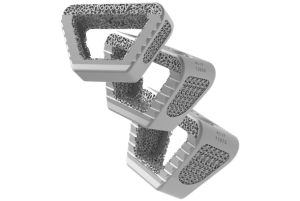
All personalized devices are made-to-order for a specific patient and designed to meet their individual needs and circumstances. Two examples of personalized medical devices include prosthetic leg sockets with dynamic stiffness optimized for the individual patient’s lifestyle and size or orthopedic implants that match the contour of the bone.
Depending on the use case, there are two main types of personalized medical devices — patient-matched and custom devices.
Patient-Matched Devices
Patient-matched devices have design features that you can customize to a predetermined limit to accommodate a specific patient’s condition and needs. From a product development standpoint, these devices are usually more attractive than custom ones because you can automate their design and manufacturing. This automation enables companies to produce patient-matched devices at a mass scale economically.
Custom Devices
According to the FDA, a custom device is a device that necessarily deviates from an applicable performance standard, premarket approval requirement, or devices generally available. The purpose of this deviation is to comply with a physician’s or dentist’s specific requirements. These custom devices are unique to each patient.
Why Are Personalized Medical Devices Important?

Personalized medical devices are critical to the advancement of healthcare. These devices enable doctors to tailor treatment plans to each patient, helping them overcome health challenges that would otherwise be difficult to address.
These devices offer several benefits:
- Shorter procedures
- Improved precision during operation, mitigating the need for alterations
- Improved functionality and aesthetics
- Increased contact area to improve the load distribution
- Improved patient satisfaction
- Reduced patient discomfort and pain
- Reduced total cost of care
Numerous clinical studies have proven these benefits. McKinsey even found that in 90% of cases, using a patient-specific hip implant is more cost-effective than using a standard implant. Moreover, a study published in Academic Radiology found that the average time saved in the operating room when using patient-specific surgical guides is approximately 23 min — amounting to $1,500 saved per case.
Strategies for Medical Device Companies

There are two main strategies companies can adopt when developing medical devices. The first strategy is mass customization, which involves directly using the patient’s unique data to design and manufacture a customized device tailored to their individual needs. This approach is suited to patients with potentially unusual conditions or complications, as their unique needs often require specialized treatment options.
Alternatively, some companies prefer a strategy that utilizes an infinite sizing approach. This method uses patient data to select the most appropriate medical device from a more extensive product family. Once the most suitable device is selected, the device is manufactured on demand. While this method does not always provide as much precision as mass customization, it is more economical and efficient, making it an effective alternative for many medical companies today.
Additive Manufacturing for Personalized Medical Devices
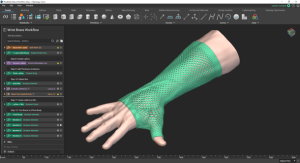
Patient-specific wrist-hand orthosis.Compared to conventional manufacturing techniques, AM offers many benefits that improve the viability and cost-efficiency of manufacturing personalized medical devices. It is no surprise that many companies are embracing additive manufacturing in the design and manufacturing of their products.
A key benefit of AM for personalized medical devices is the marginal cost of customization. AM technologies allow you to create scalable, automated, end-to-end workflows for your custom products — from design to production.
Another notable advantage of AM is that it enables you to create biologically-relevant structures or unique design features, which are often impossible to develop with alternative technologies. Lastly, AM can provide accelerated product development. Once you have overcome the challenge of creating a process, AM technologies allow you to replicate it relatively easily across different devices.
Design Software for Personalized Medical Device Design
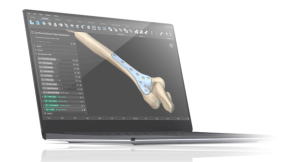
nTopology is a next-generation design software built from the ground up to enable engineers to take full advantage of the design freedom of additive manufacturing. This advanced software gives you design tools to develop innovative medical devices that improve patient outcomes and provides a clear pathway for personalization at scale.
nTopology’s key features include:
- Implicit Modeling — Create robust processes that don’t break when design inputs radically change. Generate complex structures with billions of design elements in seconds and visualize them in real time.
- Field-Driven Design — Control design parameters at every point in space from a variety of data. Use simulation and test data to drive your designs, not just check them. Encode your expertise to fine-tune critical design features.
- Design Process Automation — Eliminate repetitive tasks to increase throughput and focus more time on innovation. Package and share design processes to empower others. Fully automate design generation with nTopCL scripts.
Get a demo to learn more about nTopology’s engineering design software for additive manufacturing.
Download Our Personalized Medical Devices Guide
Are you interested in learning more about personalized medical devices? Download nTopology’s comprehensive Personalized Medical Devices Guide to discover the applications for these devices and the challenges you will need to overcome to maximize their benefits.