

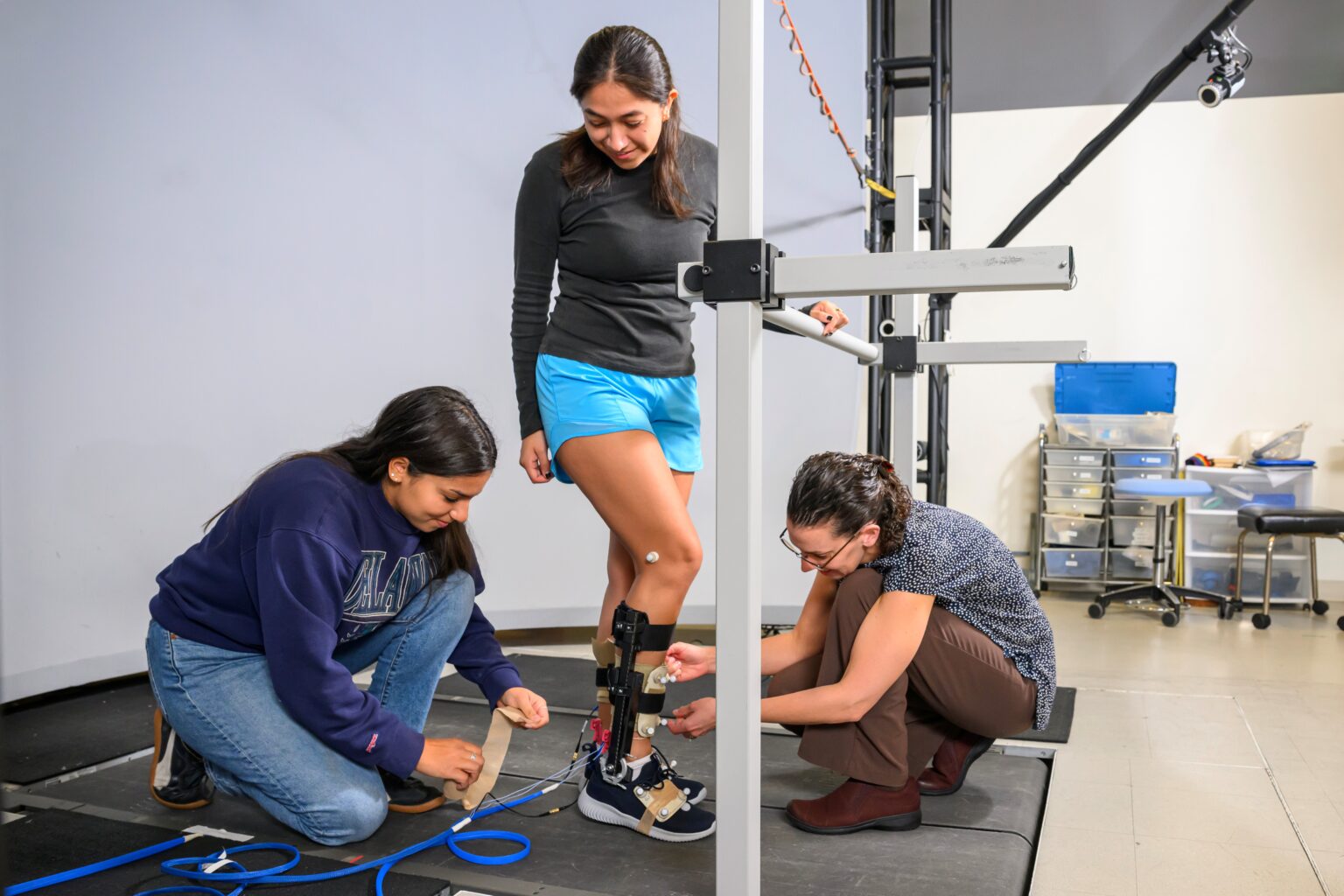
Researchers in the University of Delaware’s Orthotics and Prosthetics for Enhanced Mobility Lab are exploring how AFOs can help people with Achilles tendinopathy regain mobility more quickly. Up to 20 percent of patients continue to have symptoms for a decade.
“Because it’s an overuse injury, modification of activity is beneficial during rehabilitation,” said Elisa Arch, PhD, an associate professor of kinesiology and applied physiology in the university’s College of Health Sciences. “The elasticity of the tissue changes and sometimes never recovers. Being inactive during rehab can exacerbate comorbidities and be very detrimental to a person’s overall health.”
Outside of physical therapy, which is the prescribed treatment for Achilles tendinopathy, it is harder to modulate tendon load during daily living, Arch said.
“AFOs have never been tested in people with Achilles tendinopathy,” she said. “I’ve seen heel wedges, lifts, and foot orthotics used to address Achilles tendinopathy with little success, but no one thinks about AFOs, and AFOs are all I think about.”
The Biomotum AFO is being tested on a split-belt treadmill to collect data on tendon load with varying stiffness adjustments. The Biomotum device allows separate adjustment of dorsiflexion and plantarflexion stiffness, which is key for Achilles tendinopathy rehab and may help avoid adverse side effects. Using quantified stiffness to assist an injured joint is a relatively new concept, Arch said, and she hypothesized that higher stiffness provides greater tendon offloading and that gradually reducing stiffness as the tendon heals could support recovery.
“An orthotist casts a person’s limb, builds an AFO, tests it out, and trims and adjusts through trial and error,” she said. “Measuring stiffness and gathering data on AFOs is still emerging as researchers and clinicians recognize the need for data on the devices’ mechanical properties.”
Editor’s note: This story was adapted from materials provided by the University of Delaware.