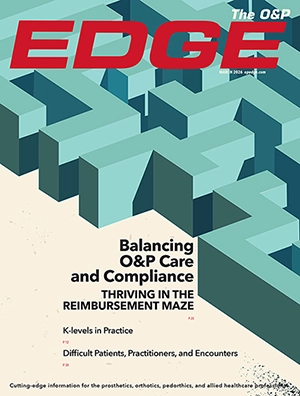

O&P clinicians’ passion for the profession lies in patient care and innovative solutions, not in navigating complex documentation, shifting reimbursement codes, or facing the constant threat of audits. Still, these administrative demands are more than a necessary burden; they are a critical component of a sustainable practice. As the reimbursement landscape grows more challenging, it is essential for every member of the O&P team, from clinicians to support staff, to understand the financial and compliance implications of their work.
Balancing clinical duties with administrative responsibilities can be particularly challenging for smaller practices. Brianna Sehrer, MSOP, CPO, O&P Specialists, Louisiana, operates in a clinician-owned company where she has refined her own version of that balancing act. As one of three clinicians in an eight-person practice, Sehrer manages her own patient load and the related coding and documentation, while also handling appeals and peer-to-peer review when insurance claims are denied.
“My day-to-day is me and the person at the front desk,” she says. While a billing specialist and another employee handle initial billing and insurance authorizations, Sehrer is often the one writing appeal letters and conducting follow-ups. She also leverages her background to assist coworkers in coding and documentation review.
The Documentation Hurdle
One of the most significant administrative hurdles is ensuring documentation is accurate and thorough enough to satisfy payer requirements. “There are often specific guidelines of what the medical review team is looking for,” Sehrer explains. “If you aren’t documenting exactly what they want, you are opening yourself up to denial.”
The reliance on physician documentation to corroborate medical necessity is often a complicating factor. Inaccurate or incomplete notes from referring physicians can lead to claim denials, particularly with Medicare. “They often check the box that something is fine when it’s not,” Sehrer says. “For example, they may say that a patient has a range of motion in an ankle when they don’t have an ankle because they’ve undergone an amputation.”
Even minor discrepancies necessitate time-consuming follow-ups. To combat this, Sehrer emphasizes the importance of proactively communicating with key referral sources to educate physicians about what documentation is required. “I do a lot of scoliosis cases, and I make it a point to build a relationship with the physicians so that we align on the bracing recommendation,” she says. “This cuts down on documentation mismatch.”
Similarly, for prosthetics patients, Sehrer guides physicians to include critical details like a patient’s motivation to ambulate—a key requirement for Medicare coverage.
Staying Current and Compliant
Sehrer stays informed about the ever-changing reimbursement landscape by actively participating in the American Orthotic and Prosthetic Association (AOPA) Coding and Reimbursement Committee, which gives her direct insight into the coding process. She suggests all clinicians subscribe to newsletters from professional organizations and consulting groups.
Recent policy changes, such as Medicare’s expanded coverage for K2-level ambulators to receive microprocessor knees (MPKs), have had a significant positive impact. “I don’t know that I have ever seen as much change in terms of policy reimbursement as I have in the last three years,” Sehrer says. “It’s helping people get better coverage and removing barriers to coverage.”
When audits or denials happen, Sehrer’s approach is methodical. “The first thing I do is get the document from the insurance provider on the reason,” she explains. “People get hung up on rebutting the whole picture of the situation from A to Z when the denial is often really based on something specific.” By focusing on the exact denial issue, clinicians can avoid giving too much information or inadvertently weakening their case.
Tony Gutierrez, CP/L, is the director of clinical advancement and innovation for Bionic Prosthetics and Orthotics, headquartered in Indiana. In contrast with Sehrer’s clinic, Bionic operates 49 clinics in 12 states. Seven years ago, Gutierrez helped build an internal software system, One Source, to tackle reimbursement, documentation, and policy issues head on. He currently acts as advisor on the administrative and authorization side and oversees the practice’s most complex prosthetic cases.
“It is impossible for each clinician to fully understand the layers and complexities of insurance policies and compliance requirements and also be able to fully do their job as a clinician,” he says. “This software helps them know the questions to ask, and it’s helped us to grow our practice.”
One Source, which is also now available to clinics outside of Bionic, collects a detailed medical history from patients. It takes previous history into account to paint a picture of mobility goals and then ties that to features of what the prosthetist is recommending for the patient. “That language is all baked into the codes,” Gutierrez says. “We are trying to take a holistic approach, so our clinical team doesn’t just think about a microprocessor knee, for example, but also about the patient’s limitations and why that device is the best fit. With this information, the software surfaces the most appropriate clinical application based on their payer source.”
As a larger clinic, Gutierrez says Bionic has the advantage of seeing and identifying reimbursement trends, such as patterns in denials, sooner than smaller practices might.
He also advocates for internal training to keep clinicians up to speed on the changing intricacies of policies and coverage criteria. “We have a series of 35 to 40 training videos we’ve developed to train our clinicians on things like AFO coverage criteria for Medicare,” he says.
Bionic also conducts weekly calls with clinicians about how to maximize successful outcomes with referral sources. “We have to educate on what we can do and the proper way to get it covered,” Gutierrez says. “Ultimately, we try to challenge clinicians to match the desired outcomes to the functional need and then focus on what is the most medically necessary device to help them get there.”
The Consultant Perspective
Curt Bertram, CPO, FAAOP, senior manager, clinical affairs, O&P Insight, offers a broader perspective about how practices can move from merely surviving audits to building a robust, audit-proof business. O&P Insight provides practice, business, and clinical consulting services to independent O&P clinics across the country.
Documentation failures, he says, often stem from clinicians being pressed for time, which increases the temptation to rely on generic templates. This can leave them vulnerable to compliance issues. To counter that, Betram advocates for a shift in mindset—viewing administrative knowledge as a clinical tool.
“To ensure requirements are met while simultaneously prioritizing patient care, invest the time on the front end to learn payer policy coverage criteria and what determines medical necessity,” he says. “This front-end investment saves time in the long run not having to go back and do it again; your documentation is defensible the first time.”
Beyond knowing the codes, the fundamental nature of required documentation is evolving. The profession is moving away from device-centric notes and toward a more holistic view of the patient, according to Bertram. He points out that successful documentation now relies on “defining the unmet needs of the patient…and how your treatment plan meets those unmet needs.” This focus, he says, is critical for justification. “Our technology and clinical services are life changing. We need to do a better job on the ‘how and why this makes our patients’ lives better’ and back that up with outcomes.”
If Bertram could change one thing about the current system, it would be to place a stronger emphasis on patient-centric medical records and documentation.
Building a Compliant, Collaborative Team
In a rapidly evolving regulatory environment, Bertram says staying informed is non-negotiable. His advice for keeping up with changes is to sign up on the payer websites for email updates and viewing audits as chances for further education. “An audit is a lesson in how to improve your documentation, procedures, and coding. They are wrong at times, however, when they are correct, it’s a learning opportunity.”
Still, Bertram cautions that this learning must extend beyond the clinician. “I have always stated that O&P is a team sport,” he says. “A simple typo could result in a denial that takes months to remedy. This costs not only time, it raises the cost of the claim and decreases [operational profitability].”
Fostering a team-based approach requires respect, commitment to quality patient care, good communication, and training. This investment in education must cover all aspects of the business. “We all learn about new devices,” Bertram says. “We should all invest in learning about the reimbursement/documentation/coding aspects of the business.”
Looking ahead, Bertram sees artificial intelligence (AI) as a key technology ally in creating efficiencies and decreasing time and costs associated with revenue cycle management. “The one thing we don’t have more of is time,” he says, “AI can give you back time for both clinical and administrative functions.”
He also views professional organizations as essential partners in advancing the O&P industry.
Michelle Wullstein, CPCO, senior compliance officer, O&P Insight, commonly hears complaints related to physician documentation. “The O&P clinic staff doesn’t feel like they have any control over that,” she says.
Although the documentation from physicians can result in claim denials, Wullstein agrees with Bertram’s assessment that small clerical errors tend to cause most issues. “These issues are preventable with detailed internal processes that prioritize efficiency and compliance.”
While her consultant colleagues provide a strategic roadmap, Wullstein focuses on the granular details that keep an O&P practice solvent. In doing so, she challenges the narrative that administrative burdens are an enemy to clinical excellence.
“The discussion around documentation and patient care frames them as two conflicting concepts, as if you have to sacrifice one in order to prioritize the other,” she says. “I firmly believe that compliant documentation and patient care go hand-in-hand.”
Wullstein explains that accurate records are not just about getting paid, they are about validating a treatment plan. “Obtaining compliant physician records ensures the patient is getting the most medically appropriate device for their unique needs,” she says. Ensuring claim reimbursement through proper documentation also reduces patient financial burden for unpaid claims.
Navigating the Regulatory Maze
Despite efforts by the Centers for Medicare & Medicaid Services to reduce provider/supplier burden, such as the 2020 removal of the initial prescription requirement for formal reviews, clinics often feel the weight remains heavy due to increased audits and more stringent policy interpretations.
To stay afloat in this sea of regulations, Wullstein echoes Bertram’s sentiment on the importance of information flow. “The best way to stay up to date on any payer changes is to sign up for industry email listservs,” she advises.
Wullstein also stresses the importance of internal auditing as a proactive measure. “Internal audits can shine a light on those areas that require improvement so clinic training/education can be targeted at addressing those specific needs,” she says. Just like external audits from payers, these internal reviews can identify process failures before they turn into costly denials.
Financial Realities of Compliance
Wullstein is candid about the stakes involved for every member of the O&P team. “Unfortunately, it all comes down to money; we need money to operate the business and serve the patients,” she says. “Every part of daily operations is interconnected. It’s with a firm foundation of internal processes and compliance that we maintain these operations.”
To achieve this, she advocates for a culture where no role is viewed as secondary, from the front desk that sets the tone, to the technicians in the back who ensure precise fabrication.
Ultimately, Wullstein envisions a reimbursement model that moves away from the fee-for-service structure. “I’d love to see a shift to a value-, patient-centered model that prioritizes the totality of the patient-care experience,” she says. This ideal system would value the input of the entire treatment team—orthotists, prosthetists, and therapists—ensuring that the financial incentives align with the patient’s best interests.”
Lesleigh Sisson, vice president and general manager, O&P Insight, views the documentation and coding landscape through an operational lens. With her experience consulting for O&P practices nationwide, she understands the nuanced challenges. It isn’t enough to know the rules, she says, clinicians must also be able to manage the volume and velocity of information coming at them. “The pace of change isn’t the only challenge, it’s the layering of changes across codes, coverage policies, documentation standards, and payer-specific quirks.”
As an example, Sisson cites the fact that clinicians are often forced to juggle evolving local coverage determinations, state Medicaid updates, and commercial plan edits that all shift according to different calendars. “Add in inconsistent payer interpretations, [not otherwise covered] codes that require nuanced justification, and different documentation expectations between upper- and lower-limb prosthetics, and it’s easy to see why even experienced teams feel like they’re decoding a moving target.”
Sisson has observed that the most successful practices are the ones that don’t treat policy changes as surprises. Instead, they build a rhythm around updates and implement a tight change-management loop. Specifically, she advises designating a policy lead who summarizes what has changed each week, distills that information, and then explains why it matters. She says a lot can be shared in a 15-minute staff huddle, such as side-by-side examples, updated checklists, or smart phrases in a practice’s electronic health record (EHR) system.
Streamlining via Structure
Efficiency is another key principle O&P Insight reinforces with clients. “The clinics that document most efficiently use clinical record frameworks that prompt the ‘why’ behind the care—capturing the individual patient’s diagnosis, functional level, daily activities, and personal goals—and clearly connecting those factors to the device design, componentry, and expected functional benefit,” Sisson says.
O&P Insight then helps clients support that patient-centered story with smart phrases for common clinical scenarios and prompts that align the clinical narrative with coverage requirements using clear, payer-friendly language without losing the patient focus. “We help [our clients] translate policy language into clinic language,” Sisson explains. “That means starting with what matters clinically for the patient, then showing teams how to express that story in a way the payer understands: Here’s the sentence the payer looks for, here’s the documentation language that supports it, and here’s where it fits naturally in your template.” By tracking these updates in a shared resource, teams avoid reinventing the wheel while maintaining consistency across claims.
On the software side, Sisson notes that EHR integrations that surface payer criteria within the clinical workflow help reinforce good habits, while simple, patient-focused checklists embedded in the plan section keep documentation concise, consistent, and audit ready.
To combat friction between completing documentation tasks and providing high-quality patient care, she encourages separating creation from completion. In this model, clinicians focus on capturing the clinical narrative—outcomes, safety, and function—in real time, while the support team ensures the file is payer-ready by attaching forms and technical details. This leads to a standard audit-ready packet with everything from physician records to proof of delivery.
“When you design the process around the end state—clean, complete submissions—the administrative burden becomes a series of smaller, routine next steps that don’t compete with patient care,” Sisson says.
The Power of Narrative and Training
For new clinicians overwhelmed by these demands, Sisson suggests mastering the clinical story arc: diagnosis, functional presentation, risks, goals, device rationale, and expected outcomes. “If you can tell that story clearly, we can translate it into payer language together,” she says. “And remember, your note is patient advocacy on paper. You’re not writing for a bureaucracy; you’re documenting why a person needs the right device to live safely and independently.”
When audits occur, clarity is often the key to successful outcomes. Sharing a story about a complex upper-limb prosthesis denial, Sisson highlights the benefits of a methodical approach. “Instead of rewriting the entire note, we mapped each coverage requirement to explicit clinical statements: control strategy, task-specific functional goals, safety risks without the device, and prior interventions with outcomes.” By following this structure of criteria, evidence, outcome, her team not only overturned the denial, but received compliments from the reviewer.
Future-Proofing the Practice
Sisson is also optimistic about technologies that foster efficiency. Specifically, she points to smarter EHR workflows that highlight criteria as soon as clinicians begin their documentation, AI-assisted claim scrubbing that flags missed elements, and prior authorization automation. “Combine those with standardized outcomes captured in the clinic, and we’re moving from reactive appeals to proactive, first-pass clean claims. That’s better for patients, teams, and the financial health of independent O&P clinics.”
Still, Sisson cautions that technology and automation must be paired with collaboration. She encourages practices to normalize co-owning outcomes by using tools like shared dashboards and regular feedback loops. “The cultural shift happens when wins are celebrated as team wins.”
From the clinician standpoint, Sehrer also emphasizes the role of collaboration. This is key for her practice. “I don’t forget that physical therapists are my friend. Oftentimes we focus so much on getting documentation and sign-off from the doctor that our other allied health professionals get left out of the equation,” Sehrer says.
Whether dealing with claims or patients, focusing on the people involved remains central to balancing the load of administrative tasks and patient care, and staying fulfilled in the profession. “At the end of the day you are still helping people who need help, and that’s why we got into this,” she says. “Even when you are doing something simple like helping a patient find a doctor or understand how to get a prosthesis, all of those things are making a difference.”
Looking ahead, Sehrer is optimistic that insurance coverage will expand into higher tech devices, just as we’ve seen with MPKs. “O&P is on the brink of a lot of growth in the applications of orthotics and prosthetics, and insurance companies are going to start coming around to the difference these make for the whole health of the person.”
To that end, she agrees that clinicians must be diligent in focusing on the whole health of a patient in their documentation. “Get into detail on the role that being able to walk plays in lowering someone’s cardiac risk, for example,” she adds. “Paint a bigger picture and use a patient’s physician and physical therapist to help you do that.”
Sehrer, who acts as Louisiana’s state lead for So Every BODY Can Move, also underscores the role advocacy and professional organizations play in removing barriers in reimbursements and audits. Advocacy in the national and state organizations for O&P is crucial for expansion of coverage, she says. “At the end of the day, it should always be about what is best for the patients.”
All these experts agree that while AI can play a big role in easing some of these burdens in the future, its use must be balanced with methodical human input. “It is imperative that the clinicians review the documentation created by AI to ensure it is accurate and relevant,” Wullstein says.
Gutierrez reiterates that human involvement is paramount from the very beginning when using AI tools. “It is the same as anything else—garbage in, garbage out—so think about what information is the most valuable to put into it,” he says. “Conversely, insurance payers are using AI to automatically deny claims based on keywords and other presets. So, again, you have to match device need to medical outcome, and if you always do that, you’ll have more success advocating for the patient.”
Tara McMeekin is a writer and editor based in Colorado.
Compliance image: Iryna/stock.adobe.com