
The rehabilitation journey for individuals using orthotic and prosthetic devices extends far beyond fitting. Providing the right device and training is a critical first step, but true empowerment lies in broad, long-term support.
From fostering opportunities to participate in athletics and providing outlets for peer support, to offering education and resources, manufacturers and clinicians and more are helping individuals with limb loss and mobility impairments to not only adapt but thrive.
A Holistic Approach to Support
Johsa Smith, patient experience program manager, Hanger Clinic, oversees the Ampower patient support/peer support program. Ampower matches volunteers who have experienced limb loss or limb difference with new patients beginning their journey.
“We provide peer mentors who have gotten back to living their new normal life with people who are new to their journey,” Smith says. “While O&P care providers can prepare new amputees for things up to a point, it often isn’t until they talk with others who have been through a similar scenario and can say, ‘This is normal,’ or acknowledge, ‘Yes, this part sucks,’ that they feel real emotional support.”
That emotional support component is what the Ampower program aims to provide. Participants don’t have to be a Hanger Clinic patient to take advantage of the program, and all of the mentors receive comprehensive training and have access to support resources through the program.
One of the most important roles of Ampower’s peer mentors, according to Smith, is teaching patients to be their own advocates.
“People are often scared to speak up for themselves,” she says. “We reinforce to them that a relationship with their clinician is lifelong, so it needs to be a good fit. That means finding the one that is the best fit for you and who advocates for you.”
Ampower provides access to support and services that holistically address emotional, social, and physical aspects of life after limb loss. Mentors talk with patients about the importance of following the direction of their care providers, including things like reinforcing the importance of sticking with physical therapy exercises. They also offer basic tips and tricks and ensure their patient mentee feels comfortable asking questions.
“We educate our mentors on how to ask questions as well as how to give advice,” Smith adds. “It doesn’t always have to focus on monumental things; sometimes it’s very practical things such as, ‘How do I pull my pants up in a restroom stall?’ Or, ‘How do I stand up when I am sitting on the floor?’ Everyone is different and needs different things to get back to living their best life.”
Partnerships aren’t based just on geography, but also on gender and pairing people who have the same level of amputation. “We know our mentors and their back story so that we can really match patients with the best peer support,” Smith says.
In addition to Ampower, Hanger partners with outside organizations and nonprofits so patients have options to participate in athletic and recreational programs. This allows them to get back to activities they used to do or learn about new ways to be active. Partners include the Endeavor Games, Challenged Athletes Foundation, Angel City Games, and Camp No Limits for kids, among others. Every partner Hanger teams up with aims to support patients, whether they are seeking athletics for their health, for recreation, or if they dream of competing.
Encouraging goal setting is another element of the program that Smith believes is helpful. Mentors coach patients to find something to focus on and then set small goals. “Goals don’t always have to look like running a 5K; they may be as simple as getting out of the hospital,” Smith adds.
“Celebrating small milestones works. When you’re having a hard time, you can look back on those accomplishments.”
In her five and a half years overseeing Ampower, Smith has learned that every mentor has a lot to offer patients even if they might not realize it at first. Supporting patients isn’t about delivering big, inspirational speeches or life-changing advice, it’s about showing them what’s possible.
“I tell them that just seeing you do something that they may not think they could ever do as a person who lost a limb is often the most powerful thing you can do. Hope is really what they give to patients who are struggling.”
Clinicians Offer Unique Perspectives
Matt Bulow, CP, national clinic director, ForMotion Clinic, lost his leg to bone cancer when he was 14 years old. Having been both a patient and a prosthetist gives Bulow a unique perspective: The patient’s need for emotional and motivational support is at the forefront of everything he does.

“I approach treating a patient from two perspectives—the technical aspect, and then remembering that you’re dealing with a person,” he explains. “They can have the best prosthetic fitting and the best technology and still not have a great outcome. Or they can have a ‘just fine’ prosthesis and, with the right emotional support, still achieve a great outcome.”
“Without giving up any personal information, I often relate a situation to one I have seen with another patient, or even myself,” Bulow says. “I never rely on the fact that I am an amputee—I always listen and try to relate.”
Beyond the clinical setting, Bulow manages expectations around athletic and recreational opportunities for people with limb loss. As an athlete who competed in running, volleyball, and tennis in the Paralympics in 1992, 1996, and 1998, talking with patients who want to get involved in sports comes easily. Like Smith, Bulow emphasizes that benefitting from athletics doesn’t always mean achieving the exceptional.
“I help patients focus on getting back to being who they are—and that is often a sigh of relief because they’ve been bombarded with questions like, ‘Are you going to get a running leg?’ when they really just want to get back to being able to do fundamental things like supporting their family.”
Bulow and his team prioritize peer support and education as key components of recovery. “One-on-one peer support has been the most successful for me,” he says. “It’s about being present and showing patients that you’re looking out for them as much as you’re focused on fitting them well with a device.”
ForMotion developed a robust library of educational resources to address challenges faced by individuals with amputations. “We’ve taken the expertise and best practices from different clinics to create tools that are accessible and tailored to diverse patient needs,” he says.
Bulow never takes a product-first approach to help patients achieve goals or milestones. “I always lead by asking them what they want to achieve,” he adds. “If someone is excited about a product, great, but if that isn’t aligned with what they need and want to do then you need to focus on helping them find the support they need.”
Looking ahead, Bulow is excited about innovative technologies like 3D printing and artificial intelligence, which can allow clinicians to spend less time on technical tasks. Ultimately, he believes the key to supporting amputees lies in treating them as individuals with unique needs and aspirations.
“If I could give one tip to a prosthetist wondering how to better support their patients, it would be this: Do what you wish your doctor did for you,” he says. “We spend so much time with our patients. You can become an important part of their lives, and the effort you put in is worth it because the reward is making a real impact.”
Ian Gray, BOCP, ForMotion Clinic, Massachusetts (formerly Next Step O&P), knows firsthand the positive impact athletics can have for those living with limb loss. His mom underwent a transfemoral amputation at 19, following a motorcycle accident. She went on to become a competitive skier and the first recipient of a microprocessor knee.
“The importance of adaptive sports programs was introduced to me at an early age,” Gray says. “By the time I was in my early 20s, having been exposed to so much of that helped me to realize that O&P was the profession I wanted to be in.”
Empowering People With Secondary Prostheses
Starting out as a prosthetic technician, Gray became passionate about supplying patients with secondary prostheses that allow them to do things beyond their everyday walking. Being in Massachusetts, he recalls the enormous impact of the Boston Marathon bombing in 2013. Gray worked with many people who lost limbs in that tragic event including Heather Abbott, whose foundation provides secondary prostheses to patients. Last year, Gray joined the Heather Abbott Foundation (HAF) Boston Marathon team and helped raise $160,000 toward its cause.
Hillary Miller, the first HAF prosthetic recipient after the Boston Marathon bombing, works with Gray and oversees ForMotion’s Comprehensive Acute Rehabilitation Empowerment Program. She is the first person patients encounter at ForMotion to help them navigate their path.
“Hillary matches them up with a similar case that can go visit with them in the hospital, or even before their surgery,” Gray says. “That can be a great connection for a spouse or child, too, even if the patient isn’t yet ready for it.”
Gray and Miller developed a resource guide with all of the cool things available to people living with limb loss. They are also active in initiatives to get So Every BODY Can Move legislation passed, which has now been adopted in 12 states. The bill gives equitable access to O&P care by addressing limitations of insurance coverage.
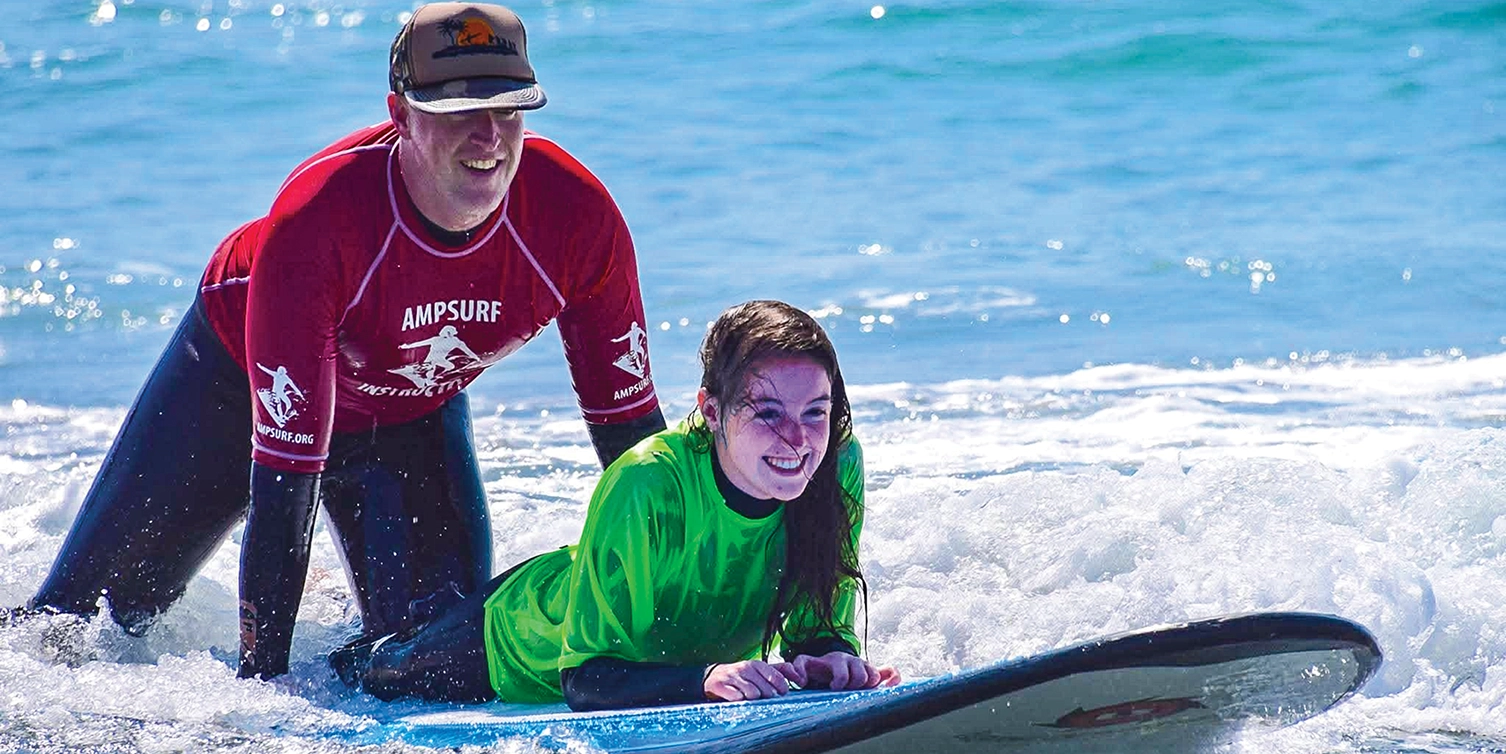
Gray is active in the adaptive snowboarding community and joined forces with AmpSurf founder Dana Cummings to support people with limb loss who want to participate in athletic and recreational activities. Cummings, a former Marine, developed the AmpSurf program after losing his leg in a car accident. He wanted to share the powerful rehabilitation and healing that he experienced himself through learning to surf.
“Dana and I conducted surfing clinics for amputees, as well as the blind and Wounded Warriors, to give them access to surfing,” Gray says. “I quickly saw the benefits—and it wasn’t just about getting them out to do these things—it was also about getting a group together that could share stories, and what that did for their healing journeys. Most amputees don’t have a lot of opportunity to be around other amputees, so this is an incredible moment to bring them all together.”
Gray says it’s just as impactful to witness how family members react when they see their loved ones in a supportive community like this.
All his experiences have reinforced the importance he and his colleagues place on taking a holistic care approach with patient care. “We see a huge benefit when you build a team around a patient, and that includes things like a clinician attending a surgical follow-up with them.”
When he meets with patients for the first time, Gray focuses on what they liked to do prior to their amputation, and what goals they have to get back to that previous lifestyle as much as they can. His team designs patients’ prostheses based on those goals, and then connects them with physical therapy, occupational therapy, peer groups, adaptive programs, or mobility clinics.
“We’re building a huge amount of resources for patients beyond just seeing them to build their device, making adjustments, and then leaving them to figure out the rest,” Gray says. “We can tailor the support they need and help them make those connections.”
Paying It Forward

For Amy Bream, who became Bulow’s patient, the journey into athletics was intertwined with one of self-discovery and confidence building. She was born with proximal femoral focal deficiency, a congenital condition that causes underdevelopment of the upper femur.
After someone else with limb loss encouraged Bream to advocate for herself, she began the search for a more advanced prosthesis that would allow her to be more active.
“Anything I said I couldn’t do before, I wanted to try—skiing, snowboarding, rock climbing—all things that I would have been terrified to try before.”
Those activities eventually brought Bream to CrossFit, which she has competed in with sponsorship since 2021.
Engaging in sports helped her gain confidence in her body and in navigating life. Now, Bream uses her platform to guide others and has created programs to help people with limb loss/difference build strength, trust their prostheses, and connect with a community that understands their journey.
“I love training and competing, but it’s a means to do other things, to help other people,” she says.
Bream developed three adaptive fitness programs for people living with lower-limb loss who need or want more than the limited amount of physical therapy sessions insurances typically cover. Her programs serve a wide range of fitness levels. One Leg Up is a monthly, interactive workout program that starts with basic exercises and progresses over time. Bodyweight and Bands offers 12 weeks of bodyweight and banded workouts. Her Proprioceptive Program offers eight weeks of exercises that focus on balance and stability to help people trust their prostheses more.
“I encourage the people I work with not to just find general adaptive programs, but to connect with people that have the lifestyle they want to have and spend time with them,” Bream says. “One person I work with was attacked by a shark a year ago and is already back to kite surfing. Another lives in New York and needed to develop the stamina to do all the walking that’s required to live in the city. All of these stories are really impactful.”
Lucas Crisanti, MS, CPO, clinical specialist, Ottobock, heads up its United States Full Circle Movement Events and Running Clinics. In his role, he sees firsthand that the benefits of staying active extend well beyond the physical.
“Many people that participate in our Movement Events tell me this is the biggest feeling of freedom they’ve had since they lost their limb,” Crisanti says.
Full Circle Movement events are designed for people at every stage of their mobility journey, from seasoned marathoners and Paralympic hopefuls to those starting out with their first prosthesis or returning to movement with a walker or wheelchair. Some participants have gone on to become Paralympians, while others run for their first time with a blade, or improve their gait mechanics with their walking prosthesis. In contrast, Ottobock Running Clinics are designed for prosthetic users who have the physical ability and a properly fitting socket to run, and they typically take place over three days.
Providing Access to Device Options

Each half-day Full Circle event provides opportunities for participants to explore adaptive movement at their own pace from trying a running blade for the first time to simply joining a supportive circle of peers. Fittings for running blades are tailored in advance to ensure trial participants feel safe and supported; individuals are encouraged to bring their own running prosthesis if they already have one. All trials are conducted under the guidance of experienced coaches, prosthetists, physical therapists, and volunteers. Local clinicians are encouraged to participate in the blade trials to gain hands-on experience with running prosthesis alignment and setup.
“I remember fitting a bilateral prosthetic user who was able to run for the first time since losing her legs in a running accident; it was a cathartic experience for her,” Crisanti says. “She has since pursued her own pair of running blades.”
Education for local O&P practitioners, physical therapists, students, and physicians is a big part of the Full Circle Movement events. “In tandem with ongoing So Every BODY Can Move initiatives nationwide, we are empowering clinicians to properly fit these devices that help their patients stay active.”
Perhaps what is most unique about the events is the opportunity for connection among people from across O&P. “There are very few times in O&P—or any healthcare field—where clinicians and the prosthetic users they serve come together from all across the country and world to learn, share, and benefit from each other’s experiences,” Crisanti notes. “Getting all of these seasoned experts and prosthetic users together is a great way to expand your network, whether as a clinician or a participant.”
As an official sponsor of many International Paralympic Committee sanctioned events, including the Paralympic Games, Crisanti says Ottobock’s involvement in para-athletics expands far beyond the Full Circle Movement events and Running Clinics. Ultimately, he is humbled that he is able to play a role in this.
“Having these people in my life makes me a better person,” he says. “Running is such an important part of my life that if I can share that and help someone else get moving, I’m honored to do so.”
Providing Support Through Resources
Beyond patient care professionals, there are other avenues to find support for people with amputations. Larry Borowsky, editor of Amplitude magazine, prides his publication on two very specific things: equipping patients with resources to advocate for themselves, and forging a successful partnership with their prosthetist.
Amplitude’s mission is to cover topics that don’t always get the attention they deserve. Its pages are filled with articles on mental health, finding accessible physical fitness activities, and navigating complex insurance matters. Amplitude maintains a So Every BODY Can Move bill tracker to give readers the latest information about prosthetic insurance reform initiatives.
The publication also highlights accessible sports like pickleball and disc golf, written by people with limb loss who participate to ensure content is relatable and authentic.
“We provide ideas that our readers can try that aren’t always running a marathon or rock climbing,” Borowsky says. “It might be bird watching, or a bicycling club you can join.”
The Community Resource Directory, an evergreen, searchable database of nonprofits and agencies, is a cornerstone of Amplitude’s online resource offerings. The directory is one of their most visited pages, designed to connect patients and prosthetists with up-to-date information, simplifying the search for essential services. Borowsky says readers appreciate the tool for helping them find specific local support, from adaptive sports groups to summer camps, without sorting through irrelevant options.
“There is a lot more potential for this resource to help both patients and prosthetists, and we want them to be aware it exists. We are trying to educate people that they have the freedom to voice their needs,” Borowsky says. “Ultimately, we encourage them to take charge of their own case management.”
Tara McMeekin is a writer and editor based in Colorado.