
Despite evidence to the contrary, Scott Davidson knew from an early age that he was an athlete. Born with severe bilateral clubfoot, doctors predicted he would spend most of his life in a wheelchair. He has had several correction surgeries, and physicians suggested shaving bones from his foot so he could better fit in shoes or amputations to relieve his constant pain.
Kids teased him because of the small size of his legs. One teacher thought he was mentally challenged because of a speech impediment. 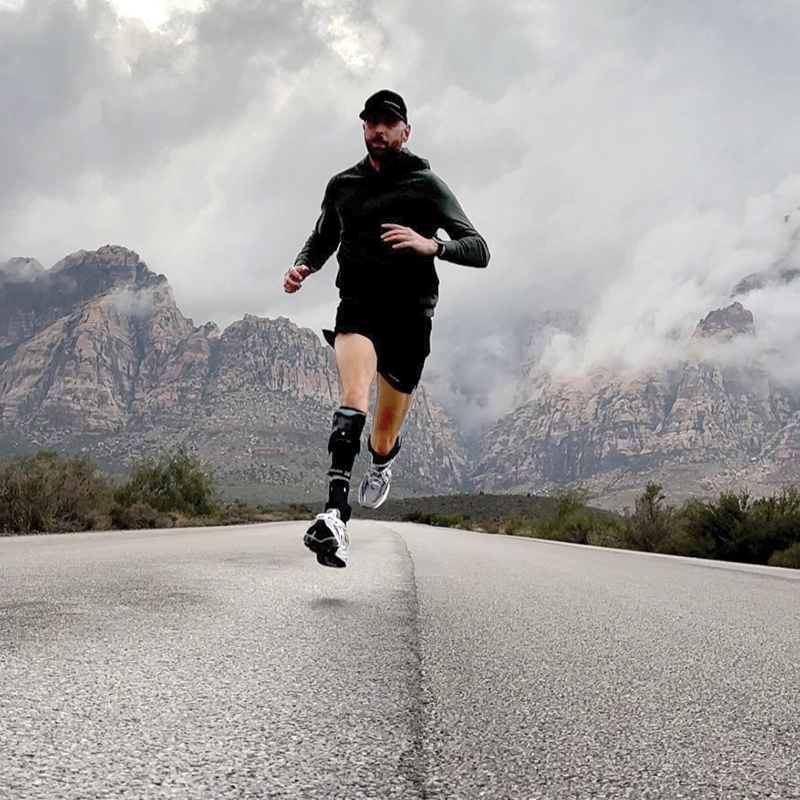
Even so, Davidson couldn’t help but listen to the voice in his head that told him he was, in fact, an athlete. Unfortunately, his desire to succeed as an athlete exceeded his physical capabilities and often exacerbated his pain. He figured he just needed a little help with the right device, and then his heart and his drive could take him the rest of the way.
“If I could just offset this [pain] by just 30 percent, I knew that I could compete,” he says.
After years of struggle, he found the assist he needed in the ExoSym, an energy-storage AFO that stabilizes the ankle, helps control pain, and offloads weight from injured areas.
For Davidson, it made all the difference. He is the first bilateral hybrid prosthetic-orthotic user to finish an ultramarathon. Now he has plans to compete in one of the most challenging footraces in the world.
A Slow Start
Childhood can be tough, especially for kids who stick out.
“I had no range of motion in my feet or ankle joints, everything was deformed, and I have no muscle below my knee,” he says. 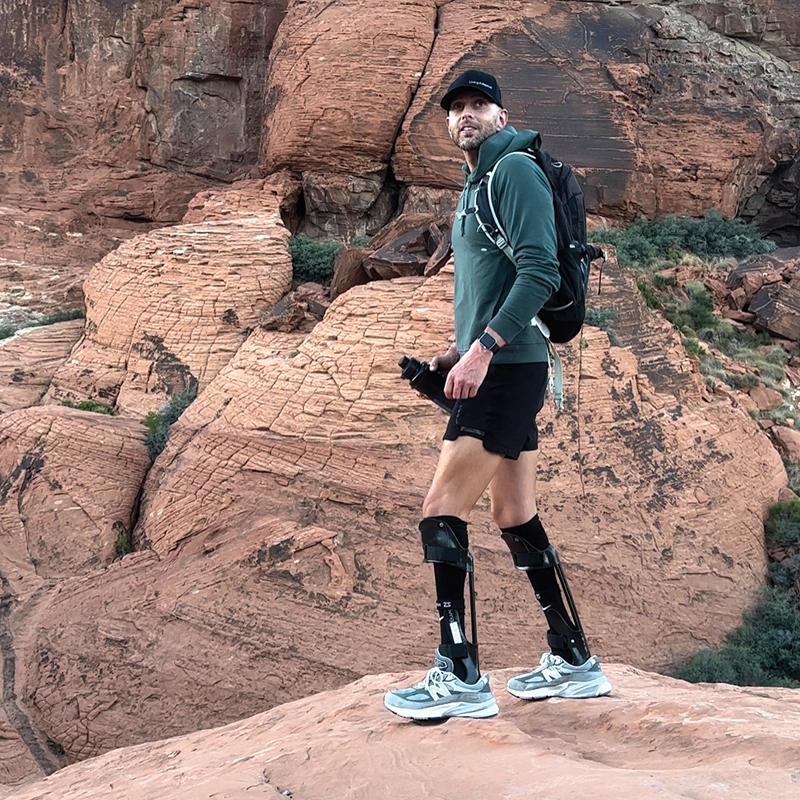
Despite these issues, he participated when his third-grade class was timed to run a mile.
“My feet hurt so bad, everything was going wrong, yet somehow I managed to pull off the fastest mile time.”
But he spent several nights afterward crying in severe pain.
He continued to participate in athletics as much as he could, but by the time he got to high school the pain was too much. Through the following years, he sought out every possible solution. He still had dreams of being a runner, but he could barely walk.
“We had massive failures,” he says. “I remember at one point, it was 1 a.m. and I was thinking, ‘I’m going to be in a wheelchair.’”
With little hope left, Davidson learned about the ExoSym. Trying it would require thousands of dollars, travel, and months of training. He wasn’t sure it was worth it, but he had to give his dreams of running one last chance.
A New Future
First developed through the Department of Defense as the IDEO (Intrepid Dynamic Exoskeletal Orthosis), the ExoSym is considered more of a dynamic exoskeleton than a brace, says its designer Ryan Blanck, CPO/L, ExoSym program director, Hanger Clinic. The device was developed for injured soldiers to return to combat after high-energy orthopedic injuries that typically might have resulted in elective amputation. Blanck didn’t envision it supporting an ultramarathoner, but built it to withstand the impact as soldiers jumped out of planes and other aspects of full military duty.
Now that it is available to civilians, ExoSym users have walked Spain’s 500-mile Camino Del Santiago and worn it in professional mountain bike races, Tough Mudders, and mountain climbs, among other life activities.
“With the human spirit, goals, and drive, coupled with a device optimized like this, anything’s possible,” Blanck says.
The ExoSym requires time, training, and muscle to use, Blanck says. Users must come to the specialized training facility in Gig Harbor, Washington, to be fitted for the device and trained to use it. The initial training period at the facility lasts four to ten days, depending on whether the user can return easily for follow-up sessions. For most users, it takes two to six months, depending on the state of their injuries, to build the muscle strength needed to use the device at maximum capacity.
Because of the time and commitment, and because the device is not always covered through insurance, patients are evaluated for success before they are fitted.
“The biggest defining factor is whether the patient is fully aware and understanding of their personal commitment ahead,” Blanck says. “If you are not yet all-in, maybe you could first try something else and then just know the ExoSym program is here when that level of focus and
commitment makes clear sense.”
When Davidson made the trip to Gig Harbor, he saw it as his last attempt at mobility. He was told by others that the ExoSym would probably be similar to other devices that he had tried, and he was skeptical about whether it would be worth its price tag, or the time and expense to train with it.
“I remember thinking that this was my last chance to get something,” he says. “All I could think was, ‘Scott, you are meant to run.’”
Trusting the Process
Things felt different as soon as he put on the prototype.
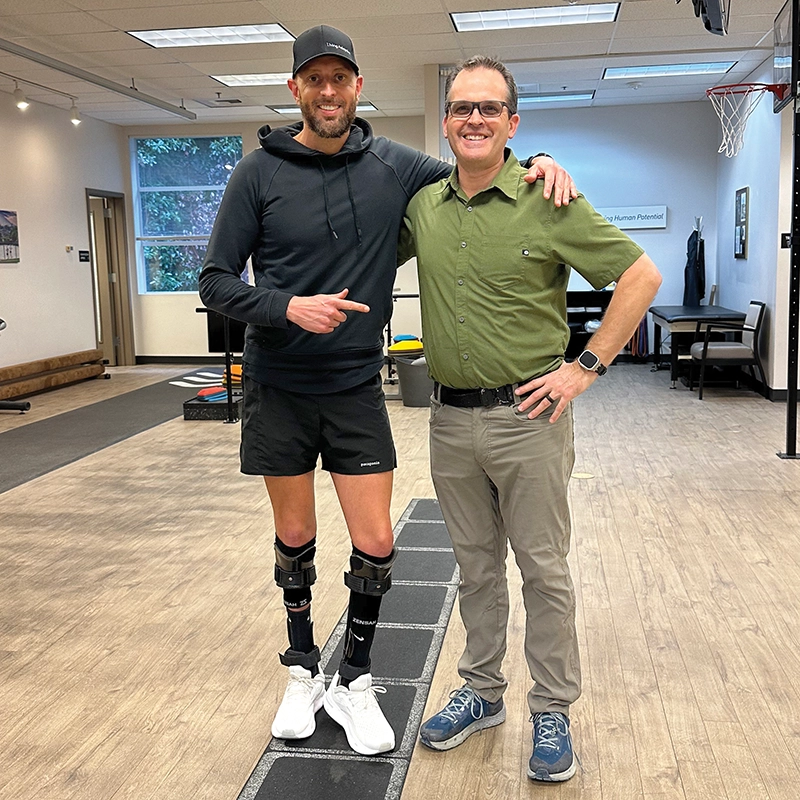
The offloading provided by the ExoSyms initially made it harder to walk than the other AFOs Davidson had used, but wasn’t causing him pain. It didn’t feel natural to use, and it took him a few days to understand how to move in it.
“If you move appropriately in this device, you’re not getting damaged,” he says. “It truly is a hybrid of a prosthetic and orthotic.
“When I describe the ExoSym, I describe it as an equal-opportunity device,” Davidson says. “You get out of it what you put into it…. It took a long time. Ryan has this thing where it takes six months to the new you, and it took all six months.”
Part of the struggle for Davidson was trusting the process. He had lived for so long with devices that hadn’t worked for him that it was hard to trust that something actually would, Blanck says.
“He, like most every case, had things he had to let go of and trust some random person in Gig Harbor, Washington,” Blanck says. “We had to walk through this with him and recognize, as there often is, that there was some challenging history of prior physical limitations there.”
With each passing month, Davidson got stronger and became more of a believer.
“It really steers based on your posterior chain and, just like any muscle, it only gets better as long as you’re building it,” Davidson says. “So, as I was building muscle, the improvements just kept happening.”
Soon enough he was running pain-free. He even texted Blanck a picture of his feet after a run, and for the first time, they weren’t swollen at all.
With the assistance he needed, Davidson was able to train like he always knew he could. He’s run races with distances of 31.1 miles, 42.5 miles, 45 miles, 50 miles, and 62.14 miles (a 100K). 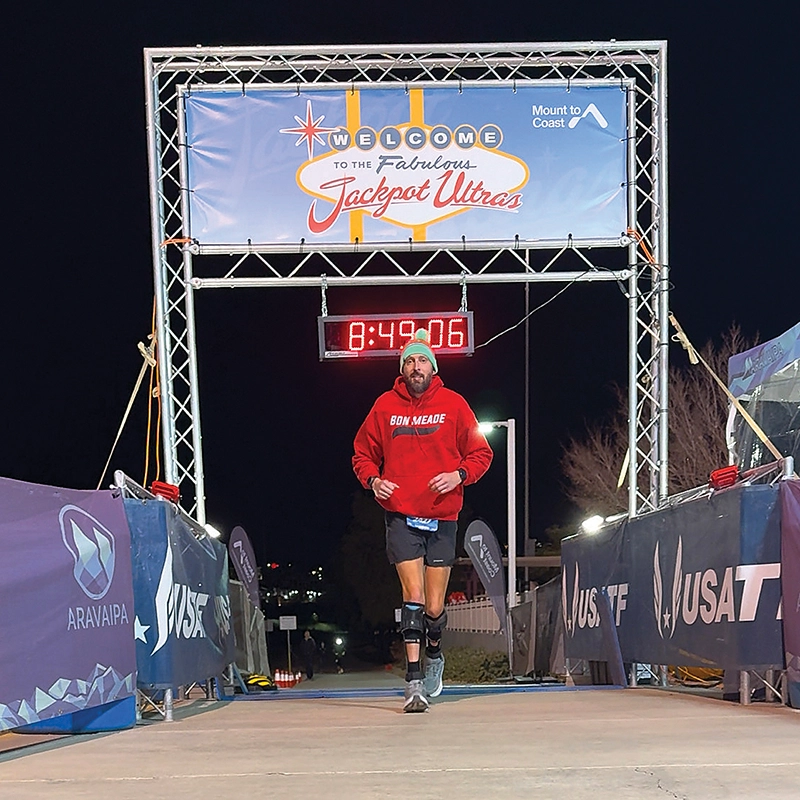
Soon enough, he started attracting sponsors, which helped him purchase a backup ExoSym set, pay off his earlier ExoSym debt, fund his training, hire an ultramarathon coach, and pay for all associated costs for his long runs.
“I hated everything about me,” he says. “I hated my legs for so many years and, all of a sudden, what was my worst nightmares is now one of my greatest—if not the greatest—strength I have. Showing my adaptability seems to be the thing that attracts brands.”
With each distance accomplished, so too came a new goal. He says he wasn’t even elated when he finished the 100K.
“When I crossed the 100K finish, you see these people crying in happiness that they finished. I felt nothing like that. I said ‘Okay, good job, you did it. Now we can move onto the next distance.’”
The next distance he plans to complete is a 100-mile run, then he wants to attempt one of the toughest footraces on earth: the Badwater 135. The grueling 135-mile race starts at Badwater Basin in Death Valley, California, the lowest elevation in North America. Runners endure extreme heat (up to 130 degrees Fahrenheit), sleep deprivation, and three mountain ranges for a total vertical ascent of 14,600 feet.
It’s a brutal task for any runner, but perhaps even more so for Davidson. The ExoSym offloads pressure, which means it controls energy, making him have to work harder to run than other competitors. To withstand the same distance as the other runners, he has to go slower and train longer.
“I’m beating up my limbs; I’m beating up my entire system more because I’m out there longer and putting in more energy just to move.”
The Badwater will be his toughest challenge. He’s not sure he’ll make it but knows that he has to try.
“The goal has always been to see how far someone like me can go.”
Maria St. Louis-Sanchez can be contacted at msantray@yahoo.com.
Photographs courtesy of Scott Davidson.