

In 2010, before Ben Hogan, CPO, became a clinician, he was working as a bike mechanic in Southern California when a man with a lower-limb amputation came into the shop in need of a bike repair. A conversation that stemmed from that encounter put Hogan on a path to O&P care and innovation.
Hogan has now been a clinician for ten years, with the last nine working at Mary Free Bed Rehabilitation Hospital, Michigan, in the Orthotics & Prosthetics + Bionics department. When he’s not treating patients, he’s working on Project Bike Leg, developing a low-cost prosthesis where nearly every part of the device is made from old bicycle parts.
“I got into prosthetics due to an amputee showing me their leg unprompted,” says Hogan, who has been a cyclist for years, particularly mountain biking. “When he walked in that day, I couldn’t help but notice the similarities between bicycles and prosthetic legs.”
In 2013, as an O&P resident at a Hanger Clinic in Ohio, Hogan got the idea for the bike leg from a rudimentary design he saw online using a bike frame with plaster for a prosthetic socket. Using what he knew about bikes, “I was naturally curious about how I could alter the original design to make it more efficient.”
Changing a Common Statistic
Hogan says his main purpose for Project Bike Leg is to disrupt a statistic from the World Health Organization, estimating that up to 90 percent of the world’s population with amputations lack access to proper prosthetic care due to insufficient infrastructure, finances, and/or local professionals. Hogan wants to decrease that number by providing an outline that details the process of making a functional transtibial prosthesis from bicycle components.
Hogan made his first prosthetic leg from bike parts in 2013, but shelved the concept until “I could tell the world that I officially had my 10,000 hours in prosthetics to master the concepts,” he says. “But I picked it back up in 2024, and I have been moving at a fast clip
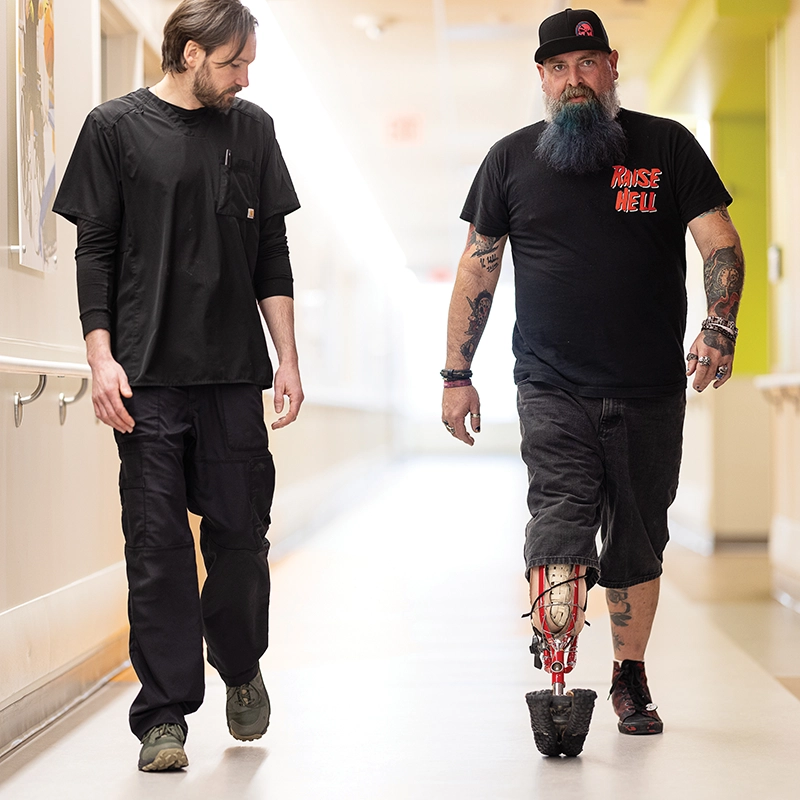
Photographs courtesy of Ben Hogan.
ever since.”
A fast clip indeed—especially given the strong interest from others along with help from students from Michigan State University (MSU).
Timothy Potter, sustainable transportation manager of the MSU Bikes Service Center, hired Hogan in 2007 as a student bike mechanic. “He was rock solid as an employee and a fun upbeat guy to work with on a personal level,” Potter remembers. “As an undergrad, I can remember thinking that he was certainly destined to go a long way in life in whatever career he pursued, and he certainly has proven me right.”
Potter saw Hogan’s original idea for the bike leg via a post on Facebook and reached out to congratulate him. Potter then suggested Hogan submit the design for the MSU senior capstone program.
“I was looking for a project to sponsor for MSU College of Engineering senior students, whom we’ve sponsored every semester for about ten years,” Potter says. “I asked him if he’d like to cosponsor a student engineering project around the bike leg. It took off from there.”
Hogan and Potter submitted the bike leg project for consideration. As a result, five MSU engineering seniors made their own bike legs to test the possibility of crafting a functional prosthesis using the schemas Hogan had developed.
“The students not only succeeded in making a functional, well-fitting leg, but theirs worked more efficiently than mine,” Hogan says.
“I totally love the concept,” says Potter, “since it combines our mutual passion in bikes and recycling/reuse, which is part of the mission of MSU Bikes since we’re part of the MSU recycling department.”
Potter, who has been involved in some aspect of cycling since he was six years old, including currently riding to work every day, knows firsthand how useful bikes are for everyday use.
“I know how many bikes sadly get abandoned on our campus and throughout the world,” he says. “It’s a wonderful combination of using the beauty of bike parts and reusing abandoned bikes in a way that will benefit the lives of so many people. Ben’s creativity in utilizing only readily found bike parts to construct his bike leg in such a way as to make it possible with rudimentary tools found in even the poorest communities is truly genius.”
Potter says his role with Project Bike Leg is multifaceted. “Cosponsoring the project means making the critical connection with the university’s college of engineering, opening up the resources available to the engineering students, and to the refinement and further development of Ben’s bike leg,” he says. “I also have a rich background with bikes from a mechanical and user perspective, so I’ve been also able to provide some mechanical advice along the way to help make the leg better.”
Like Potter, Scott Riddle, CPO, vice president, Orthotics & Prosthetics + Bionics, Mary Free Bed, is an avid cyclist who became fascinated by Hogan’s bike leg concept. “We work closely together across teams and positions at Mary Free Bed, and during an office visit Ben first showed me the bike leg,” Riddle says. “I was immediately intrigued and supportive of this out-of-box project that aligns with our mission of restoring hope and freedom [to those with amputations].”
Riddle, who has worked with Hogan for five years, says he remembers holding Hogan’s prototype for the first time.
“I was struck by how durable it felt,” he says. “How cleverly the prosthesis had been designed to take advantage of the inherently strong yet adjustable aspects of a bicycle. It’s incredibly function-forward, on every level. From the design itself to the intentional clarity and simplicity of the fabrication protocol.”
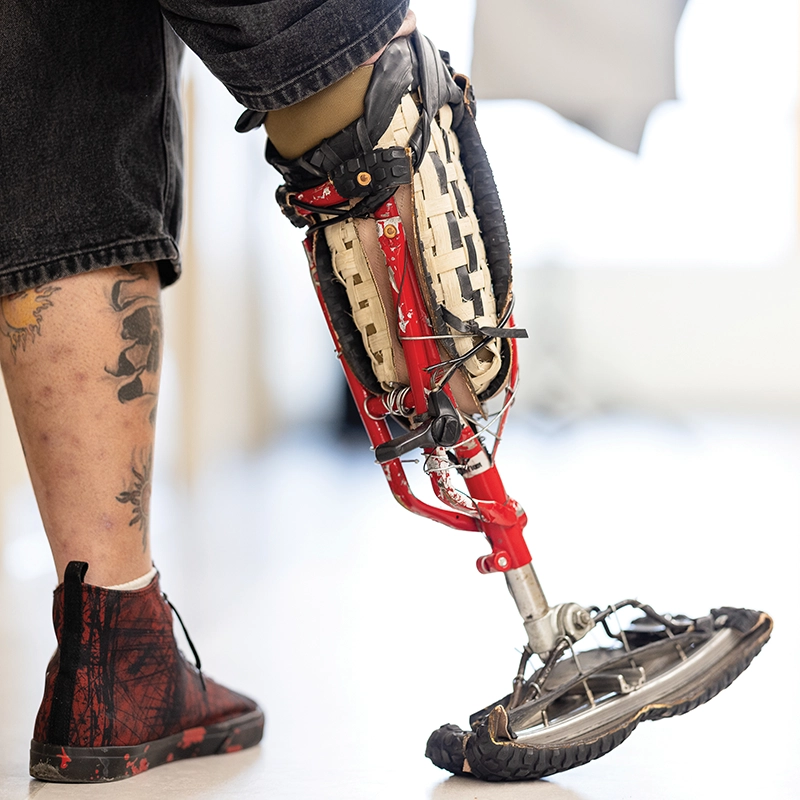
Hogan says making a bike leg, which includes a modifiable socket with cable-modulated compression and weighs about 6.5 lb., takes about eight hours to construct. Cost is also minimal, he says. “In terms of cost, you could theoretically find an abandoned bicycle anywhere, or perhaps even the one that’s been hanging on a bike hook in your garage for years, and configure it accordingly,” he says.
Hope for Future Projects
Last year, Abena Tannor, a sports, exercise, and rehabilitation physician, visited Hogan at Mary Free Bed. “She is a physiatrist in Ghana who wants to mimic the rehabilitation model that Mary Free Bed implements,” Hogan says.
Tannor was so fascinated with the functionality of Hogan’s bike leg concept that she invited him to visit Ghana. “I will be training local technicians there on how to build [bike legs] around a few trial patients,” says Hogan, who went to Ghana in March.
Hogan says he is developing a prosthetic bike leg model for people with transfemoral amputations, which is also moving forward with a new team of MSU engineering students this semester.
“I have a prototype about halfway finished with plans to have my patient take their first steps,” he says.
Hogan has no plans to monetize this endeavor or to patent his bike leg. “[The goal] would be to provide an open-source, functional, affordable, and virtually accessible prosthetic solution to address the 90 percent of amputees worldwide who lack access to proper prosthetic care,” he says. “This project has the sole purpose of addressing the dire need for prosthetic intervention in extremely resource-stricken regions with no other viable options.”
Riddle agrees and says it’s also his job to help Hogan’s concept become a reality. “As vice president of Mary Free Bed, it is my job to help our team fulfill our mission. This comes in many shapes and forms, but it begins with creating a space for our team to explore their strengths and opportunities.”
Hogan has a “true heart for mission,” Riddle says.
“He’s a team player and is clearly passionate about prosthetic care,” he says. “And, of course, he has a particular knack for out-of-the-box creativity—from being an ardent early adopter of new O&P technology to creating the bike leg to building his own in-home sauna, Ben does it all.”
Hogan’s goal?
“If trained individuals can access this schema via the internet and successfully construct a prosthesis with on-hand materials, then maybe those millions of amputees who cannot otherwise access a traditional prosthesis may finally be able to walk again,” he says.
Betta Ferrendelli can be contacted at betta@opedge.com.