

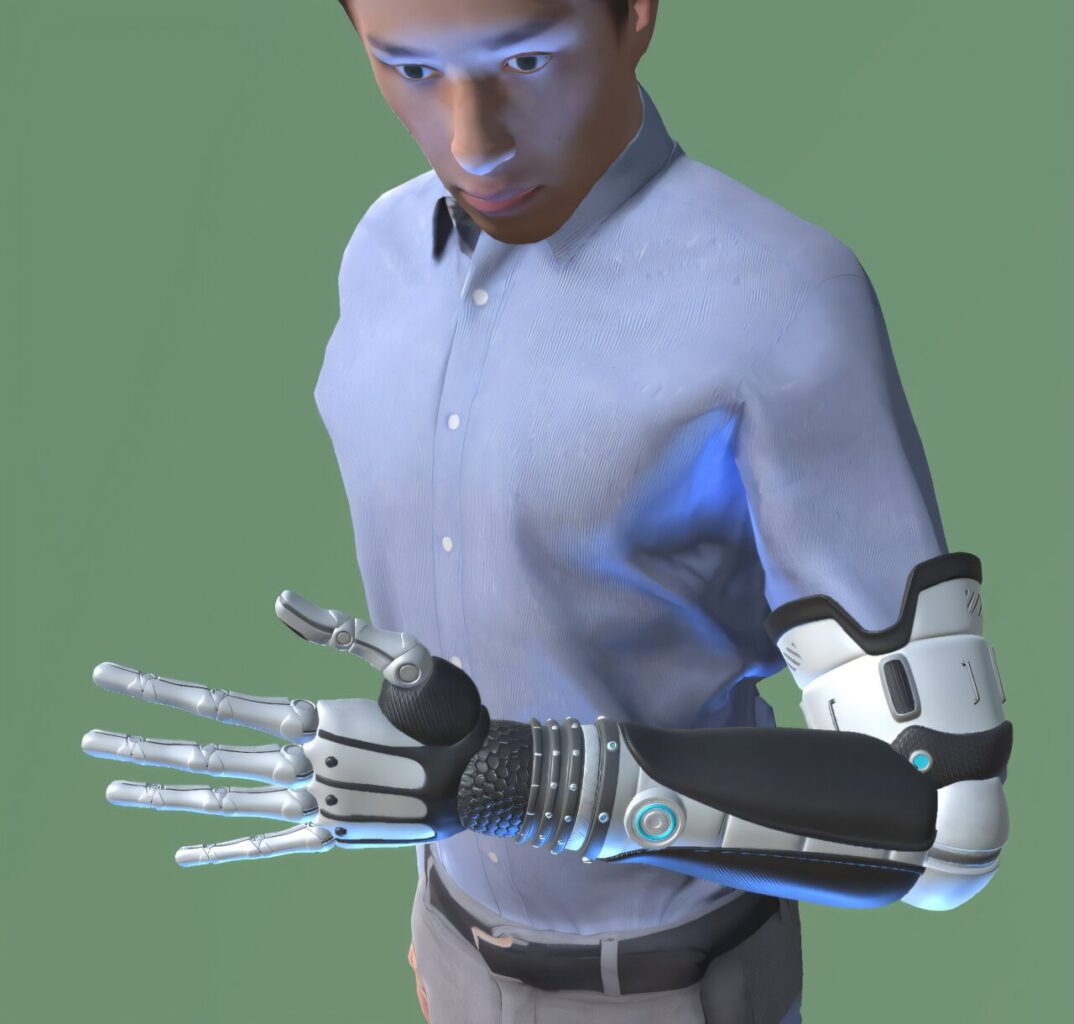
In a new study, scientists used a virtual reality simulation in which a participant’s arm was replaced by a robotic prosthetic arm to examine how the prosthesis movement speed affected embodiment, including body ownership, the sense of agency, usability, and social impressions of the robot such as competence and discomfort. They found that both overly fast and overly slow movements reduced body ownership and usability, whereas a moderate speed close to natural human reaching, with a movement duration of about one second, produced the most positive impressions.
Advances in machine learning and artificial intelligence are making it increasingly realistic that future prostheses will be able to assess situations and provide assistance through autonomous or semi-autonomous movements. However, when a body part moves independently of one’s will, people are likely to experience it as unsettling or independent of their bodies, creating a barrier to acceptance, according to the study’s authors. Addressing this issue, prior research has suggested that even if a limb moves on its own, discomfort can be reduced and acceptance as part of the body can increase when the movement’s goal or intention is understandable.
Building on that idea, researchers at Toyohashi University of Technology, Japan, focused on movement speed. The prosthetic arm (a virtual forearm) autonomously flexed toward a target, and the researchers systematically varied its movement duration across six levels (125 millisecond to 4 s). After each condition, participants rated body ownership, sense of agency, usability, and social impressions of the robot (competence, warmth, and discomfort).
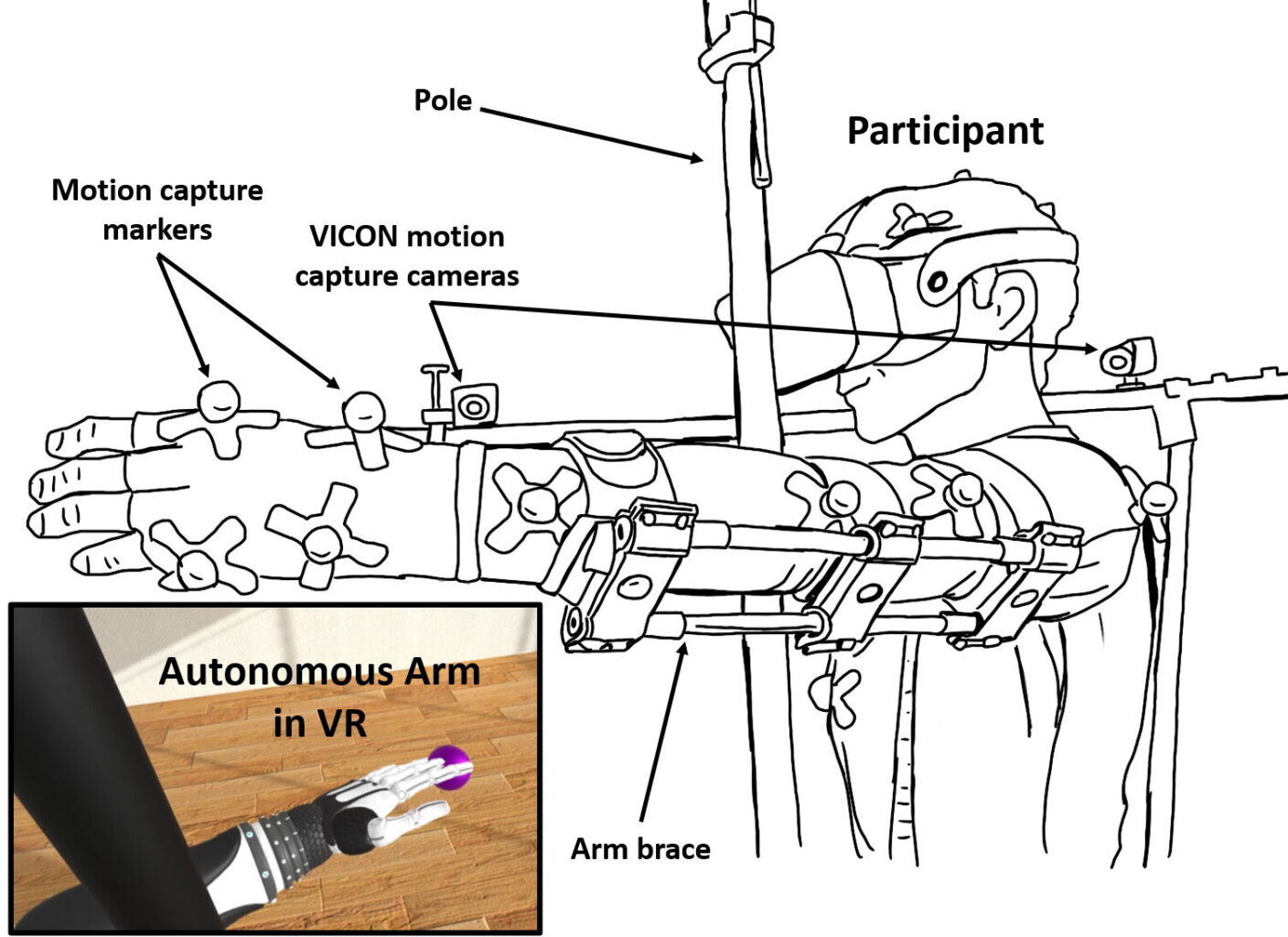
At a moderate speed (movement duration of 1 s), body ownership, agency, and usability were highest. In the fastest (125 ms) and slowest (4 s) conditions, body ownership, agency, and usability were significantly lower. Perceived competence was higher at moderate to slightly faster speeds, whereas discomfort was highest in the fastest condition. Warmth did not show a clear dependence on speed.
According to the study, the findings indicated that with autonomous assistance provided by a prosthetic limb, it is not sufficient to pursue faster and more accurate performance alone. Instead, movement speed should be designed to match what people can readily accept as part of their own bodies.
The insights may inform not only the design of autonomous prosthetic arms, but also other forms of robotic body augmentation, such as supernumerary robotic limbs, exoskeletons, and wearable robots that operate as functional extensions of the body. The research team will also examine adaptation and learning through long-term use to determine if a fast and accurate robotic body part is used continuously in daily life it may become normalized, feel easier to use, and be more readily embodied.
Editor’s note: This story was adapted from materials provided by Toyohashi University of Technology.
The study, “Movement speed of an autonomous prosthetic limb shapes embodiment, usability and robotic social attributes in virtual reality,” was published in Scientific Reports.