

OANDP-L
  • Login
No Result
View All Result
The O&P EDGE
  • PECOS
  • Magazine
    • Subscription
    • Current Issue
    • Issue Archive
    • News Archive
    • Product & Service Directory
    • Advertising Information
    • EDGE Flipbooks
  • O&P Jobs
    • Find a Job
    • Post a Job
  • EDGE Advantage
    • EA Homepage
    • EA Data
  • O&P Facilities
  • Resources
    • Product & Service Directory
    • Calendar
    • Contact
    • About Us
    • O&P Library
    • The Guide
    • Custom Publications
    • Advertising Information
    • EDGE Direct
    • Amplitude Media Group
  • PECOS
  • Magazine
    • Subscription
    • Current Issue
    • Issue Archive
    • News Archive
    • Product & Service Directory
    • Advertising Information
    • EDGE Flipbooks
  • O&P Jobs
    • Find a Job
    • Post a Job
  • EDGE Advantage
    • EA Homepage
    • EA Data
  • O&P Facilities
  • Resources
    • Product & Service Directory
    • Calendar
    • Contact
    • About Us
    • O&P Library
    • The Guide
    • Custom Publications
    • Advertising Information
    • EDGE Direct
    • Amplitude Media Group
No Result
View All Result
The O&P EDGE Magazine
No Result
View All Result
Home News

Researchers Use Noninvasive EEG to Reconstruct Hand Movements

by The O&P EDGE
March 8, 2010
in News
0
SHARES
16
VIEWS
Share on FacebookShare on Twitter

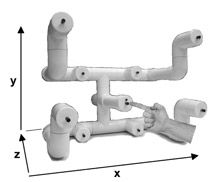
Scientists used a reaching apparatus to study finger paths from a center button to eight other buttons in random order. While volunteers touched the buttons, researchers recorded their brain signals and hand motions. Afterward, the researchers attempted to decode the signals and reconstruct the 3-D hand movements. Image used with permission of Bradberry et al. The Journal of Neuroscience 2010.

Researchers have successfully reconstructed 3D hand motions from brain signals recorded in a non-invasive way, according to a study in the March 3 issue of The Journal of Neuroscience. This finding uses a technique that may open new doors for portable brain-computer interface (BCI) systems. Such a noninvasive system could potentially operate a robotic arm or motorized wheelchair-a huge advance for people with disabilities or paralysis.

Until now, to reconstruct hand motions, researchers have used nonportable, invasive methods that place sensors inside the brain. In this study, a team of neuroscientists led by José Contreras-Vidal, PhD, of the University of Maryland, College Park (UMCP), placed an array of sensors on the scalps of five participants to record their brains’ electrical activity, using electroencephalography (EEG). Volunteers were asked to reach from a center button and touch eight other buttons in random order ten times, while the authors recorded their brain signals and hand motions. Afterward, the researchers attempted to decode the signals and reconstruct the 3D hand movements.

“Our results showed that electrical brain activity acquired from the scalp surface carries enough information to reconstruct continuous, unconstrained hand movements,” Contreras-Vidal said.

The researchers found that of the 34 sensors used, one sensor in particular provided the most accurate information. The sensor was located over a part of the brain called the primary sensorimotor cortex, a region associated with voluntary movement. Useful signals were also recorded from another region called the inferior parietal lobule, which is known to help guide limb movement. The authors used these findings to confirm the validity of their methods.

This study has implications for future BCI technologies and for those already in existence. “It may eventually be possible for people with severe neuromuscular disorders, such as amyotrophic lateral sclerosis (ALS), stroke, or spinal cord injury, to regain control of complex tasks without needing to have electrodes implanted in their brains,” said Jonathan Wolpaw, MD, of the New York State Department of Health’s Wadsworth Center, Albany, who was unaffiliated with the study. “The paper enhances the potential value of EEG for laboratory studies and clinical monitoring of brain function.”

The findings could also help improve existing EEG-based systems designed to allow movement-impaired people to control a computer cursor with just their thoughts. These systems now require that users undergo extensive training sessions. Contreras-Vidal said the length of this training could be reduced and more effortless control achieved using the methods in this study.


Related posts:

  1. BCI Devices Open Doors for People with Disabilities
  2. Less-Invasive Brain Electrodes Successful
  3. Brain-Controlled Exoskeleton One Step Closer to Reality
  4. Researchers Aim for Direct Control of Prosthetic Arms
Previous Post

IAAPOC Launches Limb Drive for Haiti

Next Post

PrimeFare East Calls for Abstracts

Next Post

PrimeFare East Calls for Abstracts

 SUBSCRIBE FOR FREE


O&P JOBS

Remote

O&P Business Development Manager

Eastern

CPO/Board Eligible Prosthetist/Orthotist/ O&P Resident or O&P Technician

Eastern

Orthotic & Prosthetic Technician

Linkedin X-twitter Facebook

Get unlimited access!

Join EDGE ADVANTAGE and unlock The O&P EDGE's vast library of archived content.
SUBSCRIBE TODAY
The O&P EDGE Magazine
 
Required 'Candidate' login to applying this job. Click here to logout And try again
 

Login to your account

  • Forgot Password?

Reset Password

  • Already have an account? Login

Enter the username or e-mail you used in your profile. A password reset link will be sent to you by email.

Close
No Result
View All Result
  • PECOS
  • MAGAZINE
    • SUBSCRIBE
    • CURRENT ISSUE
    • ISSUE ARCHIVE
    • NEWS ARCHIVE
    • PRODUCTS & SERVICES DIRECTORY
    • ADVERTISING INFORMATION
  • O&P JOBS
    • FIND A JOB
    • POST A JOB
  • EDGE ADVANTAGE
    • EA Homepage
    • EA Data
  • FACILITIES
  • RESOURCES
    • PRODUCTS & SERVICES DIRECTORY
    • CALENDAR
    • CONTACT
    • ABOUT US
    • O&P LIBRARY
    • THE GUIDE
    • CUSTOM PUBLICATIONS
    • ADVERTISING INFORMATION
    • EDGE DIRECT
    • AMPLITUDE
  • OANDP-L
  • LOGIN

© 2026 The O&P EDGE

Not enough quota to unlock this post
Unlock left : 0
Are you sure want to cancel subscription?
 

Account Activation

Before you can login, you must activate your account with the code sent to your email address. If you did not receive this email, please check your junk/spam folder. Click here to resend the activation email. If you entered an incorrect email address, you will need to re-register with the correct email address.


© 2026 The O&P EDGE

  • About
  • Advertise
  • Contact
  • EDGE Advantage
  • OANDP-L
  • Subscribe

CONTACT US

866-613-0257

info@opedge.com

201 E. 4th St.
Loveland, CO 80537

EDGE DIRECT

The most important industry news and events delivered directly to your inbox every week.

  • About
  • Advertise
  • Contact
  • EDGE Advantage
  • OANDP-L
  • Subscribe

© 2026 The O&P EDGE

Welcome Back!

Login to your account below

Forgotten Password?

Retrieve your password

Please enter your username or email address to reset your password.

Log In
The O&P EDGE Magazine
 
Required 'Candidate' login to applying this job. Click here to logout And try again
 

Login to your account

  • Forgot Password?

Reset Password

  • Already have an account? Login

Enter the username or e-mail you used in your profile. A password reset link will be sent to you by email.

Close
No Result
View All Result
  • PECOS
  • MAGAZINE
    • SUBSCRIBE
    • CURRENT ISSUE
    • ISSUE ARCHIVE
    • NEWS ARCHIVE
    • PRODUCTS & SERVICES DIRECTORY
    • ADVERTISING INFORMATION
  • O&P JOBS
    • FIND A JOB
    • POST A JOB
  • EDGE ADVANTAGE
    • EA Homepage
    • EA Data
  • FACILITIES
  • RESOURCES
    • PRODUCTS & SERVICES DIRECTORY
    • CALENDAR
    • CONTACT
    • ABOUT US
    • O&P LIBRARY
    • THE GUIDE
    • CUSTOM PUBLICATIONS
    • ADVERTISING INFORMATION
    • EDGE DIRECT
    • AMPLITUDE
  • OANDP-L
  • LOGIN

© 2026 The O&P EDGE

Not enough quota to unlock this post
Unlock left : 0
Are you sure want to cancel subscription?
 

Account Activation

Before you can login, you must activate your account with the code sent to your email address. If you did not receive this email, please check your junk/spam folder. Click here to resend the activation email. If you entered an incorrect email address, you will need to re-register with the correct email address.