
OANDP-L
  • Login
No Result
View All Result
The O&P EDGE Magazine
  • PECOS
  • Magazine
    • Subscription
    • Current Issue
    • Issue Archive
    • News Archive
    • Product & Service Directory
    • Advertising Information
  • O&P Jobs
    • Find a Job
    • Post a Job
  • EDGE Advantage
    • EA Homepage
    • EA Data
  • O&P Facilities
  • Resources
    • Product & Service Directory
    • Calendar
    • Contact
    • About Us
    • O&P Library
    • Lower Limb Directory
    • The Guide
    • Custom Publications
    • Advertising Information
    • EDGE Direct
    • Amplitude Media Group
No Result
View All Result
The O&P EDGE Magazine
No Result
View All Result
Home News

Dynamic Braces for AIS in Development

by The O&P EDGE
January 3, 2022
in News
0
SHARES
34
VIEWS
Share on Facebook
Share on Twitter

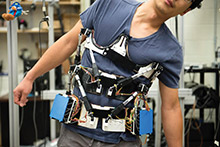
A prototype of the wearable spinal brace. Sensors record the force and motion data and transmit the information to a computer for monitoring and treatment. Photograph by Jane Nisselson, courtesy of Columbia University.

About 2 to 3 percent of children are diagnosed each year with adolescent idiopathic scoliosis (AIS); one in 500 children with AIS require treatment using spinal bracing. The typical spinal brace is made of rigid plastic, which restricts movement, and as the child grows, the required external forces to correct the abnormal posture change along the length of the curve and over the course of treatment. Having the flexibility to move when wearing a spinal brace while still applying corrective forces would be a very useful feature for both patients and physicians. To address this, a team of engineering and medical professors are developing a dynamic brace for children with AIS.

Sunil Agrawal, PhD, a professor of mechanical engineering and of rehabilitation and regenerative medicine at Columbia University, is collaborating with David P. Roye, MD, St. Giles Foundation Professor of Pediatric Orthopedic Surgery at the Columbia University Medical Center (CUMC), New York, and Charles Kim, PhD, an associate professor of mechanical engineering at Bucknell University, to develop a dynamic brace that is more flexible than the rigid braces now in use. They have just won a $1 million grant from the National Science Foundation’s (NSF’s)National Robotics Initiative to pursue their work.

Agrawal and his team have already developed prototype wearable spinal braces that consist of rings that fit on the human torso. These rings are dynamically actuated by servomotors placed on adjacent rings to control the force or position applied on the human body. Onboard sensors record the force and motion data and transmit the information to a host computer for monitoring and adjusting the treatment. The team has also developed a second brace that is fully passive, made of compliant components able to adjust stiffness in specific directions. However, both these braces have drawbacks. The dynamic brace needs an active power source while the passive brace cannot provide active controls.

“While we are the first group to propose parallel-actuated spine braces and compliant braces, these are just in initial phases,” Agrawal explained. “What we will do, thanks to the NSF award, is to design hybrid semi-active spine braces that combine the merits of the two. These will be less power hungry and can be worn over a longer duration of time.”

The team, which has drawn together experts in robotics and pediatric orthopedics, plans to test all three types of braces on children with scoliosis at CUMC. Preliminary experiments have already started to characterize the feasibility of the dynamic braces on healthy subjects with normal spines to characterize the body’s stiffness in different directions during activities of daily living.

“Scoliosis impacts the quality of life of those affected, limiting their activity, causing pain, and diminishing their self-esteem,” Agrawal added. “We expect our work will transform treatment due to the ability of the brace to modulate force or position at specific locations of the spine and will greatly improve the quality of life for children with this debilitating condition.”


Editor’s note: This story was adapted from materials provided by Columbia University.
Related posts:

  1. Academy Society Spotlight: A Discussion on the Case for Rigid Bracing in Children with Neuropathic Onset Scoliosis
  2. Five-year Case Study of an Infant With Scoliosis Using Schroth Therapy and Chêneau-type Bracing
  3. Adolescent Idiopathic Scoliosis: Cobb Angle Relative to Overall Balance
  4. Bracing the Curve
Previous Post

Hanger Announces Acceptance of its Compliance Plan by the NYSE

Next Post

AOPA Announces Legislative Advocacy Award Honorees

Next Post

AOPA Announces Legislative Advocacy Award Honorees

The O&P EDGE October 2026 issue

Read the Current Issue

SUBSCRIBE FOR FREE


O&P JOBS

Central

HH Manager, Orthotics & Prosthetics

Pacific

Orthotics and Prosthetics Assistant

Central

Certified Orthotist — Full-Time or Part-Time, Pediatric Practice

Linkedin X-twitter Facebook

Get unlimited access!

Join EDGE ADVANTAGE and unlock The O&P EDGE's vast library of archived content.
SUBSCRIBE TODAY


© 2026 The O&P EDGE

  • About
  • Advertise
  • Contact
  • EDGE Advantage
  • OANDP-L
  • Subscribe

CONTACT US

866-613-0257

info@opedge.com

201 E. 4th St.
Loveland, CO 80537

EDGE DIRECT

The most important industry news and events delivered directly to your inbox every week.

  • About
  • Advertise
  • Contact
  • EDGE Advantage
  • OANDP-L
  • Subscribe

© 2026 The O&P EDGE

Welcome Back!

Login to your account below

Forgotten Password?

Retrieve your password

Please enter your username or email address to reset your password.

Log In
Close
No Result
View All Result
  • PECOS
  • MAGAZINE
    • SUBSCRIBE
    • CURRENT ISSUE
    • ISSUE ARCHIVE
    • NEWS ARCHIVE
    • PRODUCTS & SERVICES DIRECTORY
    • ADVERTISING INFORMATION
  • O&P JOBS
    • FIND A JOB
    • POST A JOB
  • EDGE ADVANTAGE
    • EA Homepage
    • EA Data
  • FACILITIES
  • RESOURCES
    • PRODUCTS & SERVICES DIRECTORY
    • CALENDAR
    • CONTACT
    • ABOUT US
    • O&P LIBRARY
    • LOWER LIMB DIRECTORY
    • THE GUIDE
    • CUSTOM PUBLICATIONS
    • ADVERTISING INFORMATION
    • EDGE DIRECT
    • AMPLITUDE
  • OANDP-L
  • LOGIN

© 2026 The O&P EDGE