

OANDP-L
  • Login
No Result
View All Result
The O&P EDGE
  • PECOS
  • Magazine
    • Subscription
    • Current Issue
    • Issue Archive
    • News Archive
    • Product & Service Directory
    • Advertising Information
    • EDGE Flipbooks
  • O&P Jobs
    • Find a Job
    • Post a Job
  • EDGE Advantage
    • EA Homepage
    • EA Data
  • O&P Facilities
  • Resources
    • Product & Service Directory
    • Calendar
    • Contact
    • About Us
    • O&P Library
    • Lower Limb Directory
    • The Guide
    • Custom Publications
    • Advertising Information
    • EDGE Direct
    • Amplitude Media Group
  • PECOS
  • Magazine
    • Subscription
    • Current Issue
    • Issue Archive
    • News Archive
    • Product & Service Directory
    • Advertising Information
    • EDGE Flipbooks
  • O&P Jobs
    • Find a Job
    • Post a Job
  • EDGE Advantage
    • EA Homepage
    • EA Data
  • O&P Facilities
  • Resources
    • Product & Service Directory
    • Calendar
    • Contact
    • About Us
    • O&P Library
    • Lower Limb Directory
    • The Guide
    • Custom Publications
    • Advertising Information
    • EDGE Direct
    • Amplitude Media Group
No Result
View All Result
The O&P EDGE Magazine
No Result
View All Result
Home News

Neural Fingerprints Remain After Amputation

by The O&P EDGE
August 30, 2016
in News
0
SHARES
21
VIEWS
Share on FacebookShare on Twitter

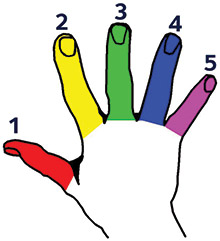
This image shows the colors used in the brain maps: 1) thumb (red); 2) index (yellow); 3) middle (green); 4) ring (blue); and 5) little finger (purple). Image courtesy of Oxford’s Hand and Brain Lab.

Even three decades after hand amputation, the brain maintains an accurate representation of missing fingers, researchers at the University of Oxford (Oxford), England, have found. The finding may have implications for the control of next-generation prosthetics. The results of their work, “Revealing the Neural Fingerprints of a Missing Hand,” were published August 23 in the journal eLIFE.

“We wanted to look at the information underlying brain activity in phantom [limb] movements, to see how it varied from the brain activity of people moving actual hands and fingers,” said team leader Tamar Makin, PhD, an associate professor and Sir Henry Dale Fellow with Oxford’s Centre for Functional MRI of the Brain (FMRIB Centre) and Oxford’s Hand and Brain Lab.

The research team used an ultrahigh-power MRI scanner to look at brain activity in two people who had lost their left hands through amputation 25 and 31 years ago but who still experienced vivid phantom limb sensations, and a control group of 11 people who retained both hands and were right-handed. Each person was asked to move individual fingers on his or her left hand. While there was less brain activity related to the left hand in the subjects with limb loss, the specific patterns making up the composition of the brain’s picture of the hand still matched well to the people in the control group. The researchers confirmed their findings by working with a third subject, who had also experienced a loss of communication between his residual arm and brain. Even this person had a residual representation of his missing hand’s fingers, 31 years after the amputation.

Although these findings provide new insight about the brain’s ability to change, they are compatible with other studies of the brain’s visual cortex that found that degenerative eye disease limiting visual input did not change the brain’s representation of the visual field.

“It seems that even, as previously thought, the brain does carry out reorganization when sensory inputs are lost, it does not erase the original function of a brain area,” said the study leader, Sanne Kikkert, a doctoral student with the FMRIB Centre. “This would remove a barrier to neuroprosthetics…the assumption that a person would lose the brain area that could control the prosthetic. If the brain retains a representation of the individual fingers, this could be exploited to provide the fine-grained control needed.”


Editor’s note: This story was adapted from materials provided by the University of Oxford.

Related posts:

  1. Neural Fingerprints Remain After Amputation
  2. Phantom Limb Pain and Low Vision
  3. Phantom Limb Pain Linked to Brain Retaining Picture of Missing Limb
  4. Cognitive Engagement of the Prosthetic Hand
Previous Post

Academy Calls for Board Nominees, Member Awards

Next Post

Amputee Coalition Publishes White Paper to Stimulate Research, Improve Care

Next Post

Amputee Coalition Publishes White Paper to Stimulate Research, Improve Care

 SUBSCRIBE FOR FREE


O&P JOBS

Eastern

We’re Looking for ABC CPs/CPOs to Join Our Team

Central

CPO

Pacific

CPO/CP & Lab Technician

Linkedin X-twitter Facebook

Get unlimited access!

Join EDGE ADVANTAGE and unlock The O&P EDGE's vast library of archived content.
SUBSCRIBE TODAY
The O&P EDGE Magazine
 

Login to your account

  • Forgot Password?

Reset Password

  • Already have an account? Login

Enter the username or e-mail you used in your profile. A password reset link will be sent to you by email.

Close
No Result
View All Result
  • PECOS
  • MAGAZINE
    • SUBSCRIBE
    • CURRENT ISSUE
    • ISSUE ARCHIVE
    • NEWS ARCHIVE
    • PRODUCTS & SERVICES DIRECTORY
    • ADVERTISING INFORMATION
  • O&P JOBS
    • FIND A JOB
    • POST A JOB
  • EDGE ADVANTAGE
    • EA Homepage
    • EA Data
  • FACILITIES
  • RESOURCES
    • PRODUCTS & SERVICES DIRECTORY
    • CALENDAR
    • CONTACT
    • ABOUT US
    • O&P LIBRARY
    • LOWER LIMB DIRECTORY
    • THE GUIDE
    • CUSTOM PUBLICATIONS
    • ADVERTISING INFORMATION
    • EDGE DIRECT
    • AMPLITUDE
  • OANDP-L
  • LOGIN

© 2026 The O&P EDGE

Not enough quota to unlock this post
Unlock left : 0
Are you sure want to cancel subscription?
 

Account Activation

Before you can login, you must activate your account with the code sent to your email address. If you did not receive this email, please check your junk/spam folder.

Click here to resend the activation email. If you entered an incorrect email address, you will need to re-register with the correct email address.


© 2026 The O&P EDGE

  • About
  • Advertise
  • Contact
  • EDGE Advantage
  • OANDP-L
  • Subscribe

CONTACT US

866-613-0257

info@opedge.com

201 E. 4th St.
Loveland, CO 80537

EDGE DIRECT

The most important industry news and events delivered directly to your inbox every week.

  • About
  • Advertise
  • Contact
  • EDGE Advantage
  • OANDP-L
  • Subscribe

© 2026 The O&P EDGE

Welcome Back!

Login to your account below

Forgotten Password?

Retrieve your password

Please enter your username or email address to reset your password.

Log In
The O&P EDGE Magazine
 

Login to your account

  • Forgot Password?

Reset Password

  • Already have an account? Login

Enter the username or e-mail you used in your profile. A password reset link will be sent to you by email.

Close
No Result
View All Result
  • PECOS
  • MAGAZINE
    • SUBSCRIBE
    • CURRENT ISSUE
    • ISSUE ARCHIVE
    • NEWS ARCHIVE
    • PRODUCTS & SERVICES DIRECTORY
    • ADVERTISING INFORMATION
  • O&P JOBS
    • FIND A JOB
    • POST A JOB
  • EDGE ADVANTAGE
    • EA Homepage
    • EA Data
  • FACILITIES
  • RESOURCES
    • PRODUCTS & SERVICES DIRECTORY
    • CALENDAR
    • CONTACT
    • ABOUT US
    • O&P LIBRARY
    • LOWER LIMB DIRECTORY
    • THE GUIDE
    • CUSTOM PUBLICATIONS
    • ADVERTISING INFORMATION
    • EDGE DIRECT
    • AMPLITUDE
  • OANDP-L
  • LOGIN

© 2026 The O&P EDGE

Not enough quota to unlock this post
Unlock left : 0
Are you sure want to cancel subscription?
 

Account Activation

Before you can login, you must activate your account with the code sent to your email address. If you did not receive this email, please check your junk/spam folder.

Click here to resend the activation email. If you entered an incorrect email address, you will need to re-register with the correct email address.