

OANDP-L
No Result
View All Result
The O&P EDGE Magazine
  • PECOS
  • Magazine
    • Subscription
    • Current Issue
    • Issue Archive
    • News Archive
    • Product & Service Directory
    • Advertising Information
  • O&P Jobs
    • Find a Job
    • Post a Job
  • EDGE Advantage
    • EA Homepage
    • EA Data
  • O&P Facilities
  • Resources
    • Product & Service Directory
    • Calendar
    • Contact
    • About Us
    • O&P Library
    • Lower Limb Directory
    • The Guide
    • Custom Publications
    • Advertising Information
    • EDGE Direct
    • Amplitude Media Group
No Result
View All Result
The O&P EDGE Magazine
No Result
View All Result
Home News

Insoles Improve Postural Stability in AIS

by The O&P EDGE
November 28, 2022
in News
0
0
SHARES
159
VIEWS
Share on Facebook
Share on Twitter

A study investigating the effects of 3D-printed insoles on patients with moderate adolescent idiopathic scoliosis (AIS) found that the insoles did not reduce the Cobb angle and angle of trunk rotation of patients but could improve postural stability.
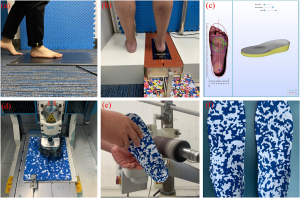
The process of 3D personalized insoles production. a. Plantar pressure distribution measurement; b. 3D foot scanner measurement; c. Computer-aided design (CAD); d. Insoles engraving; e. The rough insoles were polished; f. 3D personalized insoles. Image courtesy of BMC Musculoskeletal Disorders.

Thirty-six volunteers with AIS and curves of 20-45 degrees were randomly divided into experimental and control groups. The control group received traditional rehabilitation with TLSOs and exercises, and the experimental group received the insole interventions in addition to traditional rehabilitation. The outcome measures were Cobb angle, angle of trunk rotation (ATR), postural stability, and quality of life (Scoliosis Research Society-22 questionnaire). Measurements were conducted at baseline examination, two months, and six months.

The insoles were fabricated to increase the stress points or cut off the load-free parts, including personalized increased arch support, adding wedge blocks with different heights to the heel for adjusting the heel in a neutral position, controlling the degree of forefoot inversion and eversion, and bilateral lower limb length compensation, etc.

After two and six months of treatment, the Cobb angle and ATR in both groups were significantly decreased as compared with the baseline, but no significant group difference in Cobb angle and ATR was found. There was a significant difference in the sagittal balance index at six months compared to the control group, and a significant difference in the coronal balance index was observed at six months compared to baseline in the experimental group. Quality of life did not change in either group.

The researchers noted that asymmetry of the spine due to scoliosis might result in an abnormal force on the pelvis, and that the asymmetric load and force on both sides of the body would lead to skeletal growth disorders, aggravating the condition. In addition, they wrote, AIS patients are associated with biomechanical abnormalities of the lower extremities, such as flat feet, high-arched feet, and leg length discrepancies, therefore adjusting the asymmetrical force on both sides of the body through insoles could balance the asymmetrical force and allow the spine to grow normally.

The open-access study, “The efficacy of 3D personalized insoles in moderate adolescent idiopathic scoliosis: a randomized controlled trial,” was published in BMC Musculoskeletal Disorders.

Related posts:

  1. Five-year Case Study of an Infant With Scoliosis Using Schroth Therapy and Chêneau-type Bracing
  2. Cobb Angle or Balance? Trends, Debates in Scoliosis Orthotic Management
  3. Adolescent Idiopathic Scoliosis: Cobb Angle Relative to Overall Balance
  4. Reversing Scoliosis and Brace Treatment of a Proximal Structural Curve
Previous Post

Update: Wright & Filippis Cyber Incident Affects 877K

Next Post

Prosthesis Replicates Natural Leg Biomechanics

Next Post

Prosthesis Replicates Natural Leg Biomechanics

The O&P EDGE October 2026 issue

Read the Current Issue

SUBSCRIBE FOR FREE


O&P JOBS

Pacific

Orthotics and Prosthetics Assistant

Central

Certified Orthotist — Full-Time or Part-Time, Pediatric Practice

Multiple Locations

Certified Prosthetist / Orthotist (CPO/CP/CO)

Linkedin X-twitter Facebook

Get unlimited access!

Join EDGE ADVANTAGE and unlock The O&P EDGE's vast library of archived content.
SUBSCRIBE TODAY


© 2026 The O&P EDGE

  • About
  • Advertise
  • Contact
  • EDGE Advantage
  • OANDP-L
  • Subscribe

CONTACT US

866-613-0257

info@opedge.com

201 E. 4th St.
Loveland, CO 80537

EDGE DIRECT

The most important industry news and events delivered directly to your inbox every week.

  • About
  • Advertise
  • Contact
  • EDGE Advantage
  • OANDP-L
  • Subscribe

© 2026 The O&P EDGE

Close
No Result
View All Result
  • PECOS
  • MAGAZINE
    • SUBSCRIBE
    • CURRENT ISSUE
    • ISSUE ARCHIVE
    • NEWS ARCHIVE
    • PRODUCTS & SERVICES DIRECTORY
    • ADVERTISING INFORMATION
  • O&P JOBS
    • FIND A JOB
    • POST A JOB
  • EDGE ADVANTAGE
    • EA Homepage
    • EA Data
  • FACILITIES
  • RESOURCES
    • PRODUCTS & SERVICES DIRECTORY
    • CALENDAR
    • CONTACT
    • ABOUT US
    • O&P LIBRARY
    • LOWER LIMB DIRECTORY
    • THE GUIDE
    • CUSTOM PUBLICATIONS
    • ADVERTISING INFORMATION
    • EDGE DIRECT
    • AMPLITUDE
  • OANDP-L
  • LOGIN

© 2026 The O&P EDGE