
Days after Tre Adkins lost his left leg, his daughter walked into his hospital room to see him for the first time after his amputation and started to cry.
“She said, ‘Now Dad can’t play with us anymore,’” Adkins recalls.
“I told her that would not be the case,” her says. From that point forward, his children and his wife became the engine behind one of the fastest, most determined recoveries his care team had ever seen.
A Catastrophic Accident
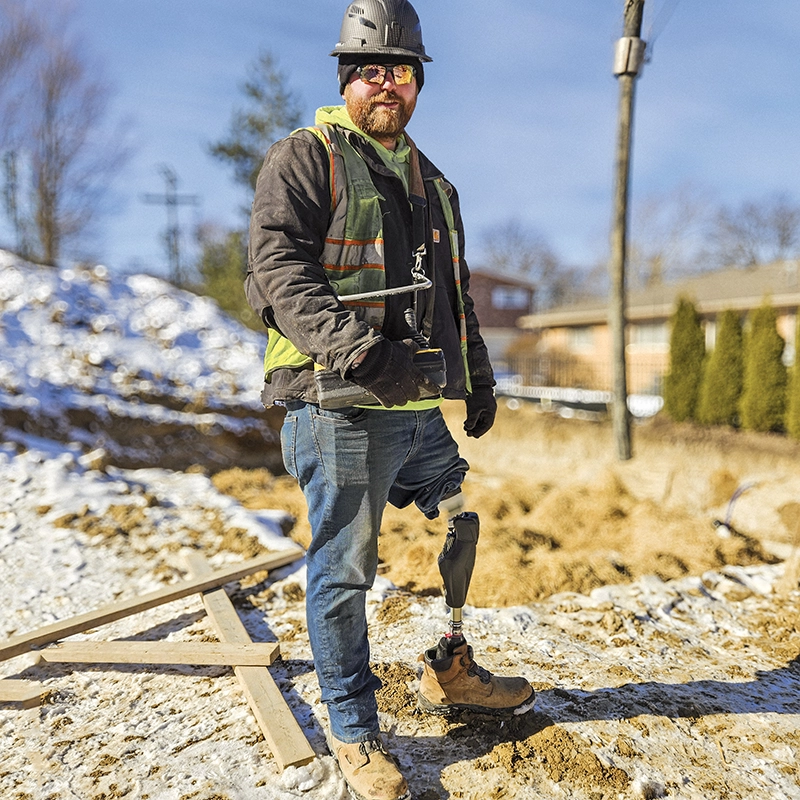
In June 2021, Adkins was driving a pumper truck for a concrete company when he rear-ended a steel hauler. His truck flipped twice and went into a ditch. He lost the lower portion of his left leg and broke his femur, all while fully conscious.
“It registered—and I wasn’t in shock,” he says. “I knew I had lost my leg, but I asked the paramedic to confirm it.”
After being airlifted, surgeons worked to stabilize him, and he underwent neck surgery, femur repair, and a revision of his amputation with a rod placed in his tibia-fibula.
“Losing the leg didn’t bother me as much because I was fortunate to be alive,” he says. “I was grateful to be the only one injured. Nothing happened to my vital organs. So, losing my leg was the least of my worries.”
He met his prosthetist, Chris Perry, CP/L, Perry Prosthetics, Ohio, while still in the hospital. “We had a good connection from the start,” Adkins says.
Adkins was out of the hospital in July and fitted for his first prosthesis, a molded suction socket, in September. From day one, he pushed himself back toward his familiar and active lifestyle. But the socket seemed to fight him at every turn.
“I would go through a round of golf and walk out of my prosthesis,” he says, explaining that sweating and skin irritation made the device nearly impossible to keep on.
Perry remembers the central problem clearly. Adkins is 6-foot-5-inches tall with a long residual limb and works a physically demanding job. “The biggest issue with socket fit was excessive perspiration no matter what we did, which was the initial indication to explore osseointegration [OI],” Perry says.
Adkins’ care team exhausted the options. They tried topical treatments. Adkins considered Botox. Perry Prosthetics enrolled him in a trial for a new Össur breathable liner. Still, nothing brought relief.
As Adkins lost weight, his limb lost volume, so Perry moved him into a series of direct sockets. “We went through three or four direct sockets due to all of the limb changes,” Adkins recalls. He layered on socks, tried sewn-in gaskets, and cycled through accessories to achieve a better seal.
Then pain began to take hold. By late 2022, the bone in Adkins’ femur had receded past the rod, so he was striking it directly. He had it removed and returned to yet another direct cast socket.
“It felt like a losing battle,” Adkins says.
A New Option
Adkins shared his frustration during one of his many follow-up appointments. His orthopedic surgeon, Seth Phillips, DO, who had performed the original amputation, raised OI as a potential option. Adkins was immediately interested in the procedure.
But OI was new, and Perry’s team had only worked with two OI patients at the time. They connected with Jason Sousa, MD, at The Ohio State University, who evaluated Adkins’ candidacy.
The vetting process was extensive. “You have to consult with each party on the team,” Adkins says. Plastic surgery, orthopedic surgery, rehabilitation, physical therapy, and mental health all weighed in.
“I checked all the boxes,” he says.
Surgery was scheduled for January 2024.
“One of the criteria with OI is that you have an unsuccessful socket-fit device,” Perry says, noting an important caveat. “You always need to get a second opinion. You have to rule out that you aren’t just getting a bad fit.”
Excessive perspiration, neuropathic pain, heavy scarring, and excess soft tissue round out the indications Perry and the team weighed. “We don’t just try one fitting. We exhaust options.”
Perry was in the operating room for the surgery.
The first stage included a thighplasty to remove loose and atrophied soft tissue from Adkins’ quadricep and hamstring. Surgeons then exposed the end of the femur and placed the implant, the fixture for an Integrum OPRA system, inside the bone without penetrating the skin, closing the limb to let the implant ossify. “His surgical team got the timeline down to three months versus what typically takes six,” Perry says.
The second surgery, in April 2024, resurfaced the bone, thinned the distal skin, and placed the OI abutment with a locking screw.
Explaining why the design works, Perry says the opening where the abutment exits the skin, known as an aperture, is engineered for stability. “That skin is thin—to the point that it won’t heal if not for the bone marrow, which feeds it the blood supply to heal,” he says. “It creates an adhesion they call the bonded matrix.” Unlike systems where the skin wobbles along the shaft, a bond is forged so that nothing moves.
The Road to Rehab
Perry advises anyone considering OI to make sure they understand that it’s a journey. “This isn’t quick,” Perry says. “Think about it taking a year.”
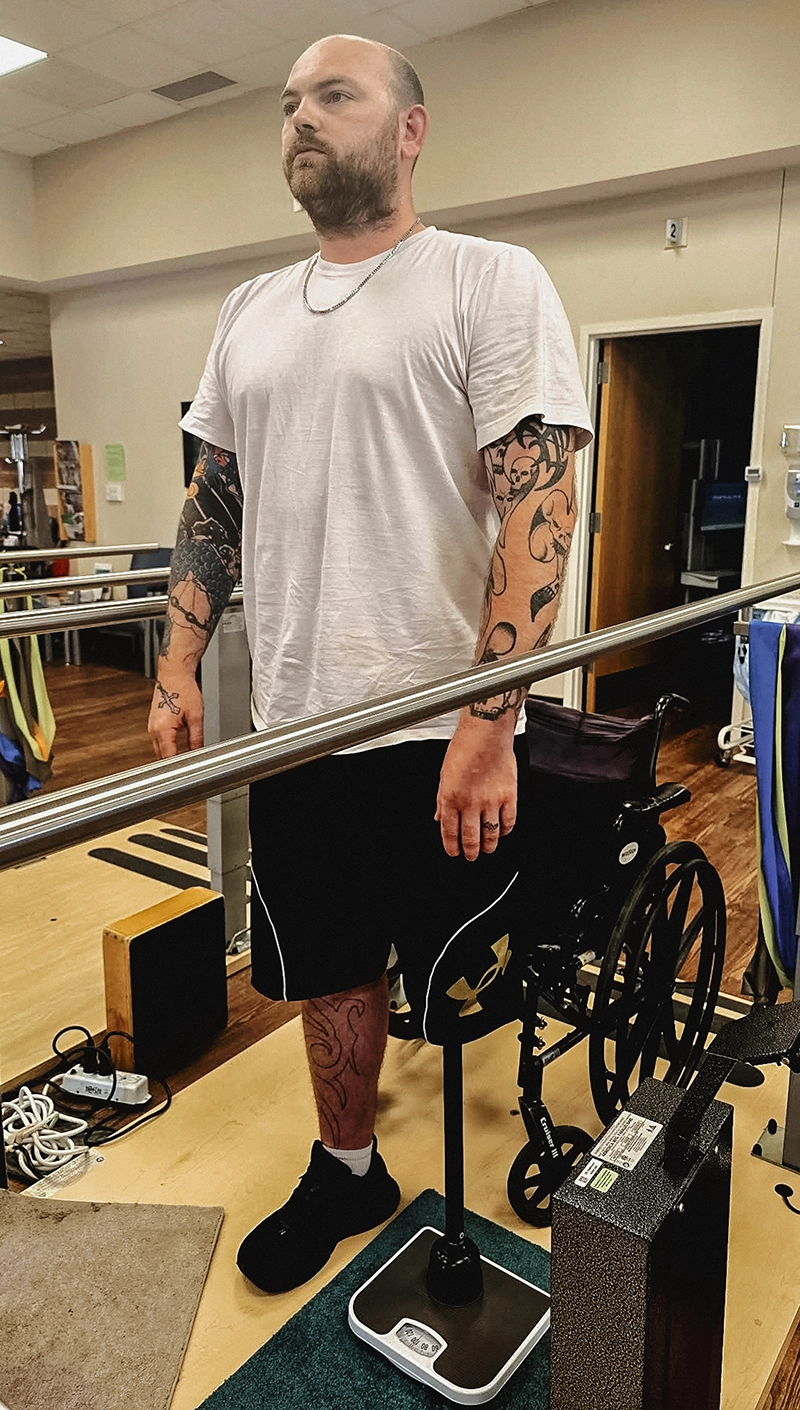
Adkins’ rehabilitation began with a short training device offering rotational control to protect the fresh implant. He loaded weight gradually, never exceeding a pain level of five out of ten.
“You apply weight to a scale and increase it each week,” Adkins says, describing the plunger-like training device. “You do that until you reach your body weight. That trains the bone to be able to hold that weight.”
The mechanism matters from a clinical perspective. “The weight bearing stimulates the ossification,” Perry says, “The cortical bone gets more dense, and it will be a stronger implant.”
Once Adkins reached his target, the team fitted his definitive setup. The Axor II serves as the connector between abutment and prosthesis. “Think of it like a drill chuck,” Perry explains. “The jaws open up and go up on the abutment, and then they tighten it.”
The Axor also carries a critical safety feature: It releases rotationally and with excess flexion if Adkins falls or if his leg is caught up, protecting the bone.
Adkins kept the components that already served him well, including an Ottobock Genium X3 microprocessor knee paired with an Össur ProFlex foot with a dynamic torsion adapter.
By August 2024, Adkins was in a full-length prosthesis, walking with an assistive device in two-hour increments. He worked up to eight, then 12 hours a day. By September, he was wearing it all day.
In November 2024, he went back to work—pumping concrete, driving a truck, operating a crane, and maneuvering job sites. “They were pretty shocked and thrilled with that turnaround time,” he says.
Managing Setbacks
Despite his initial success in rehabilitation, Adkins’ journey has not been a straight line. OI leaves a wound that never fully closes, which raises infection risk. In early 2025, after a targeted muscle reinnervation surgery, strep bacteria entered his limb, and he developed sepsis.
What followed was “months of hell,” he says: a weeklong hospital stay in February, return trips in March and April, C. diff from antibiotics, and a fifth septic episode in May. It wasn’t until the third round of antibiotics that the treatment team identified the root cause and was able to cure the infection.
Even his most recent hurdle—the bonded matrix detaching from the femur—was rare. “I had not seen that before,” Perry says. The surgical team attributes it to Adkins’ size and activity level. “He still works that truck, climbs on it, works construction, and he golfs,” Perry notes.
Surgeons performed the skin graft to repair the damage in two stages rather than one, giving the tissue more time to heal and improve the success rate.
While Adkins’ experience was significant and traumatic, Perry has seen a low overall infection rate. “Some of them are five or six years out,” he says of OI patients. “The incidence of infection with the procedure—I have been surprised how rarely we hear about it.”
OI’s Benefits
Despite the setbacks, Adkins would not change his decision. “If I had to do it all over again, I would have done it from the beginning,” he says.
With a socket, he never trusted the leg on the terrain his job demands, including sand, mud, and snow. “With OI, I feel so much more in control, and I feel so much more stable,” he says. “In my opinion, it’s so much better than having a socket.”
The day-to-day gains are real. No more sweat management, no more layering socks, no more lengthy donning routine. “I can put my prosthesis on with or without my clothes,” Adkins says. He even gets sensory feedback now. “I can feel things that I kick because of vibration.”
Perry sees the difference in the numbers that matter. Donning is fast, the leg stays on, and Adkins’ wear time climbed once movement between socket and bone disappeared. “The high-level things he does on the job—I was pretty impressed,” Perry says.
For Adkins, the benefits come back to the family that motivated him in that hospital room. “Being able to get back to doing what I love—working, playing with my kids, being confident, and knowing that my leg is always going to be there with me confirms that, for me, this was the right decision.”
Still, both Adkins and Perry know that OI is not for everyone.
“It’s not good for someone struggling with losing their limb, or who can’t have the downtime, the patience, or the determination,” Adkins says. The recovery can run one to two years, and you can’t run, jump, or climb for much of that time. “You really have to have a strong mindset.”
Perry’s biggest lesson from Adkins’ case is about timing. “If I have another patient with the same complications, we would certainly be thorough, but we might consider OI sooner. We went further with Tre because OI was new to us.”
Perry is confident that OI won’t replace traditional sockets for most patients. “This is for a very low percent of the population,” he says. “It requires carefully weighing the risk versus reward, case by case.”
He also stresses that the prosthetist’s role never ends. Componentry, alignment, reimbursement advocacy, and lifelong follow-up all continue. So does the uncertainty. Adkins still returns for adjustments, including a custom abutment being made for him now.
“You don’t exactly know what it’s going to hold five, ten, or 20 years from now,” Adkins says. “It’s not just ‘get the screw and put on your prosthesis and go.’ There are still things you have to deal with.”
For Perry, who has an amputation and endured years of struggling with prosthetic fit, patients like Adkins are the whole reason he does this work. “I had bad fittings for years, and then I met a top prosthetist who changed my life,” Perry says. “I didn’t want people to go through what I went through. To work with people who are so determined—those are the fun challenges in prosthetics.”
Souza recently cleared Adkins to return to work after a follow-up on his latest skin graft.
“There are hiccups along the way,” Adkins says. “But the pros have outweighed the cons.”
Tara McMeekin is a writer and editor based in Colorado.