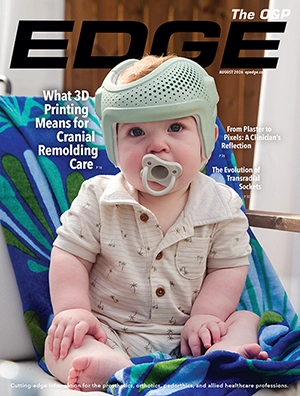

The O&P profession is a field of innovation, continuously advancing in device options, fabrication methods, and ways of fitting and training users. In this issue, we look at the impact the unique characteristics of 3D-printed cranial remolding orthoses (CROs) have had on patient care, the evolution of fabrication tools and workflows, and the role of innovation in improving fit and comfort of upper-limb prostheses.
The use of 3D-printed CROs is a relatively new development in treatment of head asymmetry and deformation in infants, though there is a robust history of treatment with traditional thermoplastic CROs. But as the technology continues to improve, there is increased interest in 3D-printed options due to advantages in breathability, comfort, speed of fabrication, and ease of use. “What 3D Printing Means for Cranial Remolding Care” examines research comparing the efficacy of 3D-printed CROs and thermoplastic CROs, advantages and tradeoffs for each type, and which is most appropriate for particular patient presentations.
When scanning technology, CAD/CAM, and later 3D printing entered the O&P landscape, they brought with them a mixture of excitement, speculation for the future, and skepticism about how they could be practically incorporated. In “From Plaster to Pixels: A Clinician’s 15-Year Reflection on 3D Printing and Digital Manufacturing in O&P,” a veteran clinician shares his perspective on the evolution he’s seen in fabrication workflows and where the next innovations may lead.
Our final feature, “The Evolution of Self-Suspending Transradial Socket Designs,” explores the development of body-powered prosthetic options to improve comfort, functionality, and fit for individuals with short forearm amputations through the experiences of a long-time user and designer of prosthetic components.
Happy reading.
Andrea Spridgen