

The recent advancement of miniaturized and portable electronics, particularly wearable and flexible devices, led researchers at Hanyang University to develop a transistor design for prosthetic devices that could enable reliable touch sensations.
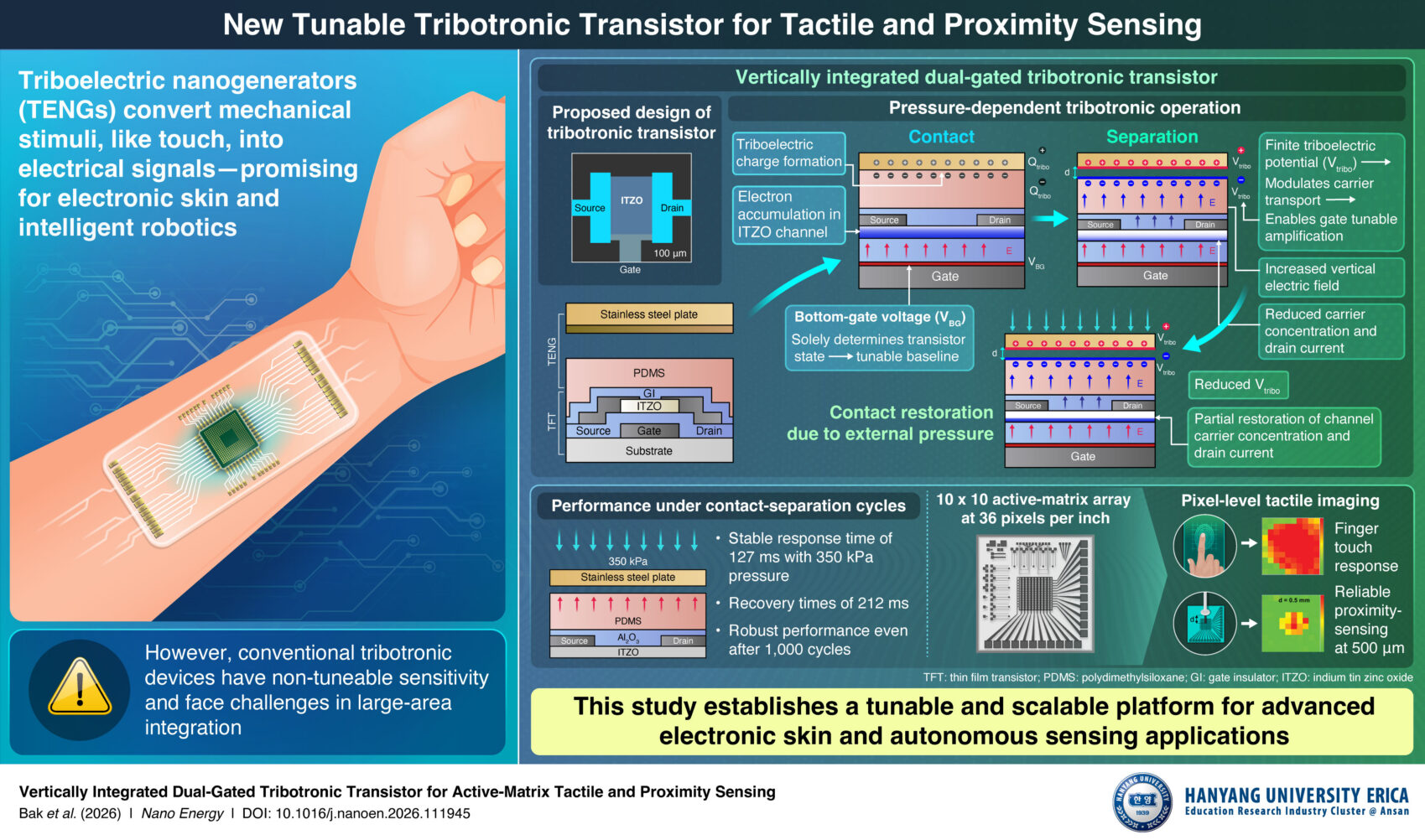
Triboelectric nanogenerators (TENGs), which convert external mechanical stimuli into electrical signals through redistribution of electric charges, have received attention for developing highly sensitive tactile sensors. They are particularly attractive for the development of advanced electronic skin and intelligent robotics, but conventional tribotronic devices have had weaknesses that limited practical applications. The research team’s novel version overcame those challenges.
“Our vertical dual-gate architecture not only offers gate-tunable amplification of the triboelectronic responses, but also minimizes pixel footprint, enabling high-density, large-area integration,” said Jaekyun Kim, PhD, associate professor, Department of Photonics and Nanoelectronics. “Our research could contribute to the development of electronic skin systems that allow robots, prosthetic devices, and wearable electronics to perceive touch, pressure, and proximity more precisely. “This will lead to safer and more reliable human-machine interaction, with applications in healthcare robots, health monitoring, and autonomous systems.”
Editor’s note: This story was adapted from materials provided by Hanyang University.