High-energy trauma (HET) has long been responsible for some of the most debilitating and difficult cases an orthotist will see in clinical practice. HET is responsible for over 250,000 injuries per year, and can be anything that involves a large amount of force combined with distal axial loading through the lower limb.7,8,15 HET injuries are commonly caused by falls from significant heights, motor vehicle accidents, and war-related blast injuries.7,8,15,16,21 While historically many of these injuries may have resulted in limb loss, advances in surgical procedures and automobile safety have led to an increase in limb salvage procedures instead.8,16,17
The goal of limb salvage within the military was returning people to active duty and/or the workforce at a faster pace.17 However, people who had gone through limb salvage procedures often had a slower and more arduous rehabilitation, with many left with chronic pain and arthritis.10,15,20,22 This led the military to build the Return to Run program within the Center for the Intrepid.2,16,17,22 The injuries seen within the program showed the need for a new category of orthosis. Through consults with Marmaduke Loke, one of the originators of a dynamic offloading carbon orthosis design at Dynamic Bracing Systems, California, and development by Ryan Blanck, CPO, the Intrepid Dynamic Exoskeletal Orthosis (IDEO) was born.12,16 This dynamic carbon orthosis, paired with the Return to Run therapy package, improved outcomes for many US servicemembers and thus has become a model for physical therapy within the civilian population as well.16,17,18,22 This article addresses orthotic treatment for HET resulting in a pilon fracture. However, the orthosis types discussed are similar to those used for orthopedic injuries like Weber fractures and other major foot and ankle crush injuries.
Pilon Fractures
Pilon fractures are somewhat rare within O&P; however, they are often seen within the orthopedic trauma community, and in many instances result in multiple clinical follow-ups, surgical revisions, and long-term disability, leading to a reduction in quality of life.3,15
A pilon fracture, also called a tibial plafond fracture, involves the distal portion of the tibia, the plafond of the ankle mortice joint that connects with the articular surface of the talus.3,6,7,15 This area of the tibia is described as the roof of the ankle mortice joint and provides the articular surface that is responsible for the primary sagittal plane motion of the talocrural joint. The talocrural joint is inherently stable, offering very little range of motion (ROM) within the transverse and coronal planes of motion. In cases of HET, the talus in pushed superiorly, resulting in the tibia potentially comminuted into multiple pieces, requiring internal and/or external fixation. These injuries also typically result in significant cartilage and soft tissue damage, creating a loss of range of motion within the sagittal plane.3,6,7,8,10,15,20
A retrospective cohort design study reported that only 60 percent of people with a pilon fracture returned to work after the injury; 29 percent reported persistent swelling; and 33 percent reported ongoing pain.(3,6,15)
Within my nearly 20 years of clinical practice, I have had the opportunity to work with many individuals with pilon fractures. I practiced in close vicinity to Harborview Medical Center in Seattle, a level 1 trauma center, during my 12-year employment with Cornerstone Prosthetics and Orthotics, Washington. During my employment with Cornerstone, I was able to be present during much of the development and trials of the orthopedic posterior dynamic element (PDE) orthosis. As I had more opportunities to work with these patients, it became apparent that many had very similar post-surgery outcomes, keeping in mind that orthotists typically see the most severe cases and do not typically have interactions with patients who have had great surgical outcomes. Pilon fractures are most common in individuals who are young to middle age who may have young children, participate in sports, and have demanding careers. Thus, these injuries are truly life-shattering for many of these individuals who must adapt to chronic pain and decreased function, sacrificing activities with family and friends, and potentially adapting to vocational changes.3,6,7,10,15
Community Awareness
Support groups on Facebook like “Pilon Fractures Suck!,” which currently has 2,867 members, have united many people within this community, helping spread success stories about dynamic custom carbon PDE AFOs.6 These stories are responsible for pushing many people to travel to receive this type of orthosis at clinics specializing in the devices, such as Cornerstone Prosthetics and Orthotics, Dynamic Bracing Solutions, and Hanger Clinic in Gig Harbor, Washington.
The intent of this article is to bring awareness about this type of injury and introduce a treatment that has proven successful for patients who may not have found relief with other solutions. I also want to emphasize that while these cases can be incredibly rewarding for the practitioner and the patient, it is not without a lot of hard work. These cases are not easy and require many follow-ups, and small adjustments in ROM and flexural rigidity dosing, similar to what would be required for a person presenting with newly acquired lower-limb loss. This intervention also requires practitioners to be well versed in triplanar mechanics of the lower limb and have a heightened knowledge of the gait cycle.5
Evaluation and Casting
The first step is a patient evaluation to determine the proper casting technique based on his or her specific ROM requirements. ROM of the foot and ankle complex within the sagittal plane is a crucial element of this evaluation, including standard methods of measurement, ensuring measurements of ankle motion with the knee flexed and the knee extended are included. Knee extension is important because the gastrocnemius is commonly tight, resulting in decreased ROM from mid-stance to late stance when the knee is extending naturally. Many patients have good ROM in plantarflexion after a pilon fracture but have limitations and pain with dorsiflexion. While the patient may have 10 degrees of dorsiflexion available, it’s important to find out specifically the precise moment the pain point starts (Figure 1).
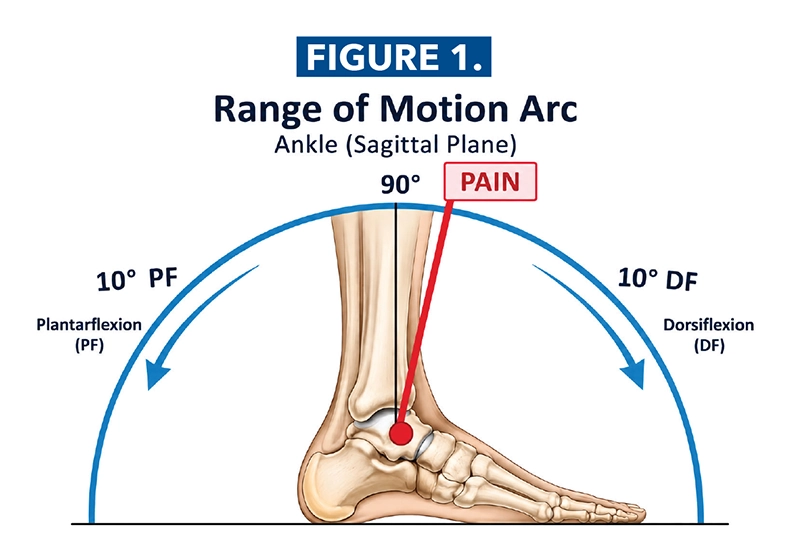
For example, the precise pain point could be at 3 degrees of dorsiflexion or at negative 5 degrees of plantarflexion based on the range where the person reports pain within the weight bearing ROM trial. Note that one could consider this ROM restriction treatment similar to how we would traditionally treat a plantarflexion contracture within an orthosis. The goal is to establish the end range of usable/good motion and thus where the orthosis will provide a dorsiflexion stop. Motion freely allowed past this point will result in further pain and discomfort for the patient. As with typical AFO casting goals, the goal is a shank vertical angle of 10-12 degrees to allow natural tibial progression.13,14 Keep in mind that if the sagittal plane alignment is determined to be in plantarflexion, which is very common, it will require adding to the already determined heel height of the patient’s shoe during casting, thus requiring heel lifts under the orthosis and also the sound limb at fitting. Depending on severity of the pain point, a major benefit of the PDE springs is that you can have a controlled ROM versus a traditional stop, if desired. This can be modulated and adjusted with the seven PDE spring categories at fitting if needed. For more information, watch the ReAktiv casting video at youtube.com/watch?v=vgRobPthm9c.
Orthosis Components
Proximal Section
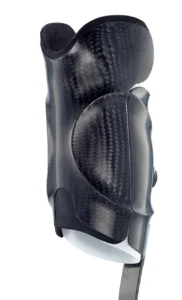 Due to the high-energy nature of these types of fractures, the destruction to the plafond will also commonly require our best attempt at offloading the limb in tandem with controlling the foot and ankle in a triplanar fashion.1,5 Thus, the three components of the dynamic custom carbon fiber orthosis will typically have an anterior patellar tendon-bearing height section that has the ability to load the posterior calf, patellar tendon, and pretibial musculature, similar to standard traditional patellar tendon-bearing transtibial modifications. The proximal cuff can be manufactured as a bivalved carbon shell or a traditional ground reaction AFO anterior section. Within the bivalved carbon cuff, a polyethylene internal section provides an underlap, enabling the anterior section to seat nicely with the posterior section without pinching the user upon donning. Socks can also be used within this proximal section to adjust the volume to provide increased offloading, once again utilizing the same premise that we have traditionally used for managing volume within a prosthetic socket.
Posterior Dynamic Element
The second carbon component is the posterior springs. The most common commercially available option is the Fabtech PDE Spring. There are seven categories of springs, which provide orthotists the ability to change the flexural rigidity of the orthosis.4 The springs are also available in three lengths, which is typically determined by the length of the patient’s limb. Many pilon fractures require starting out with a more rigid strut to decrease pain and help the patient develop trust while learning to use the orthosis. One study showed that 50 percent of people had not returned to hobbies and recreation that they once deemed important to their lives.6 Thus as the pain hopefully decreases, the goal is that the orthosis will enable the patient to return to pre-injury activities. As with a person with limb loss, the expectation is that we begin to see a stacking of return-to-function activities that in turn provide an increase in 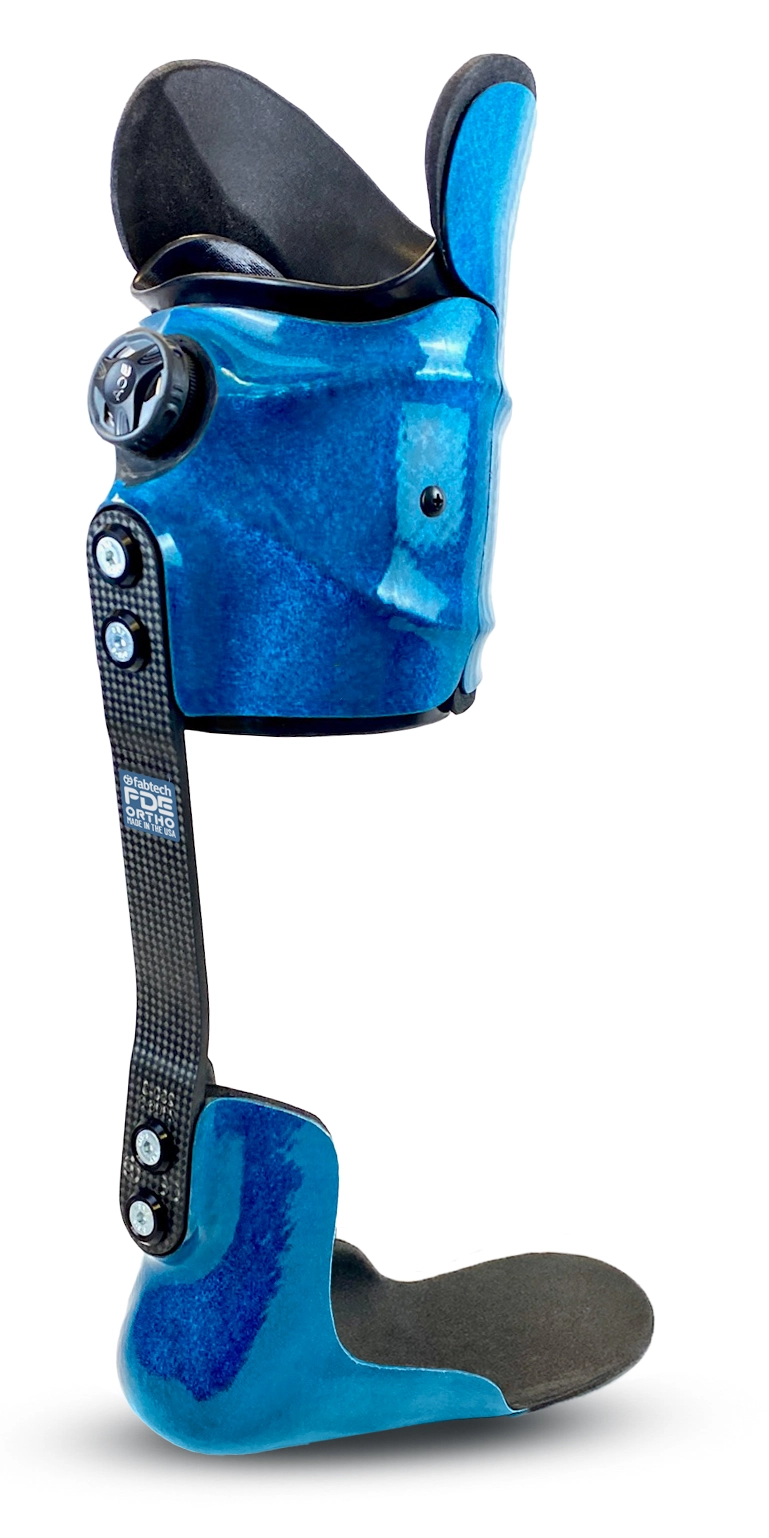 quality of life.
Initial Fitting
Follow-ups are crucial at this stage. The patient and the orthotist are essentially learning together, determining when and why we are having success or not. The initial fitting should be seen as the baseline, typically starting with a more rigid spring holding the ROM that was determined within the casting procedure, with the goal of not allowing the tibia to progress past the noted pain point. If the spring’s flexural properties allow the tibia to progress past the pain point in the sagittal plane, then increase the rigidity of the spring or decrease the dorsiflexion ROM. I recommend starting by increasing the rigidity of the spring, then progressing to changing ROM if the individual is still experiencing pain—with the goal of reducing the overall arc of motion to avoid the painful point in the arc of motion noted in Figure 1. This can take time and can also be very challenging with some cases. One must be mindful of patient expectations at this stage and take time explaining that it may take multiple modifications to figure out what the proper combination is to achieve the best possible outcomes.
Alignment Adjustment
ROM within the orthopedic PDE orthosis can be made in increments of 1 to 5 degrees with the use of wedged shaped inserts placed between the PDE spring and posterior distal foot section (Figure 2).
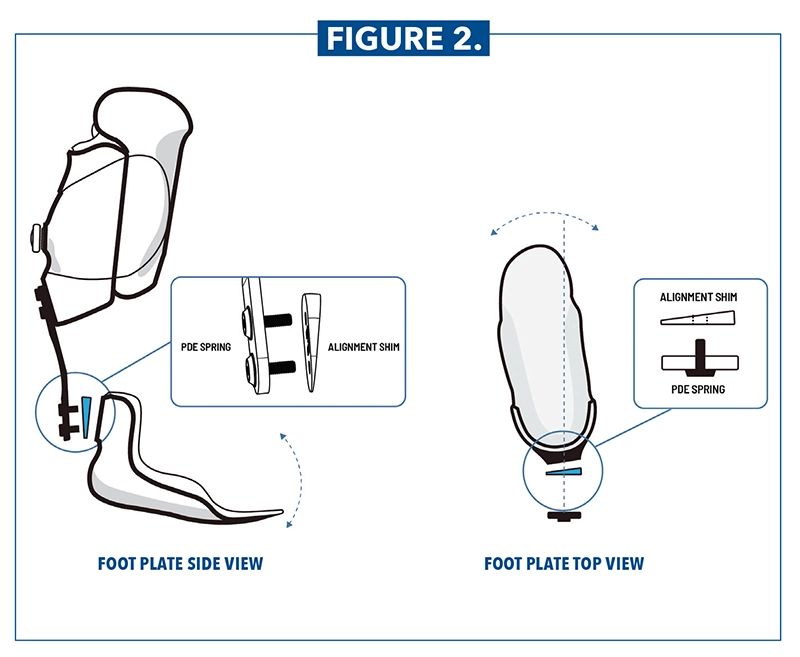
These changes can be made on the distal or proximal sections; however, I prefer to make the changes for ankle ROM on the distal segment primarily and again view ROM as my second choice versus adjusting flexural properties with the PDE springs. My rationale is that every degree added to plantarflexion or dorsiflexion comes with a cost within the standard orthosis variables that were established at casting and have been built into the orthosis. The cost is that sagittal plane alignment changes will also alter heel height and third rocker properties due to the rigid toeplate. All these factors must be considered as each variable can influence the overall function of the orthosis and may require additional wedging and shoe work.
Distal Segment
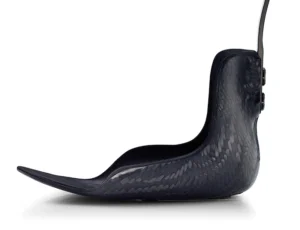
The third carbon element within the modular dynamic system is the footplate. There are many options and variables to consider based upon the patient’s presentation. Transverse plane control of the foot is crucial in these cases.5,12 A huge benefit of the PDE spring is its natural ability to control transverse axial rotation very well. Transverse plane control can also be further customized with the addition of flexible inner booties and dynamic control straps if needed. The orthotist can also utilize traditional varus/valgus control trimlines, extending proximally from the carbon footplate section and/or extending distally from the proximal cuff to enhance control of the foot and ankle.
 Third Rocker
Within the distal toeplate, due to the rigid nature of the carbon fiber, the third rocker must be built in. This is desirable versus building a rocker externally on the shoe due to factors including increased weight, cosmesis, increased fabrication time, and allowing the user increased shoe options. When using pre-preg carbon fiber, we can determine and alter the stiffness properties as desired. If flexibility is desired, a thinner layup can be used. Another option, if there is a need for increased medial lateral motion late in the stance phase, is to divide the footplate into two sections much like you would see with some prosthetic foot designs that utilize a medial and lateral column. Keep in mind that the movements of the distal segments of the foot may transfer proximally and add to continuing pain despite ROM limitations within the talocrural joint. The rigidity of the footplate within these systems can be crucial to positive outcomes, especially with combined trauma within the distal segments of the foot.
I hope this discussion provides information about the type of patient presentation that might benefit from an orthopedic PDE orthoses. As a prosthetist/orthotist, working with patients who have experienced pilon fractures and other serious orthopedic trauma cases has been incredibly challenging and rewarding, requiring a combination of all areas of knowledge within our unique field of expertise. Having the ability to change ROM and flexural properties quickly at fitting and follow-up appointments gives orthotists the ability of real-time adjustments that we have long utilized within prosthetics. I see this added ability to significantly modify orthosis properties after fabrication as a significant step forward within the practice of orthotics and has implications for future orthosis developments.
Bryan Roehr, CPO, is an assistant teaching professor in the University of Washington Master of Prosthetics and Orthotics program.
References
- Anderson, K. M., M. A. Corlett, S. M. Magdziarz, D. D. Anderson, and J. M. Wilken. 2024. Foot offloading associated with carbon fiber orthosis use: A pilot study. Gait Posture 111:191-5.
- Bedigrew, K. M., J. C. Patzkowski, and J. M. Wilken, et al. 2014. Can an integrated orthotic and rehabilitation program decrease pain and improve function after lower extremity trauma? Clinical Orthopaedics and Related Research 472(10):3017-25.
- Bonato, L., and E. Edwards. 2016. Patient reported health related quality of life early outcomes at 12 months after surgically managed tibial plafond fracture. Injury 48:946-53.
- Brice, K. 2025. Prescribed precision. The O&P EDGE 24(11):22-5.
- Fish, D. J., and J. P. Nielsen. 1993. Clinical assessment of human gait. Journal of Prosthetics and Orthotics 5(2):39–48.
- Flaherty, A. F., et al. 2026. Tibial plafond fractures and the impact of social media support groups on patient perceptions. Journal of Orthopedic Experience & Innovation 7(2).
- Gardner, S., M. Frecklington, and K. Rose, et.al 2024. Changes in functional outcomes in people with high energy ankle trauma after the use of the ReAKtiv posterior dynamic element orthosis and a rehabilitation program: A case series. Prosthetics and Orthotics International 48(4):368-71.
- Highsmith, M. J., L. M. Nelson, and N. T. Carbone, et al. 2016. Outcomes associated with the Intrepid Dynamic Exoskeletal Orthosis (IDEO): A systematic review of the literature. Military Medicine 181(S4):69-76.
- Ikeda, A. J., J. R. Fergason, and J. M. Wilken. 2019. Clinical outcomes with the Intrepid Dynamic Exoskeletal Orthosis: A retrospective analysis. Military Medicine 184(11-12):601-5.
- Lin, S. S. 2026. Development of contiguous-joint arthritis after pilon fracture: Commentary on an article by Raveena Joshi, BS, et al.: The prevalence of subtalar arthritis following pilon fractures. Journal of Bone and Joint Surgery 108(2):75-6.
- Lockwood, M. D., C. F. Hovorka, M. E. Baumann, and W. L. 2025. Childers. Clinical outcome of Two-Minute Walk Test after return to run program in IDEO users: A retrospective study. Frontiers in Rehabilitation Science 6:1602110.
- Loke, M. D. R. 2006. Triplanar control dynamic response orthoses based on new concepts in lower limb orthotics. Physical Medicine and Rehabilitation Clinics of North America. 17(1):181-202.
- Munoz, S. 2025. Relevance of gait related posture casting. The O&P EDGE 24(11):26-8.
- Owen, E. 2010. The importance of being earnest about shank and thigh kinematics especially when using ankle-foot orthoses. Prosthetics and Orthotics International. 34(3):254-69.
- Pollak, A. N. 2003. Outcomes after treatment of high energy tibial plafond fractures. The Journal of Bone and Joint Surgery 85(10):1893-900.
- Patzkowski, J. C., R. V. Blanck, J. G. Owens, J. M. Wilken, J. A. Blair, and J. R. Hsu. 2011. Can an ankle-foot orthosis change hearts and minds? Journal of Surgical Orthopaedic Advances. 20(1):8-18.
- Patzkowski, J. C., J. G. Owens, R. V. Blanck, K. L. Kirk, J. R. Hsu, and Skeletal Trauma Research Consortium (STReC). 2012. Deployment after limb salvage for high-energy lower-extremity trauma. Journal of Trauma and Acute Care Surgery 73(2 Suppl 1):S112-5.
- Pierrie, S. N., M. D. Lockwood, T. J. Cagle, J. R. Fergason, and W. L. Childers. 2026. Long-term outcomes after intrepid dynamic exoskeletal orthosis treatment coupled with advanced rehabilitation. OTA International 9(2):e477.
- Quacinella, M., E. Bernstein, B. Mazzone, M. Wyatt, and K. M. Kuhn. 2019. Do spatiotemporal gait parameters improve after pilon fracture in patients who use the Intrepid Dynamic Exoskeletal Orthosis? Clinical Orthopaedics and Related Research 477(4):838-47.
- Sharma, S., K. M. Anderson, and M. S. Pacha, et al. 2025. The effect of carbon fiber custom dynamic orthosis type on kinematics and kinetics of lower extremity joints in individuals with lower limb traumatic injuries. Gait and Posture 117:228-34.
- Sharma, S., K. M. Anderson, and M. S. Pacha, et al. 2024. The effect of carbon fiber custom dynamic orthosis use and design on center of pressure progression and perceived smoothness in individuals with lower limb trauma. Clinical Biomechanics (Bristol) 117:106284.
- Tyner, C. E., P. A. Kisala, and J. Slotkin, et al. 2025. Health-related quality of life after major extremity trauma: Qualitative research with military service members and clinicians to inform measurement of patient-reported outcomes. Quality of Life Research 34(12):3351-64.
- Web Links: ReAktiv Brace with PDE-Casting Training: https://www.youtube.com/watch?v=vgRobPthm9c
Photographs courtesy of Fabtech Systems.
Figure 1 only: Image courtesy of Bryan Roehr.