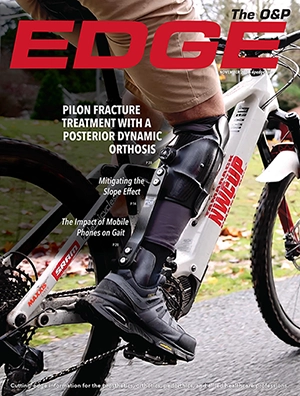

As some of you know from past columns, I’m a ballet dancer as well as an editor. And as a dancer, I spend a lot of time thinking about having a solid foundation of support in my feet and ankles. While that is essential for balancing on one leg in arabesque, it is equally important for walking to the kitchen for a glass of water. So in this issue, we focus on O&P foot and ankle interventions that address this critical area of support for ambulation.
“Pilon Fracture Treatment With a Posterior Dynamic Orthosis” describes an injury and type of orthosis clinicians may not have much familiarity with. Pilon fractures are complex fractures that involve the lower tibia and extend into the ankle joint, resulting in chronic pain and loss of function, and can be difficult to treat. The article describes the therapeutic approach a posterior dynamic orthosis offers in delivering successful outcomes in these cases and how the orthotic intervention can be used in other related traumatic injuries.
While the knee and leg components of lower-limb prostheses often draw attention, they don’t function without the crucial foot/ankle element. An ongoing challenge for this area, however, is that most prosthetic feet/ankles are optimized for level ground in a world that is full of hills and valleys, big and small. “Mitigating the Slope Effect” discusses the way hydraulic foot/ankle combinations have historically sought to address this issue and the current developments in the technology helping individuals to navigate their uneven environments.
As smart phones have become nearly ubiquitous, so too has the tendency for people to focus on using them while walking—often with less-than-optimal outcomes including tripping and collisions with objects. “The Impact of Mobile Phones on Gait” explores the influence of this dual-tasking on individuals’ posture and gait, and what that research can tell us about the demands of dual-tasking on users of O&P devices.
Happy reading.