
Hacquebord “works in some of orthopedic surgery’s most technologically ambitious territory,” Becker’s Spine Review said, and, in discussing the future of bionic reconstruction surgery and increasingly sophisticated prosthetic technology, he also addressed economic considerations affecting healthcare.
“I think the financial incentives, how systems are compensated, how physicians are compensated, are hugely important and will have a tremendous impact on how we practice medicine, more so than technology,” he told Becker’s.
As an example of how shared problem-solving can benefit patient care, related to his conversation in The O&P EDGE, Hacquebord described how challenging it is to restore hand function following severe brachial plexus injuries with surgery alone. Instead, he suggested combining advanced bionic surgical techniques with myoelectric prosthetic devices, reframing reconstruction rather than focusing solely on recreating what was lost.
“That might be the case for a lot of our clinical problems,” Hacquebord said. “Technology augments our natural anatomy rather than replacing it. It really is a coupling between the two.”
To read “Orthopedics’ bionic future has a human problem,” visit Becker’s Spine Review.
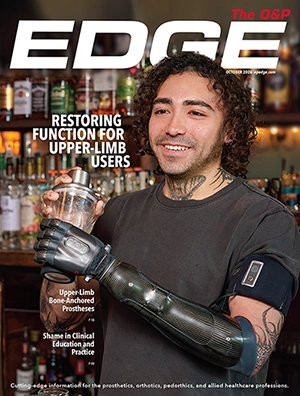
To read “Bridging the gap between hand surgery and partial hand prostheses,” visit The O&P EDGE.
Bridging the Gap Between Hand Surgery and Partial Hand Prostheses