

Part I of this series included a general overview of the hip-disarticulation patient population. Part II covered casting techniques that I have used and found helpful. This article looks at alignment and components commonly used for this unique population.
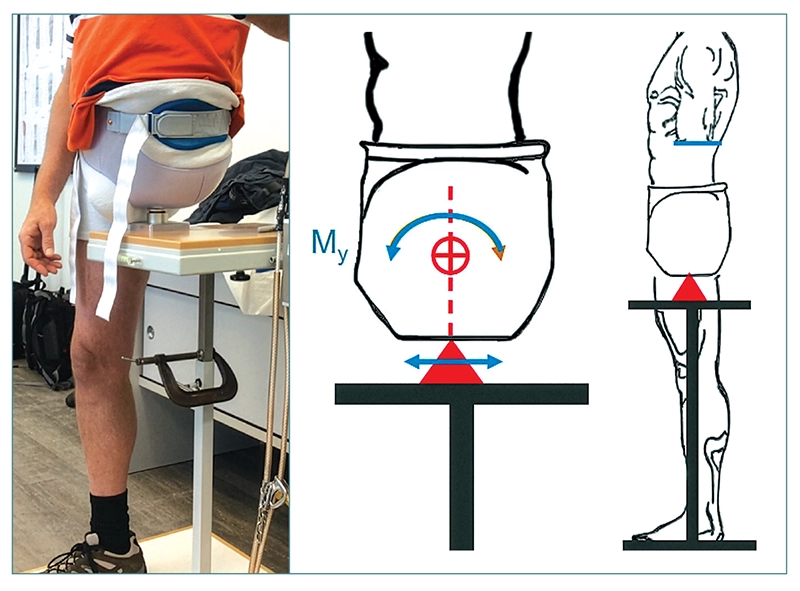
Figure 1 shows a patient in a check socket to identify the load balance point, utilizing the Ottobock Helix Reference Identification Tool. This will give an idea of where the patient feels the most balanced and stable before adding on components. Once this is identified, you should carefully mark an anterior and lateral vertical line. This will help with placement of the hip plate for mounting and adding the components.
Photographs courtesy of Ahmahn Peeples.
If you are doing this on an adjustable table, the measurement will also give you the opportunity to establish the overall height of the prosthesis. The alignment principles discussed are based on the Ottobock hip plate 7Z53, which is compatible with several Ottobock hip joints. Manufacturers’ hip prosthetic joint guidelines vary, so you will need to adapt these based on their specific products guidelines for stabilization.
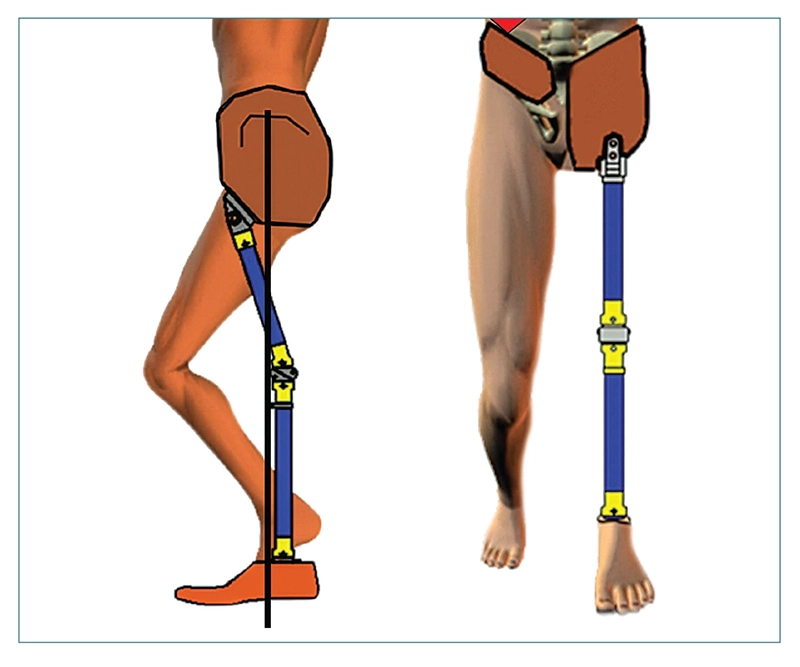
The joints are kept stable through the weight bearing line that passes behind the hip joint and in front of the knee joint during parts of the gait cycle. These characteristics keep the hip and the knee from collapsing while the user is bearing weight on the limb. When this concept was introduced, it was a unique, allowing individuals with amputations to be fitted without the locking joints that had been used previously and improving gait and ease of walking.
Component Selection
It is important to note that components distal to the socket, including the hip, knee, and foot-ankle system, are recommended based on the user’s K-level.
The simplest hip joint is a hinge that will allow flexion and limit extension. Lower K-level ambulators who need increased stability may benefit from a locking hip joint with a stride limiter or a hip flexion bias system. Strut hip systems are another option. The strut is a flat piece of carbon composite that joins the hip to the knee. During stance, the strut compresses to store energy, then releases at toe-off. Whatever hip joint is used, the anatomically correct placement of the joint is anterior to the lateral aspect of the ischial tuberosity.
This mimics the natural placement of the hip, positioning it in the space once occupied by the natural hip joint. This placement allows for a wider, more stable base of support, as well as mechanical knee center more level with the anatomical knee center when the patient is standing and sitting. Also, there is a more natural pelvic tilt and less chance of impingement of the lower borders of the rib cage on the socket brim.
Knee joints are also based on the individual’s activity level, and there are two categories: single axis and polycentric. With the exception of single-axis microprocessor knees (MPKs), most single-axis knees are best used for patients with lower activity levels, while polycentric knees are best suited for high activity levels or individuals who prefer increased stance-phase stability. Many polycentric knees improve swing-phase clearance as well. Research studies have concluded that fluid-controlled knees (hydraulic and pneumatic) help improve gait function for people with hip disarticulations. These types of knees resulted in a more normal range of motion and increased cadence.1
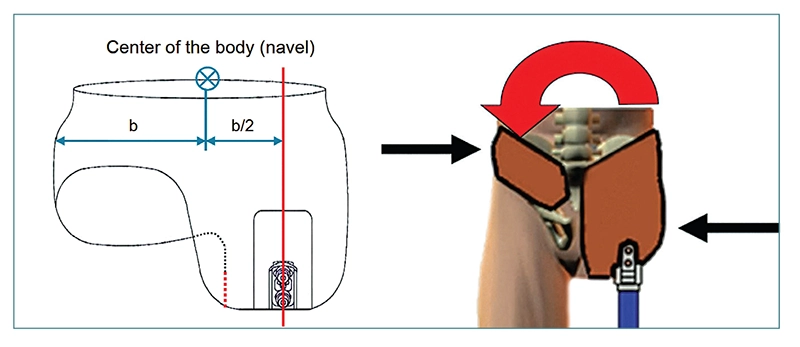
Above-knee rotators and shock absorbers are often useful for hip disarticulation patients. The positional rotator allows for the patient to get in and out of the car more easily, change shoes, or sit cross-leggged while positioning the prosthesis out of the way. Use of a shock absorber can help reduce ground reaction forces on the torso for patients, thus increasing comfort and device wear time.
Similar to the knee selection, the type of foot depends on the user’s activity level. The more responsive the foot dynamics, the more important the resistance of the knee tolerance for safe ambulation. Dynamic response feet provide push-off and a knee extension moment to drive the knee into flexion in the next phase of gait. The trade-off of minimizing component weight versus facilitating a more normal, efficient gait should always be considered. A few combinations I have found success with include the following: an Ottobock 7E7, 7E9, or 7E10 hip joint, Össur Power Knee or WillowWood Intuy Knee (which are both powered MPKs), and an Össur Proflex foot; a knee in the C-Leg family (including X3/X4 and Kenevo) with a Trias, Triton, or Taleo foot; a Blatchford Linx system; or an Orion with an Epirus or Esprit foot.
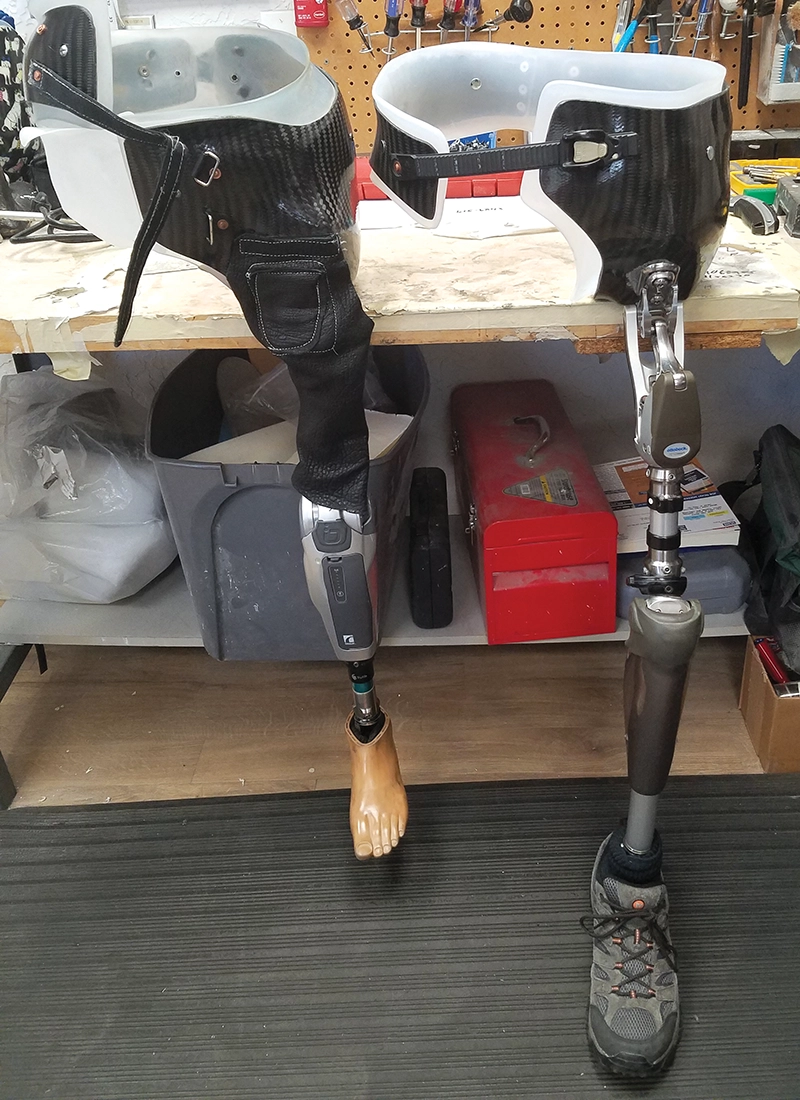
Every component that is added to the prosthesis increases the weight. Because a hip disarticulation prosthesis replaces such a large portion of the anatomy, the increased weight places a strain on the pelvic tissues and can be tiring for the user. Thus, it is important to select components whose benefits outweigh the increase in weight.
Hip disarticulation prostheses are often rejected due to ill fit, poor alignment, or the energy cost of daily use. So, as practitioners, we must think in long-term effects. Continuous communication between the patient, the rehabilitation therapist, and the practitioner is essential to a successful outcome. If the patient (or prosthetist) encounters frustration, it may be necessary to take breaks, which is okay. Again, we are thinking in the long term. This can be the difference between continuing to use the prosthesis, even intermittently, or giving up on it completely.
Prosthetists who work with this high-level amputation face a daunting but not impossible task. We must educate the patient about the unique design and fitting process required for successful outcomes. During the process, both patient and prosthetist must be patient with a slow, steady process. Good communication is key.
Because these high-level amputations are uncommon, most prosthetists have only limited experience fitting these patients, and I hope this discussion about alignment and component selection is useful to help others feel more confident in fitting this unique population.
Ahmahn Peeples, CPO/L, ACSM CPT-EIM, is a clinician with more than 20 years of experience in patient care and education, specializing in upper- and lower-limb prosthetics. He is a staff clinician and outcomes southwest regional champion with Hanger Clinic. He can be contacted at apeeples@hanger.com.
References and Suggested Reading
- Jenkins, R. 2023. “A polycentric hydraulic hip joint increases prosthetic gait biomechanics and functional capabilities for hip disarticulation amputees,” The American Academy of Orthotists and Prosthetists; oandp.org/cat-jenkins
- Carroll, K. 2001. Prosthetic and aging: Mobility for the long run. First Step: A Guide for Adapting to Limb Loss. Knoxville, TN: Amputee Coalition of America; 43-5.
- Endean, E. D., T. H. Schwarcz, D. E. Barker, N. A. Munfakh, R. Wilson-Neely, and G. L. Hyde. 1991.
- Hip disarticulation: Factors affecting outcomes. Journal of Vascular Surgery, 14(3): 398-404
- Boyd, H. B. 1947. Anatomic disarticulation of the hip. Surgery, Gynecology, Obstetrics, 84(3): 346-9.
- Huang, C. T. 1983. Energy cost of ambulation with Canadian hip disarticulation prosthesis. Journal of the Medical Association of the State of Alabama 52:47-8.
- Jensen, S., and T. Mandrup-Poulson. 1983. Success rate of prosthetic fitting after major amputations of the lower limb. Prosthetics and Orthotics International 7:119-22.
- Northwestern University suspension casting technique for hemipelvectomy and hip disarticulation. 1966. 10(1):56-61.
- Littig, D., and J. Lundt. 1988. The UCLA anatomical hip disarticulation prosthesis. Clinical Prosthetics and Orthotics 12(3): 114-8.
- Shurr, D. G., T. M. Cook, J. A. Buckwalter, and R.R. Cooper. 1983. Hip disarticulation: A prosthetic follow-up. Orthotics and Prosthetics 37(3):50-7.
- St.Louis-Sanchez, M. 2014. Improving fit+function for the hip disarticulation patient. The O&P EDGE 13(8):24-32.