
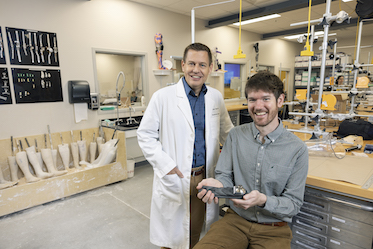
A Kennesaw State University (KSU) researcher is partnering with Little Room Innovations, an Atlanta-based company that creates O&P devices to refine and test a new type of prosthetic foot that enhances function for people with long residual limbs. Professor of exercise science Mark Geil, PhD, received a grant from the National Institutes of Health’s Small Business Innovation Research (SBIR) program to fund the work.
“The NIH realizes that a lot of small businesses don’t have the research infrastructure that universities do, and a lot of universities aren’t great at product development, marketing, and all the things that small businesses are good at,” said Geil, who is also associate dean for research in the Wellstar College of Health and Human Services. “I’m a researcher, and that’s what I know. The NIH project puts the two together.”
Students in the KSU Master of Science in Prosthetics and Orthotics (MSPO) program will work with Geil on the project.
“Because there are so few MSPO programs in the country, you are automatically noticed as a university that works in the prosthetics and orthotics and rehabilitation science space,” Geil said. “So that was a bit of a magnet for us, which is a really positive thing.”
Geil and Little Room are testing a prototype that improves upon the traditional rigid prosthetic foot by using a triangular keel inspired by the suspension used in pickup trucks. That keel will make the new foot more flexible and versatile for people with longer residual limbs. Geil said the university’s MSPO fabrication lab has a couple of different slopes and a set of stairs that are useful for testing the new prosthetic foot in everyday activities.
“The process of this NIH grant will be to take the prototype and put it on people who have a long residual limb and use the current low-profile foot that we think is too stiff,” Geil said. “Along with the stairs and slope, we’ll test the foot in the biomechanics lab to make sure people can move efficiently with the flexible foot.”
In addition to development of the device, the grant will pay people with limb loss to participate in studies, as well as pay for a high school student with an interest in biomedical engineering to participate on Geil’s team. Two MSPO students will use their required capstone projects to work with Geil on the effort.
Geil said KSU’s Innovation Launchpad helped get a patent for the prototype, too, which increases the speed at which Little Room can get the foot to market and patients who need it.
Editor’s note: This story was adapted from materials provided by Kennesaw State University.