
In recent years, O&P practitioners have learned more about how factors such as a history of stroke and anxiety or panic disorders carry meaningful impacts on mobility for lower-limb prosthesis users. However, the influence of a patient’s overall health extends far beyond basic mobility metrics. Conditions such as diabetes, peripheral vascular disease, cardiac and pulmonary diseases, obesity, and skin issues heavily affect device fitting, wear compliance, and the risk of reamputation. With this in mind, clinicians must remain attentive to how comorbidities shape O&P care while navigating the dynamics of an interdisciplinary healthcare team.
Brittany Stresing, CPO, FAAOP, owner, Limbionics, North Carolina, understands these challenges from both sides of the examination table. Diagnosed with scoliosis and spina bifida as a teenager, Stresing also underwent surgical correction for a leg length discrepancy. She experienced firsthand the impact of poor treatment. This personal history fueled her drive to enter the O&P profession and set the foundation for her commitment to ensuring patient needs are never dismissed, even when they conflict with a practitioner’s preferred timeline.
The Psychological Factor in Prosthetic Readiness
When managing prosthetic care for patients with complex medical histories, the physical fitting is often secondary to the individual’s emotional readiness. Insurance companies and employers frequently push for rapid progress, urging patients to move forward before they are mentally prepared.
“I would say the psychiatric side is a huge factor,” Stresing explains. For patients who have had recent amputation surgery, she sees that grasping the reality of their injury takes time. “It might take a few appointments to just get to know each other, and it’s important as the prosthetist not to be pushy or too excited.”
By taking a pause to listen to a patient’s goals, Stresing says, practitioners can build vital trust. Pushing too quickly often results in psychological setbacks. Stresing says that she prioritizes “meeting patients where they are psychologically.” Sometimes, this means stepping away from clinical tasks entirely. “We have appointments with patients where we talk about everything but their leg,” she says. “Talking about fun things with them is where they start feeling more comfortable.” 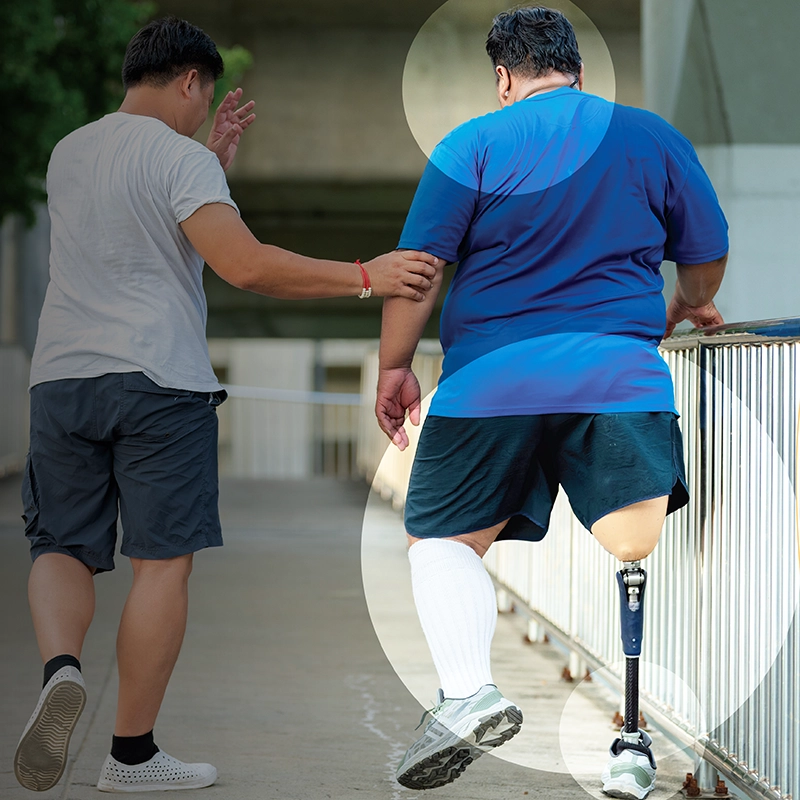
Stresing knows well the direct effect mental health can have on physical mobility. Anxiety and panic disorders can make users hesitant to trust their prostheses. “Oftentimes I see anxiety leading to a patient being more timid on the prosthesis—they fear it is going to hurt or not be stable,” she says. Addressing this requires preemptive communication. To help reduce anxiety, Stresing makes it a point to educate patients prior to putting them through the paces of trying on their prostheses.
Protecting the Sound Limb and Managing Skin Integrity
Physical comorbidities like diabetes, peripheral vascular disease, and obesity introduce significant hurdles for long-term wear compliance. Patients with complex vascular scenarios often face skin integrity issues. Stresing has often observed that patients who are successful with their prostheses tend to overdo their activity levels, ignoring the need for rest.
This is why she says it’s crucial for practitioners to educate patients on the dangers of continuous wear and the mechanics of skin breakdown. “We have to clearly tell them the importance of why we are doing this and explain that we really want to prevent further amputation,” she says.
This involves addressing not just pressure points, but also shear, which results from the friction created when skin moves against the underlying bone and tissue, typically against the socket or liner.
Care of the nonamputated limb is equally important. “We focus on the prosthesis and don’t focus enough on the sound limb. We need to be checking both for pressure purposes, and it can also help tell you a lot about alignment,” Stresing says. “The prosthesis gets all the attention.”
Educating patients about these risks requires a delicate balance of honesty and empathy. Practitioners must build strong rapport to communicate the severe risks of limb loss without causing undue alarm. “I approach educating them from the point of view that I want them to take their prosthesis off and check their skin because they have been through enough, and we don’t want to put them through another surgery,” Stresing adds.
Navigating Healthcare Team Dynamics
Managing patients with multiple comorbidities demands collaboration with endocrinologists, cardiologists, and physical therapists. However, establishing these lines of communication presents distinct challenges outside of a hospital setting.
In Stresing’s experience, physicians are often hesitant to weigh in on prosthetic matters. “Those docs don’t want to overstep their expertise, so they just expect us to do our job, and they put a lot of trust in us,” she says. This deference requires prosthetists to advocate for necessary design changes without stepping outside their own scope of practice. “You have to balance that line of stating a thought or a hypothesis and then communicate to them that you are ultimately relying on them as the expert.”
Technical prosthetic design must routinely adapt to medical interventions. “The medical conditions always take precedence, so we never want to make an assumption and do something that is counterproductive to what a doctor is trying to accomplish with wound vac or a port, for example.”
By maintaining close relationships with patients, Stresing says that practitioners can track bodily changes and make modifications to accommodate medical devices.
Leveraging Technology for Complex Cases
Stresing says practitioners are fortunate that advancements in prosthetic materials provide new ways to accommodate comorbidities. Adjustable sockets allow cognitively aware patients to manage daily volume changes. Additionally, newer hybrid gels and liners offer alternatives to rigid silicones or overly soft polyurethanes, improving comfort for compromised skin. 
Perhaps the most significant advancement for patient longevity is the expanded access to technology for lower-activity users. “I am a huge advocate for really trying to pay attention to that contralateral side,” Stresing says. “So now being able to get a microprocessor knee on a K2 is a huge advancement that reduces stress on the sound side of the body, and that is a huge one for me. And it increases their balance, which helps reduce stress.”
Ultimately, Stresing believes that managing comorbidities in lower-limb prosthetic care requires both technical skill and profound humanity. While the current healthcare environment limits the time practitioners can spend with each individual, she says fostering genuine connections remains essential. “The patients really do appreciate it—and often they make appointments for essentially social purposes,” she says. “It would be good if we could get some level of reimbursement for that time, because we want to spend it with them, we just can’t always do that.”
Even without financial incentives, taking the time to understand the whole patient shapes better, safer outcomes. “Of course, there is the element of knowing that even if you aren’t getting paid for it, you still want to do the right thing.”
Ryan Caldwell, CP/L, Hanger Integrated Care Center, Illinois, offers another layer of insight into the nuanced challenges of care for lower-limb prosthetic patients with comorbidities.
He says it is essential to understand and contextualize what level of mobility is most meaningful for each individual prosthesis user. “As their clinician, my role is to help establish realistic, patient-centered goals and support them in achieving those goals,” Caldwell says. “I have seen patients across the full spectrum of comorbidities succeed when provided with a thoughtful, customized care plan.”
Caldwell emphasizes clinical vigilance when managing conditions like diabetes and obesity. “When working with patients who have diabetes or vascular disease, several important factors must be carefully considered,” he adds. “Thoughtful attention to material selection and socket design is essential to minimize the risk of skin breakdown, particularly given the potential for delayed wound healing in this population.”
Patients with obesity, he notes, may require additional considerations to ensure safe and effective donning and doffing of their device to ensure secure and comfortable ambulation. “This can include managing soft tissue volume or addressing nonsymmetrical limb shapes,” Caldwell explains. “Ultimately, success and compliance in this population depend on understanding the level of engagement from both the patient and their care team, identifying potential barriers to care, and partnering with them to develop practical strategies to overcome those challenges.”
Integrated, team-based care forms the backbone of Caldwell’s approach. He knows well that working with patients who have additional health complexities requires a collaborative, team-based approach to achieve meaningful success. “In my experience, one of the most significant drivers of optimal outcomes is connecting patients with an established healthcare team, particularly physical and occupational therapists who have experience working with amputees,” he says. “As a clinician, I can design and deliver a prosthetic solution that matches a patient’s specific needs, however, without a coordinated team to support training, adaptation, and long-term follow-through, the likelihood of suboptimal outcomes increases. Success comes from combining thoughtful device design with comprehensive, interdisciplinary care.”
Like Stresing, Caldwell emphasizes patient education and follow-up as the keys to reducing skin issues and ulcerations that can lead to reamputation. “In our clinical practice, every patient that leaves the office will have a follow-up appointment whether or not we anticipate problems.”
This approach has helped Caldwell and his team ensure that issues are caught before they become more problematic. When necessary and appropriate, they can intervene and refer the patient out to a specialist.
Staying Attuned to Mental Health
Caldwell keeps the role of mental health top of mind as well. He understands how the profession’s approach has evolved. “While the components of mental health and strategies to combat common issues for this fragile patient population are being taught in many of our MPO programs, this was not the case more than 20 years ago when I was in school,” he recalls. “While I continue to learn more about all aspects of patient care in my clinical practice, incorporating peer-mentors, amputee support groups, and empathetic listening are imperative to patient success.”
Robert Gailey, PhD, PT, FAPTA, professor, vice chair of research at the University of Miami Miller School of Medicine, and director of the University of Miami Functional Outcomes Research Evaluation Center, also understands the importance mental healthcare plays in successful outcomes for patients with limb loss. He believes the most impactful tool care providers can offer is resources to help patients engage in advocating for their own care.
Connecting patients with support groups puts them in control and surrounds them with peers who can guide them through the process, too. “Engagement is key,” Gailey says. “Connecting with others who have navigated the healing and prosthetic can be a significant help, and it can reassure them that adherence to protocols will lead to better outcomes.”
In addition, Caldwell sees prosthetic technologies that are more intuitive for patients to use as critical for successful outcomes and reducing comorbidities commonly associated with limb loss that complicate the rehabilitation process. He says reducing cognitive load for the patient is critical. “The introduction of technology such as microprocessor knees can help alleviate some of the physical and mental demands placed on them,” he adds. “For patients with cardiac issues, selecting components that are both lightweight and functional may reduce overall physiological stress while allowing safe mobility.”
Controlling the Controllables
Caldwell urges clinical colleagues to maintain a proactive, patient-centered approach. “A guiding life principle I often return to is the idea of ‘controlling the controllables,’” he says. In practice, he says this means leveraging appropriate components, materials, and clinical processes to position patients for success. From a clinical standpoint, Caldwell says practitioners must acknowledge comorbidity challenges and find an appropriate pathway forward. “Given that patients may be committed to a particular technology for three or more years, it is especially important to think proactively and avoid unnecessarily limiting technology based solely on the presence of comorbidities,” he says. “Early intervention, paired with visible and measurable progress, is critical to building confidence and helping patients establish a positive and sustainable trajectory in their overall healthcare journey.”
Addressing Root Causes and Working With the Rehab Team
Gailey notes that for some patients the loss of limb and subsequent prosthesis is often secondary to the disease that caused the amputation.
“Generally, when you have someone who is a complex patient, whether it be diabetes or vascular disease, the loss of the limb is not really the major diagnosis. That was the life-saving procedure.”
While prosthetists focus on designing and fabricating the device, he says physical therapy is crucial to help address the full breadth of factors involved in rehabbing the entire patient. He cites clinical research that shows a 30 percent increase in mobility in patients who are seen by a physical therapist during their rehabilitation.
Gailey encourages physical therapists to prioritize patients’ recovery from comorbidities rather than solely focusing on education around the use of their prosthetic devices. As part of that, he points out that systemic and vascular health issues often compromise executive function, memory, mood, and motor function, which can further impede patients’ success with their prostheses.
Often when patients face an overwhelming list of instructions for a new prosthesis, they struggle to process the information. “Anxiety and depression after limb loss is a big factor, and then you add the stress-related fear of using the prosthesis,” he says. “Many individuals face such complex health and social issues that their prosthesis is eventually abandoned, not due to the device itself, but because of secondary external factors.”
All these factors make it crucial for interdisciplinary teams to work together for the best patient outcomes. Because prosthetists typically operate outside the hospital system, that can be more challenging. “They’re often working in community-based clinics without access to medical records from the general healthcare system or regular medical team meetings, which can isolate them from the broader interdisciplinary team,” Gailey says.
To bridge this gap, Gailey advocates for the concept of reverse referrals. By monitoring patients for signs like the start of an ulcer, increased balance difficulties, or shortness of breath and communicating these updates back to physicians, prosthetists integrate themselves into the patient’s wider care team. “Those that have embraced this reverse referral concept really do enjoy a better rehab team relationship,” he says. “While referrals are often viewed as a one-way street, proactive assessment allows prosthetists to identify medical red flags and refer patients back to the physician. This bidirectional approach supports clinic volumes and patient outcomes, transitioning the prosthetist from a vendor to an essential member of the care team.”
Bring Technology Into the Rehabilitation Process
Gailey is heavily focused on emerging technology to reduce the physical and financial burdens of rehabilitation and to increase patient compliance. He says that traveling to and from physical therapy can take hours, leading many patients, particularly elderly patients, to abandon their treatment.
Gailey believes that wearable technology offers a powerful solution and the future for patient rehabilitation, and ultimately, better patient outcomes. He highlights a recent study involving sensors worn at the knee and connected to patients’ music streaming devices. Gait was compared when walking in a clinic with a physical therapist and then on their own at home. When patients walked correctly at home, their music played clearly. If their gait faltered, the music distorted. “We found that most people want to hear their music, and audio feedback motivates them to walk better. With the right cues, they walk like they are with their physical therapist guiding them,” he adds. “We say that it’s like having a PT in your pocket.”
Patients can go on walks and get coaching while doing so. “On their own, they were unable to self-correct,” Gailey notes. “I often use the analogy of a golfer at the driving range—it is difficult to perceive your own technical errors without a coach or some sort of feedback to guide you.”
He looks forward to the time when these digital mechanisms and wearable techs will allow patients everywhere who lack easy access to clinics to receive high-quality care from home.
Ultimately, he stresses that managing limb loss goes far beyond the device itself. “It’s not just the prosthesis, it is basically total care,” he says. “It’s skin, general health, weight management, mental health, the ability to socialize, and your ability to learn how to live your best life in your new body.”
Prosthetists Value Holistic Care
Both Stresing and Caldwell share the sentiment that lower-limb prosthetic care is never just about the device. For them as prosthetists, it’s about treating a whole person, with a unique medical history, comorbidities, and emotional needs.
They also agree on the vital role of education, follow-up, and the importance of a healthcare team invested in the long-term well-being of each individual. Technology, communication, and empathy—not just surgical skill or prosthetic materials—are what matter most in achieving safe, satisfying outcomes for every patient.
Tara McMeekin is a writer and editor based in Colorado.
Opener image: BESTIMAGE/stock.adobe.com
Oxygen image: Rido/stock.adobe.com
Blindness image: rawpixel.com/stock.adobe.com