

As with most people who have experienced a traumatic amputation, Abram Hanover remembers the date, time, and location of his motorcycle accident that claimed the lower part of his left leg.
“Tuesday, July 11, 2023, was like any other day,” remembers Hanover, who was away from his Michigan home for work that week. “But little did I know that things were about to be rocked to the core.”
After work, he had gone on a motorcycle ride with a buddy. Hanover remembers he was about to pass a box truck at an intersection, but the truck had slowed down to turn left and failed to use its turn signal.
“I reacted as fast as I could after realizing this, and I dove to my right to avoid striking the truck,” says Hanover, who successfully missed colliding with the vehicle, but clipped the back bumper with his bike. In the process the shifter peg on his motorcycle tore through his left foot, mangling his foot and ankle.
He tumbled through the air and ended up on his back.
“I sat up and looked down to see the damage to my leg and realized my foot had been traumatically amputated. Not hanging there broken, or mangled, it was just gone.”
Hanover also suffered a broken tibia, fibula, and broke his femur in three spots. He also tore all the muscle and ligaments from the top of his knee.
Wide Awake
Hanover remembers not losing consciousness through the initial accident. “That seems to be the thing that surprises people the most, that I was awake through the whole thing,” he says. “I remember my friend applying multiple belts to my leg before emergency crews arrived.”
He remembers first responders arriving, assessing him, and calling flight for life and joking with paramedics and emergency room personnel. “I don’t think it really set in until I saw my then fiancée in the middle of the night,” he says.
“I woke up and looked down and once again saw how mangled my leg was, and then I saw my fiancée curled up in a hospital chair beside me. It was an emotional moment shared between us that I’ll never forget.”
An Unusual Rehabilitation
Hanover, who works in the machine tool and automation industry, described his recovery and rehabilitation process as a “bit out of the normal.” He describes himself as an extremely active individual, someone who loves the outdoors and anything that has wheels and an engine.
“I’ve always pushed the limits on everything I’ve done,” he says. The road to becoming someone with an amputation who uses a prosthesis was no exception.
“The challenges of this new experience would be looked at as just that—new challenges for me to conquer,” he says.
Hanover went through the normal preliminary rehabilitation in the hospital, but after issues with his insurance company denying an inpatient rehabilitation facility, “I was sent home to figure it out.”
After a follow-up with an orthopedic surgeon at the University of Michigan and research that Hanover and his wife had done on their own, he started physical therapy for his hip and knee injuries. It wasn’t long before he was back at the gym on crutches for lifting and strengthening. 
When Hanover received his first prosthetic device that December, his physical therapist recommended that he work with someone who already had an amputation, and had already gone through the initial process to help guide him.
Being stubborn and “feeling passed around,” Hanover says he continued his own physical therapy with additional help from Perry Prosthetics, Michigan, where he was receiving care.
“The most challenging thing through being a new amputee and the recovery process is the mental mindset,” he says. “In a traumatic amputation you are suddenly thrust into a world without any prior notice. There’s no slow progression or cognitive decision to become an amputee. You just are. I became a below-knee amputee in an instant.”
Chris Perry, CP/L, owner and founder, Perry Prosthetics, has firsthand knowledge of the journey Hanover has taken. At 16 years old, Perry was riding his motorcycle home from school in 1983 when a pickup turned in front of him and changed the course of his life. He stayed in the hospital for nearly three months while physicians tried without success to save his leg. After his amputation, Perry says he received less-than-desirable prosthetic care for several years until he found the prosthetist who not only helped him change his life, but inspired him to enter the O&P profession.
“I started working in the prosthetic field in 1991 for a prosthetist who helped me go from surviving and getting by in life as an amputee, to being able to thrive as an amputee,” says Perry, who opened his O&P practice in 2000.
Perry says of Hanover, “He is easy to work with. He is in tune with his fitting process and how his activities affect that fit and what he can do to manage the fit. This makes him a very valuable part of his own care team. He’s a smart guy and offers great feedback and input.”
The Best Fit
Hanover credits his care from Perry Prosthetics and his orthopedic surgeon who he says understood optimal limb length and what was going to be needed to achieve that.
The first prosthetic foot Hanover started with was an Össur Pro-Flex XC Torsion. “It was a great stiff foot that provided stability and the confidence that I needed in the beginning,” he says.
Since Hanover says he is “very hard on the torsion joint,” an Össur representative recommended a new foot in July 2024, the Össur Pro-Flex Terra, to try out before it was released.
Hanover loved the new device. “The dynamics of the Pro-Flex Terra foot are so night and day that I compare the XC to feeling like I was using a two-by-four for a foot,” he says. 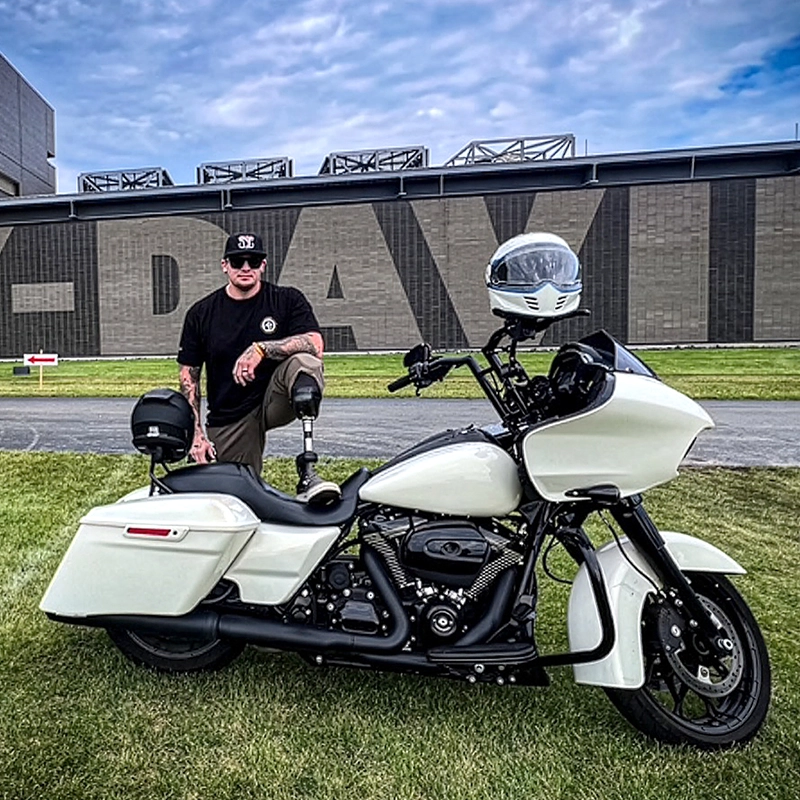
Perry says Hanover has always been fitted with a total surface bearing, lightweight, carbon socket with suction suspension achieved by a gel sleeve and an expulsion valve.
But when he trialed the Pro-Flex Terra he found it to be even more accommodating to his desired activities while remaining a comfortable and smooth foot for everyday walking, Perry says.
Hanover is also currently being fitted with a running prosthesis and has a BioDapt Versa 2 foot, which he uses for snowboarding.
That running prosthesis is coming in especially handy as Hanover continues to compete in the M22 Challenge, which features a 2.5-mile run (including a dune climb, which Hanover says is his toughest challenge), a 17-mile bike ride, and a 2.5-mile paddle. He has trained and competed in the event the last two summers and did better than he expected both years, but says there’s always room for improvement.
The Best Ways of Coping
Hanover, a project site coordinator, wasted little time in not only returning to work, but getting back to riding his motorcycle and being outdoors. Despite the challenges, he continues to persevere.
“I returned back to the industry as a senior field service engineer after my accident and was performing the same duties as before,” Hanover says. “It goes without saying there was no shortage of challenges in returning to a physically demanding profession. In addition to the work, it also requires traveling 40-plus weeks out of the year. Luckily for me, it is a career that I had been in for ten-plus years before my accident. I have continued to learn to adapt and adjust on the fly.”
Before the Grave Podcast
Hanover credits his family and friends for their unwavering support, especially his wife, Hayley. “She has been my rock from day one, who not only supported me, but challenged me when I wanted to quit,” he says. “Her patience, grace, and her stubbornness will never fall short of my appreciation.”
When Hanover was still recovering in the hospital, Hayley suggested writing as a way to clear his head and organize his thoughts, so Hanover started a podcast, Before the Grave, to share his stories.
“There’s plenty of darkness and tragedy in the world, but there can never be enough inspiration and positivity,” he says. “Before the Grave podcast was born through inspiration of those moments before we someday take our last breath. We will inevitably analyze everything we could’ve, should’ve, or did experience and pursue. It’s become a passion of mine to assist in telling those stories and hopefully inspiring them as well.”
Betta Ferrendelli can be contacted at betta@opedge.com.
Caption 1: Hanover describes himself as an active individual who loves the outdoors and anything that has wheels and an engine. Photograph courtesy of Perry Prosthetics.
Caption 2: Hanover wasted little time returning to his work and active lifestyle. Photograph courtesy of Perry Prosthetics.
Caption 3: Despite the accident, Hanover was excited to resume riding. Photograph courtesy of Abram Hanover.