

OANDP-L
  • Login
No Result
View All Result
The O&P EDGE
  • PECOS
  • Magazine
    • Subscription
    • Current Issue
    • Issue Archive
    • News Archive
    • Product & Service Directory
    • Advertising Information
    • EDGE Flipbooks
  • O&P Jobs
    • Find a Job
    • Post a Job
  • EDGE Advantage
    • EA Homepage
    • EA Data
  • O&P Facilities
  • Resources
    • Product & Service Directory
    • Calendar
    • Contact
    • About Us
    • O&P Library
    • The Guide
    • Custom Publications
    • Advertising Information
    • EDGE Direct
    • Amplitude Media Group
  • PECOS
  • Magazine
    • Subscription
    • Current Issue
    • Issue Archive
    • News Archive
    • Product & Service Directory
    • Advertising Information
    • EDGE Flipbooks
  • O&P Jobs
    • Find a Job
    • Post a Job
  • EDGE Advantage
    • EA Homepage
    • EA Data
  • O&P Facilities
  • Resources
    • Product & Service Directory
    • Calendar
    • Contact
    • About Us
    • O&P Library
    • The Guide
    • Custom Publications
    • Advertising Information
    • EDGE Direct
    • Amplitude Media Group
No Result
View All Result
The O&P EDGE Magazine
No Result
View All Result
Home News

Researchers Strive to Limit Errors in Powered Prostheses

by The O&P EDGE
December 1, 2014
in News
0
SHARES
8
VIEWS
Share on FacebookShare on Twitter

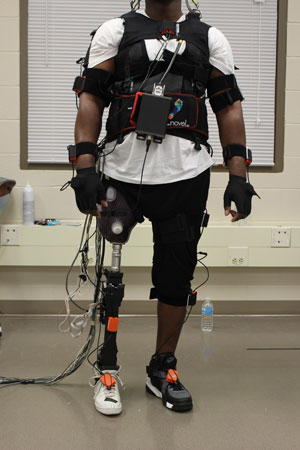
Photograph courtesy of NC State University.

Powered lower-limb prosthetic devices hold promise for improving the mobility of amputees, but errors in the technology may also cause some users to stumble or fall. New research examines exactly what happens when these technologies fail with the goal of developing a new generation of more robust powered prostheses.

“My work has focused on developing technology that translates electrical signals in human muscle into signals that control powered prosthetic limbs-such as decoding muscle signals to tell a prosthetic leg that it needs to walk forward or step up onto a staircase,” said Helen Huang, PhD, senior author of a paper about this research and an associate professor in the joint biomedical engineering program at North Carolina State University (NC State) and the University of North Carolina at Chapel Hill (UNC-CH).

“But sometimes this ‘decoding’ technology makes mistakes, such as thinking someone wants to climb a step when he doesn’t,” said Fan Zhang, lead author of the paper and a PhD student in the joint biomedical engineering program. “This is a problem, because we don’t want to put users at risk of stumbling or falling.”

Huang’s team set out to understand exactly what happens to users of powered prosthetic legs when there’s an error in the decoding technology.

“We not only want to improve the decoding accuracy, but determine which errors are important and which have little or no impact on users,” Huang said. “Understanding the problem is an important step in finding ways to make these prostheses more reliable.”

To address the issue, study subjects used a customized prosthetic device that was programmed to make errors in a lab setting that allowed Huang’s team to monitor each user’s balance and biomechanics. Users were also asked how stable they felt during each trial.

The researchers found that some errors were so insignificant that users didn’t even notice them-particularly errors that were short in duration or that occurred when a user’s weight was not being applied to the prosthetic leg.

But errors that lasted longer, or that occurred when a user’s weight was on the prosthetic limb, were more noticeable. The researchers also determined that critical, or especially noticeable, errors were also characterized by a large “mechanical work change,” meaning the prosthetic limb thought it had to do significantly more or less work than the user intended.

“One of the things we’ll be doing as we move forward with this work is seeking ways to limit that mechanical work change,” Huang said. “Any system that involves a human interface will have occasional errors. But we think we can find ways to make those errors effectively insignificant.”

This article was adapted from information provided by NC State.

Related posts:

  1. The Dawn of Powered Lower-limb Prostheses
  2. Powered Prosthetic Feet: The Second Chapter
  3. O&P Research Supports Evidence-based Care
  4. The Present and Future of Powered Knees
Previous Post

National Disability Institute Encourages Passage of ABLE Act

Next Post

PFA Announces New Leadership

Next Post

PFA Announces New Leadership

 SUBSCRIBE FOR FREE


O&P JOBS

Central

Certified Prosthetist/Orthotist (CPO), Certified Prosthetist (CP), Certified Orthotist (CO), Certified Prosthetist/Orthotist Assistant (CPOA), or Certified Orthotist Assistant (COA)

Central

CPO/LPO/CO/LO

Eastern

Certified Prosthetist Orthotist (CPO) – Senior Clinical & Leadership Track

Linkedin X-twitter Facebook

Get unlimited access!

Join EDGE ADVANTAGE and unlock The O&P EDGE's vast library of archived content.
SUBSCRIBE TODAY
The O&P EDGE Magazine
 
Required 'Candidate' login to applying this job. Click here to logout And try again
 

Login to your account

  • Forgot Password?

Reset Password

  • Already have an account? Login

Enter the username or e-mail you used in your profile. A password reset link will be sent to you by email.

Close
No Result
View All Result
  • PECOS
  • MAGAZINE
    • SUBSCRIBE
    • CURRENT ISSUE
    • ISSUE ARCHIVE
    • NEWS ARCHIVE
    • PRODUCTS & SERVICES DIRECTORY
    • ADVERTISING INFORMATION
  • O&P JOBS
    • FIND A JOB
    • POST A JOB
  • EDGE ADVANTAGE
    • EA Homepage
    • EA Data
  • FACILITIES
  • RESOURCES
    • PRODUCTS & SERVICES DIRECTORY
    • CALENDAR
    • CONTACT
    • ABOUT US
    • O&P LIBRARY
    • THE GUIDE
    • CUSTOM PUBLICATIONS
    • ADVERTISING INFORMATION
    • EDGE DIRECT
    • AMPLITUDE
  • OANDP-L
  • LOGIN

© 2026 The O&P EDGE

VOTE NOW!
Not enough quota to unlock this post
Unlock left : 0
Are you sure want to cancel subscription?
 

Account Activation

Before you can login, you must activate your account with the code sent to your email address. If you did not receive this email, please check your junk/spam folder. Click here to resend the activation email. If you entered an incorrect email address, you will need to re-register with the correct email address.


© 2026 The O&P EDGE

  • About
  • Advertise
  • Contact
  • EDGE Advantage
  • OANDP-L
  • Subscribe

CONTACT US

866-613-0257

info@opedge.com

201 E. 4th St.
Loveland, CO 80537

EDGE DIRECT

The most important industry news and events delivered directly to your inbox every week.

  • About
  • Advertise
  • Contact
  • EDGE Advantage
  • OANDP-L
  • Subscribe

© 2026 The O&P EDGE

Welcome Back!

Login to your account below

Forgotten Password?

Retrieve your password

Please enter your username or email address to reset your password.

Log In
The O&P EDGE Magazine
 
Required 'Candidate' login to applying this job. Click here to logout And try again
 

Login to your account

  • Forgot Password?

Reset Password

  • Already have an account? Login

Enter the username or e-mail you used in your profile. A password reset link will be sent to you by email.

Close
No Result
View All Result
  • PECOS
  • MAGAZINE
    • SUBSCRIBE
    • CURRENT ISSUE
    • ISSUE ARCHIVE
    • NEWS ARCHIVE
    • PRODUCTS & SERVICES DIRECTORY
    • ADVERTISING INFORMATION
  • O&P JOBS
    • FIND A JOB
    • POST A JOB
  • EDGE ADVANTAGE
    • EA Homepage
    • EA Data
  • FACILITIES
  • RESOURCES
    • PRODUCTS & SERVICES DIRECTORY
    • CALENDAR
    • CONTACT
    • ABOUT US
    • O&P LIBRARY
    • THE GUIDE
    • CUSTOM PUBLICATIONS
    • ADVERTISING INFORMATION
    • EDGE DIRECT
    • AMPLITUDE
  • OANDP-L
  • LOGIN

© 2026 The O&P EDGE

Not enough quota to unlock this post
Unlock left : 0
Are you sure want to cancel subscription?
 

Account Activation

Before you can login, you must activate your account with the code sent to your email address. If you did not receive this email, please check your junk/spam folder. Click here to resend the activation email. If you entered an incorrect email address, you will need to re-register with the correct email address.