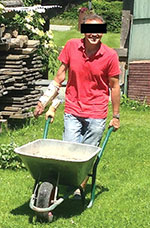
The patient in Case 2 is shown using a hybrid hand setup as a home training tool. Photograph courtesy of the study authors and the Journal of Neurosurgery.
A range of surgical procedures are available to restore nerve and muscle function following injuries to the plexus brachialis associated with nerve root avulsion. The surgeries can often restore stability and mobility to the shoulder and upper arm and, in a few cases, mobility of the hand and fingers. A research group led by Oskar Aszmann, A.o.Univ.Prof.Dr.med.univ., of the Department of Surgery at Medical University of Vienna (MedUni Vienna) and Vienna General Hospital has developed a treatment protocol that can be used to establish which patients with plexus brachialis syndrome will most probably benefit from undergoing amputation of their nonfunctional hand and being fitted with a myoelectric prosthesis. The study was published January 17 in the Journal of Neurosurgery.
The authors have called upon their experience with patients who presented at the Division of Plastic and Reconstructive Surgery at MedUni Vienna/Vienna General Hospital with global plexus brachialis injuries between 2011 and 2015. In 16 of those cases, the nerve damage was so severe that no surgical intervention could restore adequate functionality of the hand. Those patients were offered the alternative of undergoing amputation and being fitted with a myoelectric prosthesis. The seven-step protocol that was used to make the determination for amputation follows:
- Physical and psychological assessment: The patient must still be able to use the shoulder and elbow but no longer have any motor or sensory capability in the hand. The patient must be sufficiently psychologically robust to cope with the associated emotional challenges.
- Recording of the electromyographic (EMG) signals of the muscles in the lower arm: Two separate signals are required to control a myoelectric hand. If there are fewer than two signals present, surgical procedures can be used.
- Optionally: Operation to perform a selective nerve transfer and/or transplant of the healthy muscle to improve nerve conduction and muscle activation in the lower arm, where there are not at least two EMG signals.
- Brain training: This biofeedback training makes it possible to respond to reinnervated muscles to control the movement of the hand and lower arm.
- Trying a hybrid hand: The patient learns to control the prosthesis with EMG signals before undergoing amputation.
- Amputation of the nonfunctioning biological hand.
- Replacement of the biological hand by a myoelectric prosthesis, followed by additional training and checking of the prosthetic hand function.
Results are available for five patients who underwent amputation at least three months after their last prosthetic adjustment; the remaining 11 patients were in the early stages of the protocol. Their functional results were recorded using the Action Research Arm Test (ARAT), the Southampton Hand Assessment Procedure (SHAP), and the Disabilities of the Arm, Shoulder, and Hand (DASH) questionnaire. All five patients displayed a significant improvement in hand function, which was maintained over the follow-up period.
“Once the patients had got used to working with the bionic hand, the deafferentation pain (chronic pain felt by people with severed nerves), which was severe in three of the five patients, diminished,” said Aszmann. According to the authors, “The patients reported a subjective correlation between the length of time they wore the prosthesis each day and the reduction in pain. If they were unable to wear the prosthesis because it was undergoing regular maintenance, the pain increased again within a few days.”
Editor’s note: This story was adapted from materials provided by MedUni Vienna.