
A doctoral student at Northern Arizona University (NAU) received an award from the National Institutes of Health (NIH) for his work on a flexible AFO for children with cerebral palsy. Sam Hopkins won the NIH F31 fellowship, which is given to doctoral students doing research training in health-related areas.
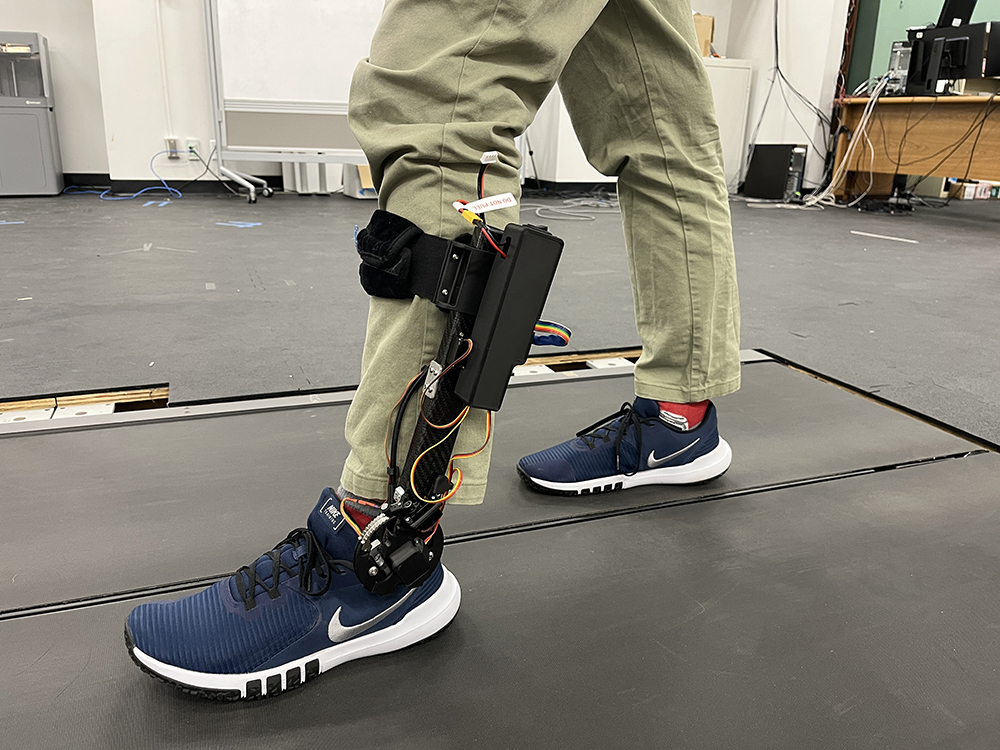
Hopkins said the device will offer greater flexibility for high range-of-motion activities like climbing stairs, getting in and out of a car, and sitting down or standing up than other AFOs, allowing the user to move more freely during typical activities and walk with greater stability and confidence.
The AFO will be made of carbon fiber tubing and 3D-printed parts using carbon-reinforced nylon plastic, which can be as strong as aluminum. He’s also making it flexible enough that it doesn’t need to be fitted to each individual user. Because of the materials and processes they’re using and no need for customization, Hopkins estimates the commercial cost of each device will be about $2,000 per leg.
“Right now, you have the fully passive, spring-like devices—they do one thing, and they do it really well—but they can’t adapt, versus the fully powered motorized exoskeletons that can do a lot of different things, but they’re heavy and bulky,” Hopkins said. “Our device is that bridge. It’s more lightweight than other devices, using smart and adjustable springs instead of a bulky motor; it’s kind of passive but it still has that adaptability we want.”
“I’m so thrilled that Sam has received this prestigious fellowship because he is one of the most talented, hardworking, deserving PhD students I’ve ever had,” said Zach Lerner, PhD, a mechanical engineering professor and head of the Biomechatronics Lab where Hopkins works as a research assistant. “This award will provide exceptional doctoral training while advancing a transformative robotic ankle-foot orthosis design that may significantly improve mobility for individuals with cerebral palsy. By pioneering this adaptive robotic bracing technology that responds to changing terrain, Sam’s work has the potential to redefine assistive care and facilitate independence.”
Editor’s note: This story was adapted from materials provided by NAU.