
Researchers at the Massachusetts Institute of Technology (MIT) have shown that they can accurately track muscle movement using small magnetic beads implanted in residual muscles, which could make it easier for people with certain types of amputations to control their prosthetic limbs.
The researchers demonstrated the accuracy of the magnetic measurements in three participants with transtibial amputations who each had amputation surgery to create an agonist-antagonist myoneural interface (AMI). In AMI surgery, muscle pairs are reconnected so that they still dynamically communicate with each other within the residual limb. The participants had magnets implanted in up to four muscles of the ankle joint.
“This interface is minimally invasive, so it could be accessible to more people. You place two beads in the muscle, and you have access to all of this rich information about the muscle dynamics,” said Christopher Shallal, an MIT graduate student in the Harvard-MIT Program in Health Sciences and Technology, and one of the lead authors of a paper about the work.
With this approach, known as magnetomicrometry, external sensors placed on the skin can measure the change in distance between the magnets, allowing muscle length and velocity to be calculated.
“For four decades, the standard methodology for neurally controlling prostheses has been to use skin electrodes to measure muscle activation,” said Hugh Herr, PhD, a professor of media arts and sciences, co-director of the K. Lisa Yang Center for Bionics at MIT, an associate member of MIT’s McGovern Institute for Brain Research, and the senior author of the new study. “However, to control a prosthetic limb, joint position, torque, or impedance has to be controlled, and one cannot directly determine such mechanical signals using electrical activation alone.”
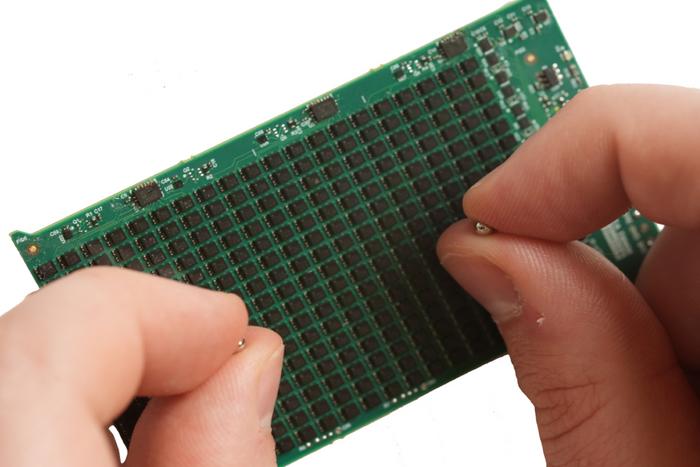
The magnetic signals can be read from a depth of up to 6 centimeters from the skin’s surface, using a customized external sensor that is worn over the skin, positioned over the muscles that are being tracked.
“Magnets can be tracked wirelessly through the body, so you can get very specific muscle signals and measure the mechanical output of the muscle without needing to be extremely invasive,” Shallal said.
The beads are 3 millimeters in diameter, about the size of a sesame seed. The magnets are made from an alloy of neodymium, iron, and boron, and are coated with gold and a polymer called parylene Cto make them biocompatible.
Each of the participants also had electrodes implanted into the same muscles that received magnetic beads. This allowed the researchers to compare the accuracy of three different types of measurements: magnetomicrometry, electromyography with implanted electrodes, and electromyography with electrodes on the surface of the skin.
During the experiments, the participants were not wearing a prosthetic limb but were asked to perform tasks such as moving a cursor on a screen to a particular target using their muscle movements. Using each of the three measurement techniques, the signals generated by the muscle movements were translated into control signals that moved the cursor; in the future the signals could be fed into the controller of a robotic ankle-foot prosthesis.
“The cursor on the screen represented the degrees of freedom that they would control on a robotic ankle-foot prosthesis. This virtual neuroprosthetic task allowed us to compare the performance across different neural interfaces, and our results suggest that the magnet-based approach can offer more accurate and stable control,” Shallal says.
The researchers are now performing a larger study to evaluate how well people can control prosthetic limbs using measurements from the magnetic beads.
Editor’s note: This story was adapted from materials provided by MIT.
The study, “A wireless magnetic implant system for continuous neuromuscular sensing,” was published in Nature Sensors.