
CJ Rudolph, a third-year doctoral student at the University of Tennessee (UT), won $5,000 in seed funding at UT Health Sciences’ entrepreneurship workshop for a device designed to make scoliosis braces more comfortable and effective. His pitch focused on two challenges in pediatric scoliosis treatment: the rigid plastic orthosis and Velcro-style hook-and-loop fasteners that loosen over time, reducing corrective force while making the braces uncomfortable and restrictive.
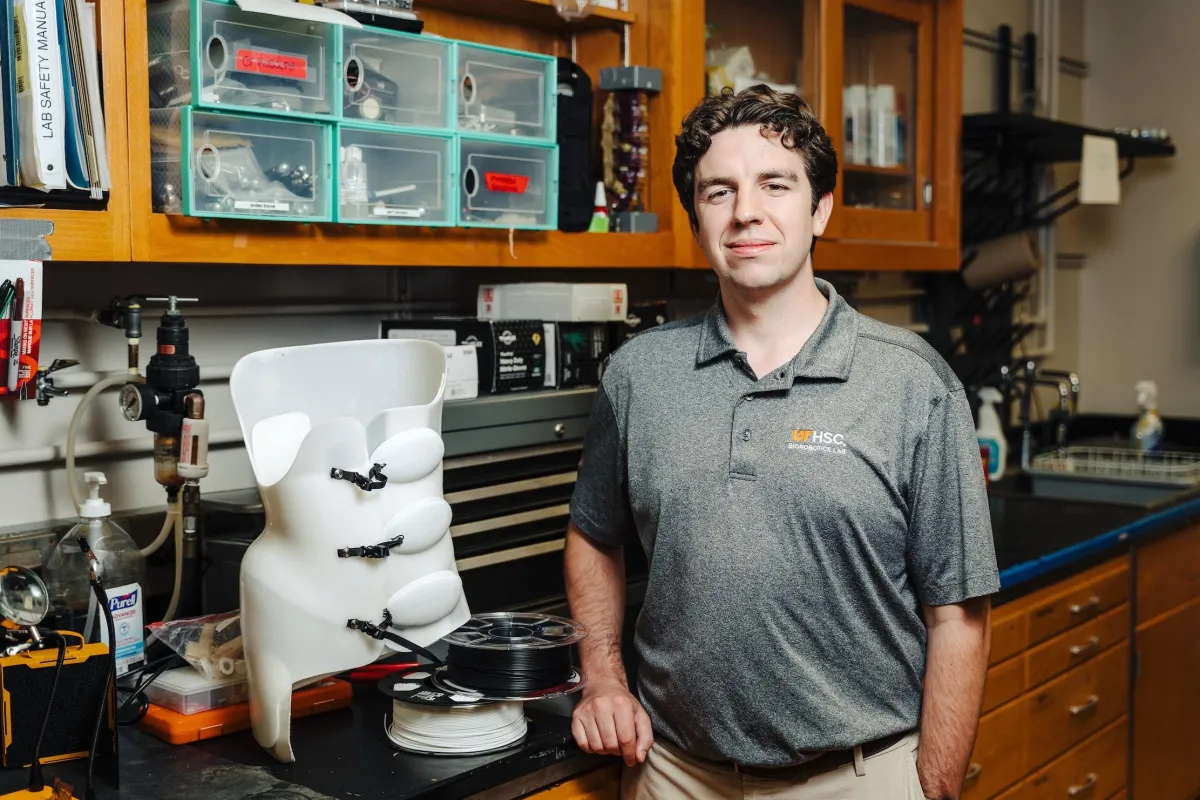
Working alongside students Matthew Grosman and P.J. Johnson in the lab of Denis DiAngelo, PhD, distinguished professor and program director in the Department of Orthopedic Surgery and Biomedical Engineering, Rudolph helped develop the Constant Tension Unit to replace static hook-and-loop tension with laminated stainless-steel springs housed in a custom 3D-printed enclosure. The device maintains consistent corrective pressure while allowing patients to move and breathe more comfortably.
“The first thing they say is, ‘Oh wow, I feel like I can breathe,’” Rudolph said.
Early testing has shown the device maintains corrective tension more consistently than conventional straps while improving patient comfort. Because it functions as an accessory rather than a new device, the technology could face a more streamlined regulatory pathway. The team has already begun working with pediatric orthopedic surgeons at Campbell Clinic and Le Bonheur Children’s Hospital to evaluate the device.
UT Health Sciences’ inaugural “From Discovery to Impact: Entrepreneurship & Industry Partnerships in Health Sciences” workshop gave researchers a low-pressure environment to take the first step toward turning their science into real-world impact. The workshop concluded with a pitch competition, where graduate students and postdoctoral fellows presented their research as potential commercial ventures.
“That’s one of the biggest problems with grad school,” Rudolph said. “Professors and students will work on things for their whole career and never take it out of the lab. That’s what the whole goal should be, to take this to people that are actually going to use it.”
Editor’s note: This story was adapted from materials provided by the University of Tennessee.