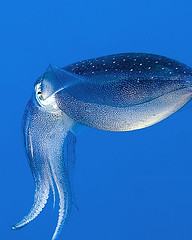
<img class="" style="float: right;" src="https://opedge.com/Content/OldArticles/images/2008-04_19/Squid.jpg" width="214" height="268" hspace="4" vspace="4" /> The razor-sharp beaks that giant squids use to attack whales--and maybe even Captain Nemo's submarine--might one day lead to improved artificial limbs for people, according to an article by the Associated Press (AP). That deadly beak may be a surprise to many people, and has long posed a puzzle for scientists. They wonder how a creature without any bones can operate it without hurting itself. Now, researchers at the University of California, Santa Barbara (UCSB), report in the journal <i>Science</i> that they have an explanation. The beak, made of hard chitin and other materials, changes density gradually from the hard tip to a softer, more flexible base where it attaches to the muscle around the squid's mouth, the researchers found. That means the tough beak can chomp away at fish for dinner, but the hard material doesn't press or rub directly against the squid's softer tissues. Herbert Waite, a professor in the university's Department of Molecular, Cellular & Developmental Biology and co-author of the paper ("Jumbo Squid Beaks: Inspiration for design of robust organic composites," A. Miserez, Y. Li, J.H. Waite, and F. Zok, 2007, <i>Acta Biomaterialia</i> 3: 139-149), described the squid beak as like placing an X-Acto blade in a block of fairly firm Jell-O and then trying to use it to chop celery. The base of the blade would damage the gelatin, but because of the change in density the base of the beak doesn't damage the squid, he pointed out. The squid solves the problem by changing the beak composition progressively, rather than abruptly, so that its tip can pierce prey without harming the squid in the process. The researchers calculated the changes by carefully measuring the ratios of chitin--the material in insect shells--water and proteins in the beaks of Humboldt squid, showing gradual changes from tip to base. Waite said it was the first time this had been measured. He said he was surprised that the main difference in density resulted from the amount of water included in each part of the beak. Waite noted that such graduated materials could have broad applications in biomedical materials. "Lots of useful information could come out of this for implant materials, for example," Waite told the AP. "Interfaces between soft and hard materials occur everywhere." Frank Zok, professor and associate chair of the UCSB's Department of Materials, said he had always been skeptical of whether there is any real advantage to materials that change their properties gradually from one part to another, "but the squid beak turned me into a believer. "If we could reproduce the property gradients that we find in squid beak, it would open new possibilities for joining materials," Zok said in a statement. "For example, if you graded an adhesive to make its properties match one material on one side and the other material on the other side, you could potentially form a much more robust bond." The researchers are learning lessons that can be applied to medical materials in the future, said Phillip B. Messersmith of the Department of Biomedical Engineering at Northwestern University, Evanston, Illinois. Messersmith, who was not part of the research team, noted that hard medical implants made of metal or ceramic are often imbedded in soft tissues. "The lessons here from nature might be useful in transitions between devices and the tissues they are imbedded in," he told the AP. Ali Miserez, a UCSB researcher and co-author of the paper, suggested the research could point the way to new types of medical materials. "We could maybe imagine creating a full prosthesis that mimics the chemistry of the beak, so that it matches the elasticity of cartilage on one side and, on the other side, you could create a material which is very stiff and abrasion resistant," he said in an interview provided by <i>Science</i>. The research was funded by the National Institutes of Health, National Science Foundation, NASA and the Swiss National Science Foundation.
<img class="" style="float: right;" src="https://opedge.com/Content/OldArticles/images/2008-04_19/Squid.jpg" width="214" height="268" hspace="4" vspace="4" /> The razor-sharp beaks that giant squids use to attack whales--and maybe even Captain Nemo's submarine--might one day lead to improved artificial limbs for people, according to an article by the Associated Press (AP). That deadly beak may be a surprise to many people, and has long posed a puzzle for scientists. They wonder how a creature without any bones can operate it without hurting itself. Now, researchers at the University of California, Santa Barbara (UCSB), report in the journal <i>Science</i> that they have an explanation. The beak, made of hard chitin and other materials, changes density gradually from the hard tip to a softer, more flexible base where it attaches to the muscle around the squid's mouth, the researchers found. That means the tough beak can chomp away at fish for dinner, but the hard material doesn't press or rub directly against the squid's softer tissues. Herbert Waite, a professor in the university's Department of Molecular, Cellular & Developmental Biology and co-author of the paper ("Jumbo Squid Beaks: Inspiration for design of robust organic composites," A. Miserez, Y. Li, J.H. Waite, and F. Zok, 2007, <i>Acta Biomaterialia</i> 3: 139-149), described the squid beak as like placing an X-Acto blade in a block of fairly firm Jell-O and then trying to use it to chop celery. The base of the blade would damage the gelatin, but because of the change in density the base of the beak doesn't damage the squid, he pointed out. The squid solves the problem by changing the beak composition progressively, rather than abruptly, so that its tip can pierce prey without harming the squid in the process. The researchers calculated the changes by carefully measuring the ratios of chitin--the material in insect shells--water and proteins in the beaks of Humboldt squid, showing gradual changes from tip to base. Waite said it was the first time this had been measured. He said he was surprised that the main difference in density resulted from the amount of water included in each part of the beak. Waite noted that such graduated materials could have broad applications in biomedical materials. "Lots of useful information could come out of this for implant materials, for example," Waite told the AP. "Interfaces between soft and hard materials occur everywhere." Frank Zok, professor and associate chair of the UCSB's Department of Materials, said he had always been skeptical of whether there is any real advantage to materials that change their properties gradually from one part to another, "but the squid beak turned me into a believer. "If we could reproduce the property gradients that we find in squid beak, it would open new possibilities for joining materials," Zok said in a statement. "For example, if you graded an adhesive to make its properties match one material on one side and the other material on the other side, you could potentially form a much more robust bond." The researchers are learning lessons that can be applied to medical materials in the future, said Phillip B. Messersmith of the Department of Biomedical Engineering at Northwestern University, Evanston, Illinois. Messersmith, who was not part of the research team, noted that hard medical implants made of metal or ceramic are often imbedded in soft tissues. "The lessons here from nature might be useful in transitions between devices and the tissues they are imbedded in," he told the AP. Ali Miserez, a UCSB researcher and co-author of the paper, suggested the research could point the way to new types of medical materials. "We could maybe imagine creating a full prosthesis that mimics the chemistry of the beak, so that it matches the elasticity of cartilage on one side and, on the other side, you could create a material which is very stiff and abrasion resistant," he said in an interview provided by <i>Science</i>. The research was funded by the National Institutes of Health, National Science Foundation, NASA and the Swiss National Science Foundation.