
Two things will come as no surprise to anyone who has spent time conversing with me. First, I talk a lot. Second, I am an interrupter. However, it may surprise those same people that in conversations with most members of my family of origin, I spend less time talking than they do. Lest anyone should doubt the veracity of my claims, I offer as evidence that during phone calls I occasionally surreptitiously time how long a sibling speaks without interruption. It is not uncommon for them to speak for 20 or 30 minutes without pause. The all-time record of 45 minutes was established in the early 1990s.
I’ve often described family interactions as bumper car conversations, during which the floor is only surrendered when an interlocutor encounters one that is more forceful. Perhaps this pattern is a natural consequence of growing up in a household filled with ten siblings, strong personalities, and many firmly held convictions. These characteristics frequently resulted in verbal volatility, and in most conversations, interruption was the only way for one’s voice to be heard.
Despite differences related to personality and family patterns, interruptions are a common feature in most personal and clinical conversations. Understanding more about interruptions can help us communicate more effectively with our colleagues and patients.
Turn-Taking
Understanding the pattern of taking turns in normal conversation sheds light on interruptions. In a 2016 article in The Atlantic reporting on the work of psycholinguist Stephen Levinson, PhD, Ed Yong wrote that when two people converse, “the ‘right’ to speak flips back and forth between partners…. On average, each turn lasts for around two seconds, and the typical gap between them is just 200 milliseconds—barely enough time to utter a syllable. That figure is nigh-universal. It exists across cultures, with only slight variations.”1 This 200-millisecond gap is “the minimum human response to anything,” including beginning a race at the sound of a staring pistol.1 Yong points out that “it takes at least 600 milliseconds for us to retrieve a single word from memory and get ready to actually say it. For a short clause, that processing time rises to 1,500 milliseconds. This means that we have to start planning our responses in the middle of a partner’s turn.”1 We might expect longer gaps between turns in conversations, since there are many possible responses to what a conversation partner says. Long gaps do not exist, however “because we build our responses during our partner’s turn. We listen to their words while simultaneously crafting our own, so that when our opportunity comes, we seize it as quickly as it’s physically possible to do.”1
In every culture studied, gaps between turns are so short that the responder must have been thinking of a response before the other person finished talking. In fact, it would disrupt the normal flow of conversation if we were not simultaneously performing the dual cognitive tasks of listening and forming our response. According to Yong, the short gaps between turns is not an “indictment of conversation,” but “shows that even the most chronic interrupter is really listening.”1
The Dark Side of Interruption
In her book Time to Think: Listening to Ignite the Human Mind, leadership development coach Nancy Kline emphasized the importance of listening to help others think more effectively and took a more negative view on interruptions. She pointed out that “we think we listen, but we don’t. We finish each other’s sentences, we interrupt each other…we fill in the pauses with our own stories…. We give advice, give advice, give advice.”2 According to Kline, “real help professionally and personally consists of listening to people…so that they can access their own ideas first. Usually, the brain that contains the problem contains the solution….”2 This principle is important when discussing health behavior change with patients, since they are more likely to follow through on their own ideas than what we advise them to do.
Kline once asked a group “what they were assuming that made them interrupt their colleagues.”2 Their responses are listed in Figure 1. Kline pointed out that healthcare professionals are formally trained to think on behalf of patients. Referring to a specific study, she wrote, “When doctors were asked…how long they thought they listened without interruption to their patients…they said, ‘three minutes.’”2 The average listening time was 20 seconds. “When the patients were then allowed to speak without interruption…their actual talking time was an average of three minutes.”2 Kline observed that “what makes doctors interrupt or ask questions too soon…is not different from what makes any of us do the same with our friends, clients, or family. We think that to help is only to talk, to ask, to suggest.”2
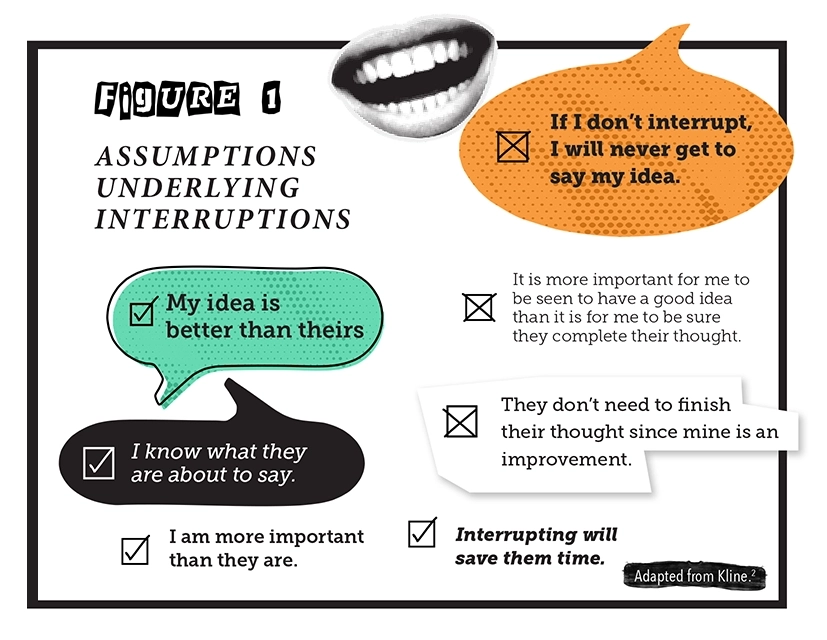 The responses in Figure 1 will resonate with many clinicians. In many cases, we have worked with hundreds (or even thousands) of patients with similar clinical presentations and can anticipate with a high degree of accuracy what a specific patient will experience and report. When patient contributions do not seem relevant or their perspectives are clearly wrong in some way, it is difficult to resist the urge to interrupt with a more relevant question or more accurate perspectives. The persistent time pressures of clinical practice can make interruptions seem like an efficient way to achieve the objectives during an encounter. We’re less likely to admit that we may consider ourselves more important than them because of our specialized training and expertise.
Interruptions in Medical Encounters
Medical care requires oral communication, with the medical interview forming a foundation of subsequent care. But a medical encounter is distinct from a casual conversation in several important ways. It is time limited, has a more specific end goal (determining a clinical problem and solution), and involves the communication of recommendations based on the expertise of the clinician. Clinicians are responsible for leading encounters in a manner that achieves those goals, whereas in casual conversations leadership is shared more equitably.
The formal training and subsequent experience of clinicians provides them with valuable information related to the health and well-being of patients. Giving information and recommendations to patients is part of our ethical and legal obligation. However, patients are the experts in their own experience, and the responsibility to accept or reject our recommendations and implement the most important aspects of the treatment plan (e.g., wearing a device) is theirs alone. Patient self-expression is crucial to achieving clinical goals. Failing to listen closely and completely to them can result in missing information essential to effective decision-making. At times, patient contributions may include topics not directly related to the clinical problem or solution, and they express opinions that are wrong. Listening to them (even when their perspectives are irrelevant or inaccurate) helps to build the trust essential to their acceptance and implementation of our recommendations. Instead, clinicians often interrupt patients to guide the discussion in a direction they consider more clinically meaningful.
Different studies have found that physicians interrupt patients’ initial statements within 18 or 23 seconds.3 Some research has found no difference between the number of interruptions by patients and by physicians, while others report that patients interrupt more than physicians. In one of those studies, “patients used more statement type of interruptions, whereas physicians used more question type of interruptions.”3 This may be due to the question/answer format of the medical interview, during which the physician asks questions to obtain relevant and specific information required to make a diagnosis or recommendation, and the patient provides answers and clarifications.
In 2022, Coyle et al. published a scoping review of interruptions during opening statements in primary care clinics, specialty clinics, and hospitals. They reported that “across six studies, the mean time to interruption was 18.2 seconds. The mean length of uninterrupted opening statements was 45.9 seconds across nine studies.”4 This means that if physicians waited an additional 27.7 seconds, they could take their turn without having interrupted the patient. (This supports the insight a physician once shared with me: “If you give the patient the first two minutes of an appointment, you can have the rest.”) Coyle et al. cautioned that interrupting patients “takes away time from the patient to fully present their concerns” but also stated that “research has not focused on the nature of clinician interruptions. For instance, an interruption encouraging expansion or more detail facilitates understanding.”4
 Two Views on Interruptions
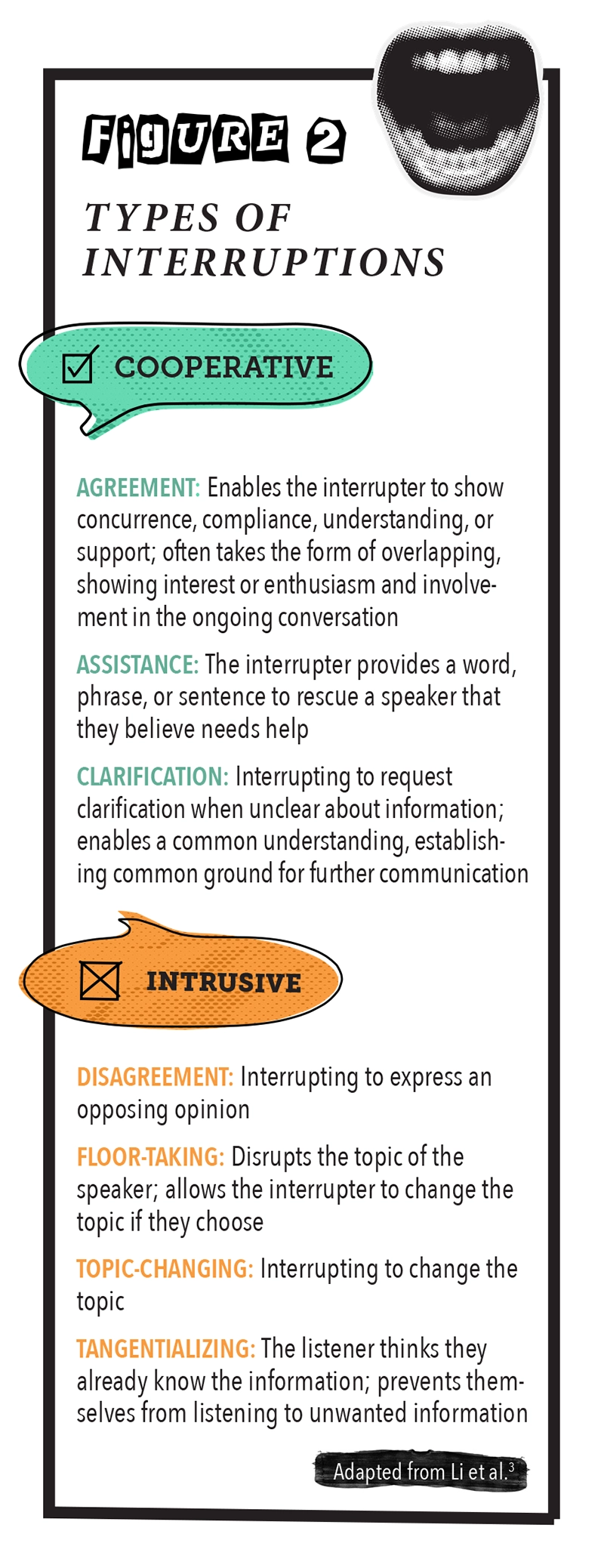
According to Li et al., “There are two distinct views among interruption researchers. One holds that interruption is a deep intrusion of the rights of the current speaker, as well as a severe disruption of the flow of the ongoing conversation.”3 However, “some types of interruption can serve as a way of getting involved, showing support and solidarity, or building rapport…. Sometimes an interruption was a means to rescue or promote the current speaker, or to elaborate on the content of the current speech.”3 Based on this more nuanced understanding, interruptions have been classified as cooperative and intrusive or supportive and disruptive.3 In Li et al.’s study of 17 physician-patient interviews, both physicians and patients interrupted intrusively and cooperatively. However, “physicians engaged in significantly more intrusive interruptions than patients, who exhibited more cooperative interruptions than physicians.”3 Again, this is likely related to patients understanding that physicians are directing and redirecting the conversations, and they are providing information in response.
Li et al. also noted that “when physicians interrupted patients, they were unsuccessful only 5 percent of the time. When patients interrupted physicians, they were unsuccessful 32 percent of the time. This high discrepancy shows that physicians are firmly in charge of the process and/or content of the conversation. It also indicates that patients would like to participate fully in the medical interview but are held up by physicians.”3 This is sobering, considering the powerful negative consequences of patient noninvolvement in their own care. If greater patient engagement is the goal, clinicians must accept that the responsibility to lead an encounter includes the responsibility to create space for patients to initiate and redirect the conversation.
Interruptions in Difficult Conversations
None of the literature I reviewed addressed the nature of interruption in difficult conversations. It’s been my observation that interruptions become more intrusive and disruptive as negative emotions escalate. The normal habit of preparing what we’ll say before the other person finishes speaking can become problematic when there is disagreement between the parties. When resolving conflicts (personal or clinical), the belief that the other person fully understands our perspective is important, and interruptions can signal that they are more focused on expressing their opinions than hearing ours. When both parties focus their efforts on convincing the other person, it is less likely that they will reach a mutually agreeable understanding.
In clinical encounters this may involve the appearance that the clinician has won the argument when the patient becomes passive and nonresponsive. However, if the patient remains unconvinced, he or she may leave the encounter without any intention of accepting the clinician’s perspective or changing his or her health behavior. While interruptions may appear to reduce the time of encounters, the outcome of this approach is often not what the practitioners are intending and will likely result in repeat appointments to address persistent problems.
Closing Thoughts
My siblings are welcoming and caring people, and like many healthcare providers, their ability to converse with almost anyone is a strength. Their propensity to talk often serves as an invitation to others to engage in interactions. Interruptions can be a way to demonstrate engagement and provide opportunities to redirect the conversation in constructive ways. However, it is worth considering the potential negative impact of those interruptions. Learning to distinguish between intrusive and cooperative interruptions, and implementing more of the latter type, can build trust and improve our effectiveness. Developing the skill of listening deeply and without judgement can be an even more powerful way to build rapport and achieve the goals of a medical encounter.
John T. Brinkmann, MA, CPO/L, FAAOP(D), is an associate professor at Northwestern University Prosthetics-Orthotics Center. He has over 30 years of experience in patient care and education.
References
- Yong, E. 2016. The incredible thing we do during conversations. The Atlantic 4.
- Kline, N. 1999. Time to think: Listening to ignite the human mind. Hachette UK.
- Li, H. Z., M. Krysko, N. G. Desroches, and G. Deagle. 2004. Reconceptualizing interruptions in physician-patient interviews: Cooperative and intrusive. Communication & Medicine 1(2):145-57.
- Coyle, A. C., R. W. Yen, and G. Elwyn. 2022. Interrupted opening statements in clinical encounters: A scoping review. Patient Education and Counseling 105(8):2653-63.
Image credit: Style Craft/stock.adobe.com; zzayko/stock.adobe.com