
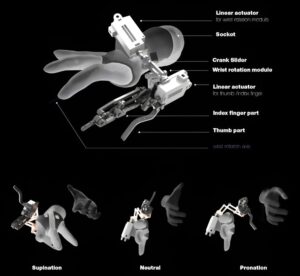
Researchers at Korea’s Pohang University of Science and Technology (POSTECH) have integrated a wrist rotation module into a robotic prosthesis, allowing for more natural movements. Traditional prosthetics often have limitations in wrist movement capabilities, which can prevent patients from freely moving their wrists, leading to the adoption of compensatory behaviors and increased strain on the arm and upper body.
In response to this issue, the research team developed the prosthetic hand tailored for a patient who lost their thumb and index finger in a car accident. The prosthesis operates by interpreting signals to the muscles through sensors and determining the motion intention.
The research team conducted an analysis of the muscle synergies in the arm and upper body associated with the new prosthesis, the conventional prosthesis, and those of individuals without prosthetic devices.
By using electromyographic signals and a motion capture system to assess arm and upper-body muscle activity, the researchers identified statistically significant differences in reaching and grasping movements between the newly designed and existing prosthetic hands.
The findings revealed that while using a conventional prosthesis, shoulder and upper-body movements were approximately 260 percent higher than normal, indicating an unnatural wrist rotation and resulting in the overuse of the arms and upper body. In contrast, the prosthesis developed by the research team facilitated a restoration to normal levels of upper-body movements, allowing for efficient and natural gestures without causing secondary damage to the musculoskeletal system. Notably, the team’s prosthetic hand exhibited over a 30 percent improvement in hand function compared to a traditional prosthetic hand.
“It is necessary to adopt an integrated approach in the development of robotic assistive devices, considering not only the replacement of a specific body part but also the interconnected components,” said Keehoon Kim, PhD, a professor at the university and leader of the research. “We aim for robotic prosthetics to be both safe and durable, ultimately restoring the lives that users may have lost.”
Editor’s note: This story was adapted from materials provided by Pohang University of Science and Technology (POSTECH).
The open-access study, “Restoring natural upper limb movement through a wrist prosthetic module for partial hand amputees,” was published in the Journal of NeuroEngineering and Rehabilitation.