

OANDP-L
  • Login
No Result
View All Result
The O&P EDGE
  • PECOS
  • Magazine
    • Subscription
    • Current Issue
    • Issue Archive
    • News Archive
    • Product & Service Directory
    • Advertising Information
    • EDGE Flipbooks
  • O&P Jobs
    • Find a Job
    • Post a Job
  • EDGE Advantage
    • EA Homepage
    • EA Data
  • O&P Facilities
  • Resources
    • Product & Service Directory
    • Calendar
    • Contact
    • About Us
    • O&P Library
    • The Guide
    • Custom Publications
    • Advertising Information
    • EDGE Direct
    • Amplitude Media Group
  • PECOS
  • Magazine
    • Subscription
    • Current Issue
    • Issue Archive
    • News Archive
    • Product & Service Directory
    • Advertising Information
    • EDGE Flipbooks
  • O&P Jobs
    • Find a Job
    • Post a Job
  • EDGE Advantage
    • EA Homepage
    • EA Data
  • O&P Facilities
  • Resources
    • Product & Service Directory
    • Calendar
    • Contact
    • About Us
    • O&P Library
    • The Guide
    • Custom Publications
    • Advertising Information
    • EDGE Direct
    • Amplitude Media Group
No Result
View All Result
The O&P EDGE Magazine
No Result
View All Result
Home News

New Therapeutics Could Accelerate Wound Healing

by The O&P EDGE
March 4, 2013
in News
0
SHARES
16
VIEWS
Share on FacebookShare on Twitter

University of California, Los Angeles (UCLA) researchers, led by Heather Maynard, PhD, an associate professor of chemistry and biochemistry, and a member of UCLA’s California NanoSystems Institute, are developing a new biomimicry healing technique to treat skin wounds, such as diabetes-related foot ulcers. The results of their research were published in the February online edition of the journal Nature Chemistry.
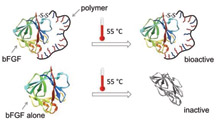

When subjected to normal conditions bFGF may encounter during transport, storage, or therapeutic use, the bFGF-heparin mimicking conjugate remains active, while natural bFGF no longer has any biological activity.
Photograph by Thi Nguyen, courtesy of UCLA.

Among the key players involved in natural wound healing is a signaling molecule called basic fibroblast growth factor (bFGF), which is secreted by cells to trigger healing processes, as well as embryonic development, tissue regeneration, bone regeneration, the development and maintenance of the nervous system, and stem cell renewal. Since the importance of bFGF was recognized in 1973, researchers have applied bFGF to wounds, but the treatments have not been very effective. What scientists now recognize, Maynard said, is that these growth factors typically lose their activity quickly in storage.

Using the principle of mimicry, Maynard and her team discovered how to stabilize bFGF, making it more suitable for medical applications. Relying on bFGF’s ability to bind heparin-a naturally occurring complex sugar found on the surface of our cells-the team synthesized a polymer that mimics the structure of heparin. Their new polymer, p(SS-co-PEGMA), mimics heparin’s natural ability to stabilize the growth factor. When attached to bFGF, the new polymer makes the protein stable to the stresses that normally inactivate it, making it more suitable for medical applications. After showing that p(SS-co-PEGMA) was non-toxic to the human cells important in wound healing, the research team used it to conjugate bFGF and demonstrated that the growth factor could remain active outside of the body for extended periods of time, even after it is exposed to heat, cold, damaging enzymes that would normally break it down, and acidic conditions like those found in wound injuries.

Moreover, they showed that this bound bFGF functions just like normal bFGF to trigger the same signaling pathways involved in the healing process.

The ability to stabilize bFGF means that it can be potentially stored, shipped, and made available for use by doctors and patients as needed, Maynard said.

The new material is now being tested by dermatologists. The team is also researching ways to stabilize other proteins involved in wound healing and ways to make bFGF more active.

Editor’s note: This story was adapted from materials provided by UCLA.

Related posts:

  1. PLX-PAD: Stem Cell Treatment May Save Limbs
  2. New Material Helps Accelerate Skin Regeneration in Major Wounds
  3. Researchers Discover Way to Boost Cancer-Killing Cells
  4. ‘Living’ Plastic: Are Self-Healing Plastics a Possibility for O&P?
Previous Post

Wireless Brain Sensor Developed at Brown

Next Post

ISPO Calls for Nominations for Protocol Committee

Next Post

ISPO Calls for Nominations for Protocol Committee

 SUBSCRIBE FOR FREE


O&P JOBS

Pacific

CPO

Central

CPO

Pacific

CPO

Linkedin X-twitter Facebook

Get unlimited access!

Join EDGE ADVANTAGE and unlock The O&P EDGE's vast library of archived content.
SUBSCRIBE TODAY
The O&P EDGE Magazine
 
Required 'Candidate' login to applying this job. Click here to logout And try again
 

Login to your account

  • Forgot Password?

Reset Password

  • Already have an account? Login

Enter the username or e-mail you used in your profile. A password reset link will be sent to you by email.

Close
No Result
View All Result
  • PECOS
  • MAGAZINE
    • SUBSCRIBE
    • CURRENT ISSUE
    • ISSUE ARCHIVE
    • NEWS ARCHIVE
    • PRODUCTS & SERVICES DIRECTORY
    • ADVERTISING INFORMATION
  • O&P JOBS
    • FIND A JOB
    • POST A JOB
  • EDGE ADVANTAGE
    • EA Homepage
    • EA Data
  • FACILITIES
  • RESOURCES
    • PRODUCTS & SERVICES DIRECTORY
    • CALENDAR
    • CONTACT
    • ABOUT US
    • O&P LIBRARY
    • THE GUIDE
    • CUSTOM PUBLICATIONS
    • ADVERTISING INFORMATION
    • EDGE DIRECT
    • AMPLITUDE
  • OANDP-L
  • LOGIN

© 2026 The O&P EDGE

VOTE NOW!
Not enough quota to unlock this post
Unlock left : 0
Are you sure want to cancel subscription?
 

Account Activation

Before you can login, you must activate your account with the code sent to your email address. If you did not receive this email, please check your junk/spam folder. Click here to resend the activation email. If you entered an incorrect email address, you will need to re-register with the correct email address.


© 2026 The O&P EDGE

  • About
  • Advertise
  • Contact
  • EDGE Advantage
  • OANDP-L
  • Subscribe

CONTACT US

866-613-0257

info@opedge.com

201 E. 4th St.
Loveland, CO 80537

EDGE DIRECT

The most important industry news and events delivered directly to your inbox every week.

  • About
  • Advertise
  • Contact
  • EDGE Advantage
  • OANDP-L
  • Subscribe

© 2026 The O&P EDGE

Welcome Back!

Login to your account below

Forgotten Password?

Retrieve your password

Please enter your username or email address to reset your password.

Log In
The O&P EDGE Magazine
 
Required 'Candidate' login to applying this job. Click here to logout And try again
 

Login to your account

  • Forgot Password?

Reset Password

  • Already have an account? Login

Enter the username or e-mail you used in your profile. A password reset link will be sent to you by email.

Close
No Result
View All Result
  • PECOS
  • MAGAZINE
    • SUBSCRIBE
    • CURRENT ISSUE
    • ISSUE ARCHIVE
    • NEWS ARCHIVE
    • PRODUCTS & SERVICES DIRECTORY
    • ADVERTISING INFORMATION
  • O&P JOBS
    • FIND A JOB
    • POST A JOB
  • EDGE ADVANTAGE
    • EA Homepage
    • EA Data
  • FACILITIES
  • RESOURCES
    • PRODUCTS & SERVICES DIRECTORY
    • CALENDAR
    • CONTACT
    • ABOUT US
    • O&P LIBRARY
    • THE GUIDE
    • CUSTOM PUBLICATIONS
    • ADVERTISING INFORMATION
    • EDGE DIRECT
    • AMPLITUDE
  • OANDP-L
  • LOGIN

© 2026 The O&P EDGE

Not enough quota to unlock this post
Unlock left : 0
Are you sure want to cancel subscription?
 

Account Activation

Before you can login, you must activate your account with the code sent to your email address. If you did not receive this email, please check your junk/spam folder. Click here to resend the activation email. If you entered an incorrect email address, you will need to re-register with the correct email address.