

Engineering students at 12 universities are participating in a design competition to develop a temperature-regulation device for para athletes’ residual limbs. During winter sliding sports like para bobsled and para skeleton, athletes often remove their prostheses during training and competition, leaving their residual limbs vulnerable to cold, stiffness, and injury. The students are tasked with developing a lightweight, comfortable, and performance-ready warming system that helps athletes stay warm between and during runs—without interfering with movement or equipment.
The third annual Project S.E.R.V.E. (Student Engineering for Resilience of Veterans and Emergency Responders) National Design Competition, in partnership with Team USA’s Para Sliding program, focuses on adaptive athletes and includes an athlete mentor participating with each school. The designs will be evaluated for innovation, practicality, safety, and generalizability for upper- and lower-limb amputations.
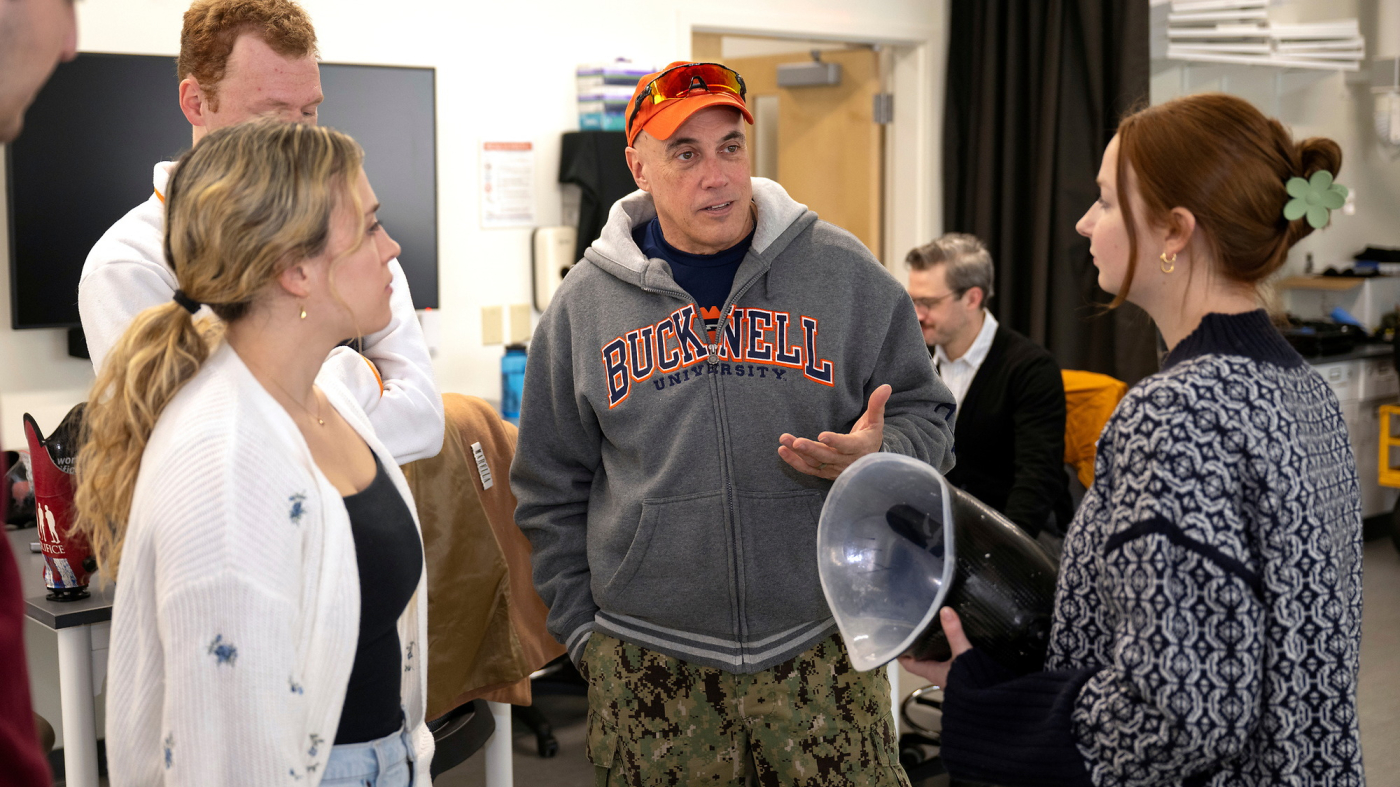
Kevin Bittenbender, a World Cup skeleton para athlete medalist and retired army sergeant major who has a lower-limb amputation, is participating as Bucknell University’s athlete mentor.
“When you have a residual limb exposed to extreme heat or cold, it can be detrimental, particularly when you have residual feeling,” Bittenbender said. “After competition, my prosthetic limb has either swollen or shrunk. Maintaining a balance of heat is important. The fewer limbs you have, the less circulation you have.”
The Bucknell team has chosen an electrical-powered heating mechanism, requiring consideration of moisture, impact, safety, and temperature limits needed for prostheses that may be fabricated with thermoplastics.
“There are many complications. Moisture, contact with walls, and extreme temperatures all factor into the design,” said Macy Volp, one of the Bucknell team members. “Those complications really drive our decision-making.”
Bittenbender believes successful designs could expand access to sliding sports, including skeleton, bobsled, and luge, and other Paralympic winter sports such as cross-country skiing, downhill, and biathlon, strengthening the case for inclusion in the 2030 Paralympic Winter Games in the French Alps.
The Project S.E.R.V.E. National Design Competition finals will be held April 25-26 at Virginia Tech.
Editor’s note: This story was adapted from materials provided by Bucknell University.