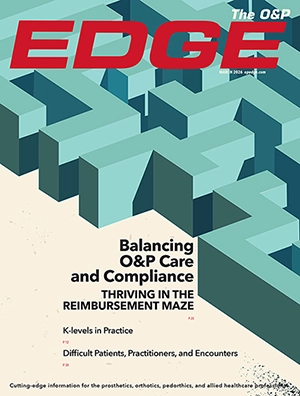

With increasing regulatory hurdles and pressures from payers to provide detailed documentation to justify devices, clinicians and support staff can sometimes feel like their jobs revolve more around reimbursement than patient care. In this issue, we asked experts to share their expertise about how to balance the need to address these administrative burdens with focusing on what drove them to enter the profession: helping patients regain their mobility and independence.
For people living with lower-limb amputations, their K-levels have one of the biggest impacts on their access to prosthetic devices. In “K-levels in Practice: The Impact on Patient Care,” clinicians, physicians, physical therapists, and billing specialists share their advice on how to find the right devices within the system, including telling the story for payers when fitting a microprocessor knee on patients with a K2 designation, and appropriately assigning or reassessing a K-level.
In today’s O&P practices, understanding the billing and reimbursement environments cannot be limited to administrative employees; everyone from clinicians to the front office staff members must have an understanding of the financial and compliance implications of their work. “Balancing O&P Care and Compliance: Thriving in the Reimbursement Maze” discusses strategies practices can use with their staff to ensure that physician and practitioner documentation is complete and patient focused, team members are up to date on new regulations, and technology tools are used appropriately to ensure complete, compliant claims, without losing critical individual narrative information.
Finally, “Difficult Patients, Practitioners, and Encounters” explores a scenario that is familiar to most people who work in healthcare—patients who have been identified as chronically dissatisfied and difficult. It also suggests ways in which clinicians’ behavior in response to a “difficult” patient can impact the tenor of the encounter and reframing the situation from label to relationship can improve the clinical experience for both parties.
Happy reading.
Andrea Spridgen