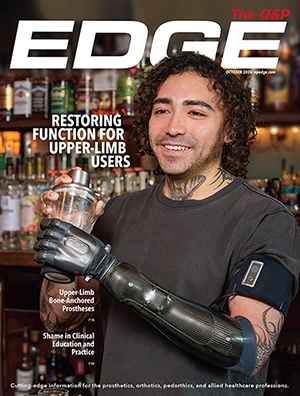

The first patient in the clinical development program for the e-OPRA Implant System has undergone surgery in which the implant was anchored into the bone and electrodes were placed on muscles and around nerves. The program is being led by the Regenstein Foundation Center for Bionic Medicine at Shirley Ryan AbilityLab and is conducted in collaboration with Northwestern Medicine and the University of Chicago.
It is the first study to combine osseointegration, targeted muscle reinnervation, a surgical technique that reroutes nerves, and pattern-recognition control using implanted sensors that record the electrical activity generated in the muscles, together with nerve electrodes that provide sensory feedback. The study, in which eight patients will be enrolled, is expected to inform the future development of implantable intelligent bionics.
The study, funded by an award of $8.7 million from the National Institute of Neurological Disorders and Stroke, part of the National Institutes of Health, is expected to conclude in 2030, at which point the results will be made publicly available.
The surgical procedure was performed at Northwestern Memorial Hospital under an investigational device exemption from the US Food and Drug Administration.
“Being in the operating room when e-OPRA was implanted in the first patient in the United States was a significant milestone for Integrum. Shirley Ryan AbilityLab and Northwestern Medicine are among the world’s foremost institutions in rehabilitation medicine and reconstructive surgery respectively, and we look forward to our continued collaboration to evaluate and improve the performance of the system,” said Rickard Brånemark, chief medical and scientific officer, Integrum.
“It is highly encouraging to see the program at Shirley Ryan AbilityLab advancing. e-OPRA builds on the value of our bone-anchored implants and addresses an area of growing interest: connecting the body to the prosthesis through skeletal anchoring, the decoding of muscle signals and restored sensory feedback. If the program succeeds, it will open new possibilities for people with limb loss to regain both mobility and sensation,” said Martin Hillsten, CEO, Integrum.