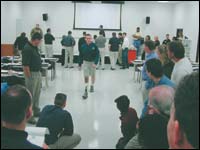
The Ohio Willow Wood company, Mount Sterling, Ohio, hosted a special educational program for students and instructors from four of the leading U.S. O&P schools. Attending the special session March 11-12 were 42 students and six instructors, including 14 students from California State University-Dominguez Hills (CSUDH), California, 14 students from the Hanger P&O Newington Certification Program in Connecticut; seven students from the University of Washington-Seattle; and seven from Century Community Technical College in Minnesota. Instructors attending were Scott Hornbeak, CPO, Cal State Dominguez Hills; Paul Armstrong, CP, Todd Sleeman, CP, and John Burger, CPO, Newington; Steve Stolberg, CP, Century College; and Stephanie Yoshino, CPO, University of Washington. This special session was presented very much like a typical Ohio Willow Wood Summit session, with seminars on the Alpha® Liner and socket and the Pathfinder™ prosthetic foot. Conducting the session were Phillip Harrison, educational prosthetist; Larry Corley, educational specialist; and Raymond Francis, CP, chief prosthetist. Before their arrival, the students were randomly assigned to one of three teams: Team Alpha, Team Geo, or Tem Impulse. When they arrived at the Summit at Ohio Willow Wood, they were treated to breakfast and then aside to find their place card within the classroom seating arrangement. Students Try SkillsThe first day was dedicated to the Success with Alpha Liner seminar. After demonstrating the casting and modification of an Alpha socket, Phillip Harrison asked each team member to look inside his or her place card. Those with a pink mark were assigned the task of casting a patient for each of their teams, based on what they had just observed. After receiving positive molds from Custom Fabrication, Harrison then asked the students with a purple mark on their place card to come forward to modify the positive molds of the casting process. While the students were served lunch in the Summit dining area, Custom Fabrication pulled check sockets for each of the four casts that had been taken that morning. In the afternoon Harrison demonstrated how to use the check socket in evaluating the fit and what to look for in the Alpha Liner fabric in order to make any necessary adjustments. After receiving this instruction, the students whose place cards had a blue mark were asked to lead evaluations of one of the check sockets by identifying potential fit issues or adjustments that might be needed. Interactive, Hands-on Approach Builds Success A key element of the success of each team in this fitting process was the responsibility of the lead student who formed the cast, and then the ability of any given student on the team to build upon what the previous student had done. This interactive, hands-on approach proved to be highly successful for the class. The random assignment of students to three teams was also very beneficial in this process, as the students were given opportunities to openly share attained knowledge from their respective programs along with a head start on establishing professional working relationships within their field. The next day, Foot Selection Process and the Pathfinder Seminar were the main topics. After demonstrating proper alignment of the Pathfinder on a patient, Harrison invited those students whose place card had a green mark to fit and align a Pathfinder within their group. This time, however, on two of the teams the patient happened to be one of the students who also was an amputee. Rebecca Colin, a transfemoral amputee from the University of Washington, and Don Priest, a bilateral transtibial amputee from CSIDH, were more than happy to try out the Pathfinder. For the third team, Ohio Willow Wood design engineer Lonnie Nolt served as the patient. Students Give Impromptu Presentations While observing their teammate in the fitting and alignment process, other team members were strongly encouraged to take notes and make general observations leading into the afternoon activity. After returning from lunch, Harrison surprised one more person from each team, those with the last remaining mark on the place cards. Each of three students was asked to give an impromptu clinical presentation to the audience about the alignment used for their particular patient, while the patient demonstrated his or her gait for the rest of the class. Appreciative Comments Received "The enthusiasm demonstrated by the students, their curiosity and questions, and their team-oriented spirit were key elements to success," said Ohio Willow Wood spokeswoman Meredy Fullen. "It was a great opportunity for us to share with the practitioners of tomorrow." "Hosting the seminar at the Summit allows Ohio Willow Wood to draw on their clinical and engineering staff to present concepts and field questions," said Todd Sleeman, CP, instructor, Newington Certification Program. "I was pleased that, while discussing their product lines, they also presented general prosthetic concepts that can be applied to clinical practice regardless of product." "The key to success in the field of prosthetics is knowledge, which you provided on your products and theories by having us here," CSUDH student Don Priest, told Ohio Willow Wood staff members. "It is apparent that the company cares about the employees here, and that, in turn, is reflected in the level of care they put in making the products." "Every manufacturer should invest this amount of effort and time to afford people the opportunity to explore the strengths and weakness of their devices, as well as to understand the applications that these devices were designed for," said Paul D. Armstrong, CP, instructor, Newington Certification Program. "CSUDH students were impressed with the OWW plant and staff," said Scott Hornbeak, CPO. "All staff were extremely courteous and went out of their way to make the students feel welcome. Many staff members sat in the back of the education presentations, making it convenient to ask questions about the products and company when appropriate. "The plant tour was a highlight; the plant is extremely clean and well run," Hornbeak continued. "The OWW employees are enthusiastic about their work, and the students came away impressed by the dedication to engineering excellence and quality control."
The Ohio Willow Wood company, Mount Sterling, Ohio, hosted a special educational program for students and instructors from four of the leading U.S. O&P schools. Attending the special session March 11-12 were 42 students and six instructors, including 14 students from California State University-Dominguez Hills (CSUDH), California, 14 students from the Hanger P&O Newington Certification Program in Connecticut; seven students from the University of Washington-Seattle; and seven from Century Community Technical College in Minnesota. Instructors attending were Scott Hornbeak, CPO, Cal State Dominguez Hills; Paul Armstrong, CP, Todd Sleeman, CP, and John Burger, CPO, Newington; Steve Stolberg, CP, Century College; and Stephanie Yoshino, CPO, University of Washington. This special session was presented very much like a typical Ohio Willow Wood Summit session, with seminars on the Alpha® Liner and socket and the Pathfinder™ prosthetic foot. Conducting the session were Phillip Harrison, educational prosthetist; Larry Corley, educational specialist; and Raymond Francis, CP, chief prosthetist. Before their arrival, the students were randomly assigned to one of three teams: Team Alpha, Team Geo, or Tem Impulse. When they arrived at the Summit at Ohio Willow Wood, they were treated to breakfast and then aside to find their place card within the classroom seating arrangement. Students Try SkillsThe first day was dedicated to the Success with Alpha Liner seminar. After demonstrating the casting and modification of an Alpha socket, Phillip Harrison asked each team member to look inside his or her place card. Those with a pink mark were assigned the task of casting a patient for each of their teams, based on what they had just observed. After receiving positive molds from Custom Fabrication, Harrison then asked the students with a purple mark on their place card to come forward to modify the positive molds of the casting process. While the students were served lunch in the Summit dining area, Custom Fabrication pulled check sockets for each of the four casts that had been taken that morning. In the afternoon Harrison demonstrated how to use the check socket in evaluating the fit and what to look for in the Alpha Liner fabric in order to make any necessary adjustments. After receiving this instruction, the students whose place cards had a blue mark were asked to lead evaluations of one of the check sockets by identifying potential fit issues or adjustments that might be needed. Interactive, Hands-on Approach Builds Success A key element of the success of each team in this fitting process was the responsibility of the lead student who formed the cast, and then the ability of any given student on the team to build upon what the previous student had done. This interactive, hands-on approach proved to be highly successful for the class. The random assignment of students to three teams was also very beneficial in this process, as the students were given opportunities to openly share attained knowledge from their respective programs along with a head start on establishing professional working relationships within their field. The next day, Foot Selection Process and the Pathfinder Seminar were the main topics. After demonstrating proper alignment of the Pathfinder on a patient, Harrison invited those students whose place card had a green mark to fit and align a Pathfinder within their group. This time, however, on two of the teams the patient happened to be one of the students who also was an amputee. Rebecca Colin, a transfemoral amputee from the University of Washington, and Don Priest, a bilateral transtibial amputee from CSIDH, were more than happy to try out the Pathfinder. For the third team, Ohio Willow Wood design engineer Lonnie Nolt served as the patient. Students Give Impromptu Presentations While observing their teammate in the fitting and alignment process, other team members were strongly encouraged to take notes and make general observations leading into the afternoon activity. After returning from lunch, Harrison surprised one more person from each team, those with the last remaining mark on the place cards. Each of three students was asked to give an impromptu clinical presentation to the audience about the alignment used for their particular patient, while the patient demonstrated his or her gait for the rest of the class. Appreciative Comments Received "The enthusiasm demonstrated by the students, their curiosity and questions, and their team-oriented spirit were key elements to success," said Ohio Willow Wood spokeswoman Meredy Fullen. "It was a great opportunity for us to share with the practitioners of tomorrow." "Hosting the seminar at the Summit allows Ohio Willow Wood to draw on their clinical and engineering staff to present concepts and field questions," said Todd Sleeman, CP, instructor, Newington Certification Program. "I was pleased that, while discussing their product lines, they also presented general prosthetic concepts that can be applied to clinical practice regardless of product." "The key to success in the field of prosthetics is knowledge, which you provided on your products and theories by having us here," CSUDH student Don Priest, told Ohio Willow Wood staff members. "It is apparent that the company cares about the employees here, and that, in turn, is reflected in the level of care they put in making the products." "Every manufacturer should invest this amount of effort and time to afford people the opportunity to explore the strengths and weakness of their devices, as well as to understand the applications that these devices were designed for," said Paul D. Armstrong, CP, instructor, Newington Certification Program. "CSUDH students were impressed with the OWW plant and staff," said Scott Hornbeak, CPO. "All staff were extremely courteous and went out of their way to make the students feel welcome. Many staff members sat in the back of the education presentations, making it convenient to ask questions about the products and company when appropriate. "The plant tour was a highlight; the plant is extremely clean and well run," Hornbeak continued. "The OWW employees are enthusiastic about their work, and the students came away impressed by the dedication to engineering excellence and quality control."