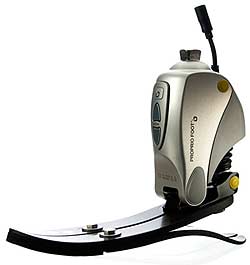
Ossur, based in Reykjavik, Iceland, has introduced its PROPRIO FOOTTM, which the company describes as the world's first intelligent foot module. "The PROPRIO FOOT is an artificially intelligent and motor-powered prosthesis that helps to replace the function that the body's central nervous system would normally play in processing information about changes occurring inside and outside the limb if it were still intact," according to Ossur. Using advanced motion sensing accelerometers, the PROPRIO FOOT can actually "sense" the surroundings of each step and accommodate for action such as sitting and standing, walking up and down stairs, and for level ground walking, Ossur said. "As fast as it measures, the data is fed into the 'brain' of the device through TerrainLogicTM identifying specific motions, such as heel strike, to enable a timely response to variations in terrain and activity." Foot motion is continuously analyzed. For each stride, gait pattern recognition algorithms in the foot are used to detect and identify when a user is walking on flat or sloped surfaces and up or down stairs, as well as when stationary or in a seated position. Currently in limited launch, the PROPRIO FOOT will be available this fall, Ossur said.It joins two other prostheses which utilize Ossur's Bionic Technology platform. One is the RHEO KNEETM, an award-winning system that automatically adapts to the wearer's walking style and environment, learning continuously until it reaches optimal efficiency, according to Ossur. The other is the POWER KNEETM, which Ossur pointed out is the world's first motor-powered knee (shown at right). "It's a testament to the value of the RHEO KNEE and the POWER KNEE that the US Department of Defense is fitting them on servicemen who have lost limbs." The company discussed its use of sophisticated technology used in these prosthetic devices: "Artificial intelligence (AI) [is] a branch of computer science dealing with intelligent behavior, learning, and adaptation in machines. Ossur uses highly advanced AI to increase the functionality of its prostheses to reduce the user's mental and physical effort, as well as the ensuing stress on other body parts following an amputation. The results are prostheses that actually do some thinking and can deal with day-to-day events like a change of shoes or heavy lifting. "Power motion, too, allows for previously unknown levels of functionality, user safety, and carefree mobility. It has the capacity to replace lost muscle function from the subtle lifting of the toe to the powerful knee extension required for foot-over-foot stair climbing." Ossur pointed out that it allocates six to eight percent of its revenues to research and development. The company noted that its PROPRIO FOOT was developed in-house by Ossur's R&D department; the RHEO KNEE was co-invented with Hugh Herr, PhD, associate professor at MIT and director of the Biomechatronics department at MIT's Media Lab; and the POWER KNEE was co-developed with Victhom Human Bionics, Quebec City, Quebec, Canada, an Ossur partner. Walking into the Future Ossur is also looking at other technologies for lower-limb prosthetic application, such as osseointegration, the science of implanting man-made, load bearing anchoring mechanisms directly into the living bone, the company said. The fixture bonds with the surrounding tissue; ultimately the prosthesis is attached to it and can withstand all normal conditions of loading. Neurosensing is where there is likely to be even more exciting advancements within the next two or three years, said Hilmar B. Janusson, PhD, Ossur's vice president of Research and Development. With neurosensing, when a prosthetic device is connected to the human neurological system, the user is enabled to regain voluntary control over the prosthesis at a thinking level, instead of having to manipulate the prosthetic function solely by means of joint mobility and muscular activity. "The next level will happen when the prosthetic device can actually anticipate the intention of the user," said Janusson. An amputee can just think about taking a step and his foot will act. "This can only be achieved when the prosthesis is able to be coupled to the human neural system and neuro-implants read the user's mind and respond accordingly," the company observed. For more information, call 800.233.6263 or visit www.ossur.com/bionics
Ossur, based in Reykjavik, Iceland, has introduced its PROPRIO FOOTTM, which the company describes as the world's first intelligent foot module. "The PROPRIO FOOT is an artificially intelligent and motor-powered prosthesis that helps to replace the function that the body's central nervous system would normally play in processing information about changes occurring inside and outside the limb if it were still intact," according to Ossur. Using advanced motion sensing accelerometers, the PROPRIO FOOT can actually "sense" the surroundings of each step and accommodate for action such as sitting and standing, walking up and down stairs, and for level ground walking, Ossur said. "As fast as it measures, the data is fed into the 'brain' of the device through TerrainLogicTM identifying specific motions, such as heel strike, to enable a timely response to variations in terrain and activity." Foot motion is continuously analyzed. For each stride, gait pattern recognition algorithms in the foot are used to detect and identify when a user is walking on flat or sloped surfaces and up or down stairs, as well as when stationary or in a seated position. Currently in limited launch, the PROPRIO FOOT will be available this fall, Ossur said.It joins two other prostheses which utilize Ossur's Bionic Technology platform. One is the RHEO KNEETM, an award-winning system that automatically adapts to the wearer's walking style and environment, learning continuously until it reaches optimal efficiency, according to Ossur. The other is the POWER KNEETM, which Ossur pointed out is the world's first motor-powered knee (shown at right). "It's a testament to the value of the RHEO KNEE and the POWER KNEE that the US Department of Defense is fitting them on servicemen who have lost limbs." The company discussed its use of sophisticated technology used in these prosthetic devices: "Artificial intelligence (AI) [is] a branch of computer science dealing with intelligent behavior, learning, and adaptation in machines. Ossur uses highly advanced AI to increase the functionality of its prostheses to reduce the user's mental and physical effort, as well as the ensuing stress on other body parts following an amputation. The results are prostheses that actually do some thinking and can deal with day-to-day events like a change of shoes or heavy lifting. "Power motion, too, allows for previously unknown levels of functionality, user safety, and carefree mobility. It has the capacity to replace lost muscle function from the subtle lifting of the toe to the powerful knee extension required for foot-over-foot stair climbing." Ossur pointed out that it allocates six to eight percent of its revenues to research and development. The company noted that its PROPRIO FOOT was developed in-house by Ossur's R&D department; the RHEO KNEE was co-invented with Hugh Herr, PhD, associate professor at MIT and director of the Biomechatronics department at MIT's Media Lab; and the POWER KNEE was co-developed with Victhom Human Bionics, Quebec City, Quebec, Canada, an Ossur partner. Walking into the Future Ossur is also looking at other technologies for lower-limb prosthetic application, such as osseointegration, the science of implanting man-made, load bearing anchoring mechanisms directly into the living bone, the company said. The fixture bonds with the surrounding tissue; ultimately the prosthesis is attached to it and can withstand all normal conditions of loading. Neurosensing is where there is likely to be even more exciting advancements within the next two or three years, said Hilmar B. Janusson, PhD, Ossur's vice president of Research and Development. With neurosensing, when a prosthetic device is connected to the human neurological system, the user is enabled to regain voluntary control over the prosthesis at a thinking level, instead of having to manipulate the prosthetic function solely by means of joint mobility and muscular activity. "The next level will happen when the prosthetic device can actually anticipate the intention of the user," said Janusson. An amputee can just think about taking a step and his foot will act. "This can only be achieved when the prosthesis is able to be coupled to the human neural system and neuro-implants read the user's mind and respond accordingly," the company observed. For more information, call 800.233.6263 or visit www.ossur.com/bionics