
OANDP-L
  • Login
No Result
View All Result
The O&P EDGE Magazine
  • PECOS
  • Magazine
    • Subscription
    • Current Issue
    • Issue Archive
    • News Archive
    • Product & Service Directory
    • Advertising Information
  • O&P Jobs
    • Find a Job
    • Post a Job
  • EDGE Advantage
    • EA Homepage
    • EA Data
  • O&P Facilities
  • Resources
    • Product & Service Directory
    • Calendar
    • Contact
    • About Us
    • O&P Library
    • Lower Limb Directory
    • The Guide
    • Custom Publications
    • Advertising Information
    • EDGE Direct
    • Amplitude Media Group
No Result
View All Result
The O&P EDGE Magazine
No Result
View All Result
Home News

MIT’s Cheetah Robot Has Implications for Prosthetic Leg Development

by The O&P EDGE
January 3, 2022
in News
0
SHARES
34
VIEWS
Share on Facebook
Share on Twitter

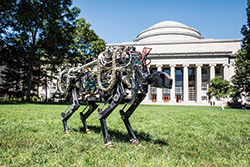
Photograph of the MIT cheetah-bot by Jose-Luis Olivares, courtesy of MIT.

Researchers at the Massachusetts Institute of Technology (MIT), Cambridge, have developed an algorithm for bounding that they’ve successfully implemented in a robotic cheetah-a four-legged assemblage of gears, batteries, and electric motors that weighs about as much as its feline counterpart, and has sprinted up to ten miles per hour (mph). The team recently took the robot for a test run on MIT’s Killian Court. The robot has implications for the development of prosthetic legs.

“We try to understand how [four-legged animals] efficiently run in the field and nature so that we can take that inspiration and then use it in our engineering world,” Sangbae Kim, PhD, an associate professor of mechanical engineering at MIT, told Gizmag. “So, for example, we can create prosthetic legs from that technology or we can even make new transportation….”

The key to the bounding algorithm Kim and his colleagues developed is in programming each of the robot’s legs so that the faster the desired speed, the more force must be applied to propel the robot forward. Kim hypothesizes that this force-control approach to robotic running is similar, in principle, to the way world-class sprinters race. He said that by adapting a force-based approach, the cheetah-bot is able to handle rougher terrain, such as bounding across a grassy field. In treadmill experiments, the team found that the robot maintained its speed even as it ran over slight bumps in its path, represented by a foam obstacle.

The act of running can be parsed into a number of biomechanically distinct gaits, from trotting and cantering, to more dynamic bounding and galloping. In bounding, an animal’s front legs hit the ground together, followed by its hind legs, similar to the way that rabbits hop-a relatively simple gait that the researchers said they chose to model first. As an animal bounds, its legs touch the ground for a fraction of a second before cycling through the air again. The percentage of time a leg spends on the ground rather than in the air is referred to in biomechanics as a “duty cycle”; the faster an animal runs, the shorter its duty cycle. The algorithm determines the amount of force a leg should exert in the short period of each cycle that it spends on the ground. That force, they reasoned, should be enough for the robot to push up against the downward force of gravity, in order to maintain forward momentum.

In experiments, the team ran the robot at progressively smaller duty cycles, finding that, following the algorithm’s force prescriptions, the robot was able to run at higher speeds without falling. In experiments on an indoor track, the robot sprinted up to ten mph, even continuing to run after clearing a hurdle. The MIT researchers estimate that the current version of the robot may eventually reach speeds of up to 30 mph.


Editor’s note: This story was adapted from materials provided by MIT.
Related posts:

  1. I, ROBOT
  2. Bipedal Robot Walks in 3D; May Advance Prosthetic Technology
  3. Robo-Legs Provide Insight into Human Gait
  4. Magnet-based Prosthetic Control System Developed
Previous Post

Tips for Dealing with the Healthcare System

Next Post

U.S. Team Snags Seven Medals at World Paraclimbing Championship

Next Post

U.S. Team Snags Seven Medals at World Paraclimbing Championship

The O&P EDGE October 2026 issue

Read the Current Issue

SUBSCRIBE FOR FREE


O&P JOBS

Central

HH Manager, Orthotics & Prosthetics

Pacific

Orthotics and Prosthetics Assistant

Central

Certified Orthotist — Full-Time or Part-Time, Pediatric Practice

Linkedin X-twitter Facebook

Get unlimited access!

Join EDGE ADVANTAGE and unlock The O&P EDGE's vast library of archived content.
SUBSCRIBE TODAY


© 2026 The O&P EDGE

  • About
  • Advertise
  • Contact
  • EDGE Advantage
  • OANDP-L
  • Subscribe

CONTACT US

866-613-0257

info@opedge.com

201 E. 4th St.
Loveland, CO 80537

EDGE DIRECT

The most important industry news and events delivered directly to your inbox every week.

  • About
  • Advertise
  • Contact
  • EDGE Advantage
  • OANDP-L
  • Subscribe

© 2026 The O&P EDGE

Welcome Back!

Login to your account below

Forgotten Password?

Retrieve your password

Please enter your username or email address to reset your password.

Log In
Close
No Result
View All Result
  • PECOS
  • MAGAZINE
    • SUBSCRIBE
    • CURRENT ISSUE
    • ISSUE ARCHIVE
    • NEWS ARCHIVE
    • PRODUCTS & SERVICES DIRECTORY
    • ADVERTISING INFORMATION
  • O&P JOBS
    • FIND A JOB
    • POST A JOB
  • EDGE ADVANTAGE
    • EA Homepage
    • EA Data
  • FACILITIES
  • RESOURCES
    • PRODUCTS & SERVICES DIRECTORY
    • CALENDAR
    • CONTACT
    • ABOUT US
    • O&P LIBRARY
    • LOWER LIMB DIRECTORY
    • THE GUIDE
    • CUSTOM PUBLICATIONS
    • ADVERTISING INFORMATION
    • EDGE DIRECT
    • AMPLITUDE
  • OANDP-L
  • LOGIN

© 2026 The O&P EDGE