

OANDP-L
  • Login
No Result
View All Result
The O&P EDGE
  • PECOS
  • Magazine
    • Subscription
    • Current Issue
    • Issue Archive
    • News Archive
    • Product & Service Directory
    • Advertising Information
    • EDGE Flipbooks
  • O&P Jobs
    • Find a Job
    • Post a Job
  • EDGE Advantage
    • EA Homepage
    • EA Data
  • O&P Facilities
  • Resources
    • Product & Service Directory
    • Calendar
    • Contact
    • About Us
    • O&P Library
    • The Guide
    • Custom Publications
    • Advertising Information
    • EDGE Direct
    • Amplitude Media Group
  • PECOS
  • Magazine
    • Subscription
    • Current Issue
    • Issue Archive
    • News Archive
    • Product & Service Directory
    • Advertising Information
    • EDGE Flipbooks
  • O&P Jobs
    • Find a Job
    • Post a Job
  • EDGE Advantage
    • EA Homepage
    • EA Data
  • O&P Facilities
  • Resources
    • Product & Service Directory
    • Calendar
    • Contact
    • About Us
    • O&P Library
    • The Guide
    • Custom Publications
    • Advertising Information
    • EDGE Direct
    • Amplitude Media Group
No Result
View All Result
The O&P EDGE Magazine
No Result
View All Result
Home News

Monkeys Drive Wheelchairs Using Only Their Thoughts

by The O&P EDGE
March 4, 2016
in News
0
SHARES
12
VIEWS
Share on FacebookShare on Twitter

Neuroscientists at Duke Health, Durham, North Carolina, have developed a brain-machine interface (BMI) that allows primates to use only their thoughts to navigate a robotic wheelchair. The BMI uses signals from hundreds of neurons recorded simultaneously in two regions of the monkeys’ brains that are involved in movement and sensation. As the animals think about moving toward their goal-in this case, a bowl of grapes-computers translate their brain activity into real-time operation of the wheelchair.
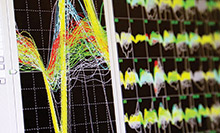

A computer in Nicolelis’ lab monitors brain signals from a rhesus macaque. Photograph by Shawn Rocco, courtesy of Duke Health.

The interface, described in the March 3 issue of the online journal Scientific Reports, demonstrates the future potential for people with disabilities who have lost most muscle control and mobility due to quadriplegia or amyotrophic lateral sclerosis, said senior author Miguel Nicolelis, MD, PhD, codirector for the Duke Center for Neuroengineering and a Duke School of Medicine professor in neuroscience.

“In some severely disabled people, even blinking is not possible,” Nicolelis said. “For them, using a wheelchair or device controlled by noninvasive measures like an EEG (a device that monitors brain waves through electrodes on the scalp) may not be sufficient. We show clearly that if you have intracranial implants, you get better control of a wheelchair than with noninvasive devices.”

Scientists began the experiments in 2012, implanting hundreds of hair-thin microfilaments in the premotor and somatosensory regions of the brains of two rhesus macaques. They trained the animals by passively navigating the chair toward their goal, the bowl containing grapes. During this training phase, the scientists recorded the primates’ large-scale electrical brain activity. The researchers then programmed a computer system to translate brain signals into digital motor commands that controlled the movements of the wheelchair.

As the monkeys learned to control the wheelchair just by thinking, they became more efficient at navigating toward the grapes and completed the trials faster, Nicolelis said.

In addition to observing brain signals that corresponded to translational and rotational movement, the Duke team also discovered that primates’ brain signals showed signs they were contemplating the distance to the bowl of grapes.

“This was not a signal that was present in the beginning of the training, but something that emerged as an effect of the monkeys becoming proficient in this task,” Nicolelis said. “This was a surprise. It demonstrates the brain’s enormous flexibility to assimilate a device, in this case a wheelchair, and that device’s spatial relationships to the surrounding world.”

The trials measured the activity of nearly 300 neurons in each of the two monkeys. The Nicolelis lab previously reported the ability to record up to 2,000 neurons using the same technique. The team now hopes to expand the experiment by recording more neuronal signals to continue to increase the accuracy and fidelity of the primate BMI before seeking trials for an implanted device in humans, he said.


Editor’s note: This story was adapted from materials provided by Duke Health.
Related posts:

  1. Monkeys Drive Wheelchairs Using Only Their Thoughts
  2. BCI Devices Open Doors for People with Disabilities
  3. BMI Helps People With Paralysis Regain Movement
  4. BMI Enables Monkeys to Move Two Virtual Arms
Previous Post

AARP Joins Campaign for Sustainable Rx Pricing

Next Post

Zimmer Biomet Holdings Acquires OI Implant Company

Next Post

Zimmer Biomet Holdings Acquires OI Implant Company

 SUBSCRIBE FOR FREE


Get unlimited access!

Join EDGE ADVANTAGE and unlock The O&P EDGE's vast library of archived content.
SUBSCRIBE TODAY

O&P JOBS

Pacific

CPO, CP or Resident

Eastern

Position Open for a Certified Orthotist

Central

CPO/CO or Board-Eligible

Linkedin X-twitter Facebook
The O&P EDGE Magazine
 
Required 'Candidate' login to applying this job. Click here to logout And try again
 

Login to your account

  • Forgot Password?

Reset Password

  • Already have an account? Login

Enter the username or e-mail you used in your profile. A password reset link will be sent to you by email.

Close
No Result
View All Result
  • PECOS
  • MAGAZINE
    • SUBSCRIBE
    • CURRENT ISSUE
    • ISSUE ARCHIVE
    • NEWS ARCHIVE
    • PRODUCTS & SERVICES DIRECTORY
    • ADVERTISING INFORMATION
  • O&P JOBS
    • FIND A JOB
    • POST A JOB
  • EDGE ADVANTAGE
    • EA Homepage
    • EA Data
  • FACILITIES
  • RESOURCES
    • PRODUCTS & SERVICES DIRECTORY
    • CALENDAR
    • CONTACT
    • ABOUT US
    • O&P LIBRARY
    • THE GUIDE
    • CUSTOM PUBLICATIONS
    • ADVERTISING INFORMATION
    • EDGE DIRECT
    • AMPLITUDE
  • OANDP-L
  • LOGIN

© 2025 The O&P EDGE

Are you sure want to unlock this post?
Unlock left : 0
Are you sure want to cancel subscription?
 

Account Activation

Before you can login, you must activate your account with the code sent to your email address. If you did not receive this email, please check your junk/spam folder. Click here to resend the activation email. If you entered an incorrect email address, you will need to re-register with the correct email address.


© 2024 The O&P EDGE

  • About
  • Advertise
  • Contact
  • EDGE Advantage
  • OANDP-L
  • Subscribe

CONTACT US

866-613-0257

info@opedge.com

201 E. 4th St.
Loveland, CO 80537

The most important industry news and events delivered directly to your inbox every week.

  • About
  • Advertise
  • Contact
  • EDGE Advantage
  • OANDP-L
  • Subscribe

© 2025 The O&P EDGE

Welcome Back!

Login to your account below

Forgotten Password?

Retrieve your password

Please enter your username or email address to reset your password.

Log In
The O&P EDGE Magazine
 
Required 'Candidate' login to applying this job. Click here to logout And try again
 

Login to your account

  • Forgot Password?

Reset Password

  • Already have an account? Login

Enter the username or e-mail you used in your profile. A password reset link will be sent to you by email.

Close
No Result
View All Result
  • PECOS
  • MAGAZINE
    • SUBSCRIBE
    • CURRENT ISSUE
    • ISSUE ARCHIVE
    • NEWS ARCHIVE
    • PRODUCTS & SERVICES DIRECTORY
    • ADVERTISING INFORMATION
  • O&P JOBS
    • FIND A JOB
    • POST A JOB
  • EDGE ADVANTAGE
    • EA Homepage
    • EA Data
  • FACILITIES
  • RESOURCES
    • PRODUCTS & SERVICES DIRECTORY
    • CALENDAR
    • CONTACT
    • ABOUT US
    • O&P LIBRARY
    • THE GUIDE
    • CUSTOM PUBLICATIONS
    • ADVERTISING INFORMATION
    • EDGE DIRECT
    • AMPLITUDE
  • OANDP-L
  • LOGIN

© 2025 The O&P EDGE

Are you sure want to unlock this post?
Unlock left : 0
Are you sure want to cancel subscription?
 

Account Activation

Before you can login, you must activate your account with the code sent to your email address. If you did not receive this email, please check your junk/spam folder. Click here to resend the activation email. If you entered an incorrect email address, you will need to re-register with the correct email address.