

OANDP-L
  • Login
No Result
View All Result
The O&P EDGE
  • PECOS
  • Magazine
    • Subscription
    • Current Issue
    • Issue Archive
    • News Archive
    • Product & Service Directory
    • Advertising Information
    • EDGE Flipbooks
  • O&P Jobs
    • Find a Job
    • Post a Job
  • EDGE Advantage
    • EA Homepage
    • EA Data
  • O&P Facilities
  • Resources
    • Product & Service Directory
    • Calendar
    • Contact
    • About Us
    • O&P Library
    • The Guide
    • Custom Publications
    • Advertising Information
    • EDGE Direct
    • Amplitude Media Group
  • PECOS
  • Magazine
    • Subscription
    • Current Issue
    • Issue Archive
    • News Archive
    • Product & Service Directory
    • Advertising Information
    • EDGE Flipbooks
  • O&P Jobs
    • Find a Job
    • Post a Job
  • EDGE Advantage
    • EA Homepage
    • EA Data
  • O&P Facilities
  • Resources
    • Product & Service Directory
    • Calendar
    • Contact
    • About Us
    • O&P Library
    • The Guide
    • Custom Publications
    • Advertising Information
    • EDGE Direct
    • Amplitude Media Group
No Result
View All Result
The O&P EDGE Magazine
No Result
View All Result
Home News

BMI Helps People With Paralysis Regain Movement

by The O&P EDGE
August 12, 2016
in News
0
SHARES
15
VIEWS
Share on FacebookShare on Twitter

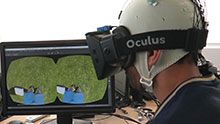
A screen grab from a video summarizing the experiment shows a patient learning to use an avatar to walk in virtual reality. Photograph courtesy of AASDAP/Lente Viva Filmes.

Eight people who have had paralysis for years from spinal cord injuries (SCIs) have regained partial sensation and muscle control in their lower limbs after training with brain-controlled robotics, according to a study published August 11 in Scientific Reports. The patients used brain-machine interfaces (BMIs)-fitted caps lined with 11 noninvasive electrodes to record their brain activity through EEG-and a virtual reality system that used their own brain activity to simulate full control of their legs. BMIs establish direct communication between the brain and computers, or prosthetics such as robotic limbs. During the course of their rehabilitation, the patients graduated from virtual reality to more challenging equipment that required more control over their posture, balance, and ability to use their upper limbs, using commercially available overhead harnesses to support the patient’s weight as he or she built strength and proper gait.

The research-led by Duke University neuroscientist Miguel Nicolelis, MD, PhD, as part of the Walk Again Project in São Paulo, Brazil-offers promise for people with SCIs, stroke, and other conditions to regain strength, mobility, and independence. Videos accompanying the study illustrates the cohort’s progress.

“What we’re showing in this paper is that patients who used a brain-machine interface for a long period of time experienced improvements in motor behavior, tactile sensations, and visceral functions below the level of the spinal cord injury. Until now, nobody has seen recovery of these functions in a patient so many years after being diagnosed with complete paralysis,” said Nicolelis, a professor of neurobiology, biomedical engineering, and psychology, and codirector of the Duke Center for Neuroengineering, who is originally from Brazil.

Several patients saw changes after seven months of training. After a year, four patients’ sensation and muscle control changed significantly enough that physicians upgraded their diagnoses from complete to partial paralysis. Most patients saw improvements in their bladder control and bowel function, he said.

Nicolelis and colleagues believe that through weekly training, the patients reengaged spinal cord nerves that survived the trauma that paralyzed their lower limbs. During most of their training, the participants also wore a sleeve equipped with haptic feedback to enrich the experience and train their brains. At the beginning of rehabilitation, five participants had had paralysis for at least five years and two for more than a decade. Patient 1, a 32-year-old woman who had paralysis for 13 years at the time of the trial, experienced perhaps the most dramatic changes, the researchers said. Early in training, she was unable to stand using braces, but over the course of the study, she walked using a walker, braces, and a therapist’s help. At 13 months, she was able to move her legs voluntarily while her body weight was supported in a harness.

Since the 1990s, Nicolelis has investigated how populations of brain cells represent sensory and motor information and how they generate behavior, including movements of upper and lower limbs. He has worked to build and hone systems that record hundreds of simultaneous signals from neurons in the brain, extracting motor commands from those signals and translating them into movement. One collaborative effort resulted in training rats to control a robotic lever to get a drink of water using only their brain activity. In later endeavors, Nicolelis trained rhesus monkeys to use BMIs to control robotic limbs, and later, the 3D movements of an avatar. The rhesus monkeys later learned to walk on a treadmill with robotic legs controlled by their brains. They also learned they could use thought to propel a small electric wheelchair toward a bowl of grapes.

The Duke experiments with rats and primates built a foundation for the work in human patients, including a 2004 article with Duke neurosurgeon Dennis Turner, MD, that established a model for recording brain activity in patients when they used a hand to grip a ball with varied force.
Nicolelis said the goal of these studies was to open doors for better prosthetics and brain-controlled devices for people with severe disabilities.

“Nobody expected we would see what we have found, which is partial neurological recovery of sensorimotor and visceral functions,” he said.


Editor’s note: This story was adapted from materials provided by Duke University.
Related posts:

  1. I, ROBOT
  2. BCI Devices Open Doors for People with Disabilities
  3. Partial-foot Amputation and Its Unexpected Evidence
  4. Monkeys Drive Wheelchairs Using Only Their Thoughts
Previous Post

Ekso Bionics Approved for Nasdaq Listing

Next Post

Amputee Coalition Announces Leadership Change

Next Post

Amputee Coalition Announces Leadership Change

 SUBSCRIBE FOR FREE


Get unlimited access!

Join EDGE ADVANTAGE and unlock The O&P EDGE's vast library of archived content.
SUBSCRIBE TODAY

O&P JOBS

Mountain

Orthotic and Prosthetic Technician

Pacific

Certified Prosthetist/Orthotist (CPO), Certified Orthotist (CO)

Central

Certified Prosthetist Orthotist (CPO and/or Board Eligible Clinician)

Linkedin X-twitter Facebook
The O&P EDGE Magazine
 
Required 'Candidate' login to applying this job. Click here to logout And try again
 

Login to your account

  • Forgot Password?

Reset Password

  • Already have an account? Login

Enter the username or e-mail you used in your profile. A password reset link will be sent to you by email.

Close
No Result
View All Result
  • PECOS
  • MAGAZINE
    • SUBSCRIBE
    • CURRENT ISSUE
    • ISSUE ARCHIVE
    • NEWS ARCHIVE
    • PRODUCTS & SERVICES DIRECTORY
    • ADVERTISING INFORMATION
  • O&P JOBS
    • FIND A JOB
    • POST A JOB
  • EDGE ADVANTAGE
    • EA Homepage
    • EA Data
  • FACILITIES
  • RESOURCES
    • PRODUCTS & SERVICES DIRECTORY
    • CALENDAR
    • CONTACT
    • ABOUT US
    • O&P LIBRARY
    • THE GUIDE
    • CUSTOM PUBLICATIONS
    • ADVERTISING INFORMATION
    • EDGE DIRECT
    • AMPLITUDE
  • OANDP-L
  • LOGIN

© 2025 The O&P EDGE

Are you sure want to unlock this post?
Unlock left : 0
Are you sure want to cancel subscription?
 

Account Activation

Before you can login, you must activate your account with the code sent to your email address. If you did not receive this email, please check your junk/spam folder. Click here to resend the activation email. If you entered an incorrect email address, you will need to re-register with the correct email address.


© 2024 The O&P EDGE

  • About
  • Advertise
  • Contact
  • EDGE Advantage
  • OANDP-L
  • Subscribe

CONTACT US

866-613-0257

info@opedge.com

201 E. 4th St.
Loveland, CO 80537

The most important industry news and events delivered directly to your inbox every week.

  • About
  • Advertise
  • Contact
  • EDGE Advantage
  • OANDP-L
  • Subscribe

© 2025 The O&P EDGE

Welcome Back!

Login to your account below

Forgotten Password?

Retrieve your password

Please enter your username or email address to reset your password.

Log In
The O&P EDGE Magazine
 
Required 'Candidate' login to applying this job. Click here to logout And try again
 

Login to your account

  • Forgot Password?

Reset Password

  • Already have an account? Login

Enter the username or e-mail you used in your profile. A password reset link will be sent to you by email.

Close
No Result
View All Result
  • PECOS
  • MAGAZINE
    • SUBSCRIBE
    • CURRENT ISSUE
    • ISSUE ARCHIVE
    • NEWS ARCHIVE
    • PRODUCTS & SERVICES DIRECTORY
    • ADVERTISING INFORMATION
  • O&P JOBS
    • FIND A JOB
    • POST A JOB
  • EDGE ADVANTAGE
    • EA Homepage
    • EA Data
  • FACILITIES
  • RESOURCES
    • PRODUCTS & SERVICES DIRECTORY
    • CALENDAR
    • CONTACT
    • ABOUT US
    • O&P LIBRARY
    • THE GUIDE
    • CUSTOM PUBLICATIONS
    • ADVERTISING INFORMATION
    • EDGE DIRECT
    • AMPLITUDE
  • OANDP-L
  • LOGIN

© 2025 The O&P EDGE

Are you sure want to unlock this post?
Unlock left : 0
Are you sure want to cancel subscription?
 

Account Activation

Before you can login, you must activate your account with the code sent to your email address. If you did not receive this email, please check your junk/spam folder. Click here to resend the activation email. If you entered an incorrect email address, you will need to re-register with the correct email address.