Researchers at Ecole Polytechnique Federale de Lausanne (EPFL) are collaborating with BionIT Labs, a developer of advanced robotic prostheses, on a new approach to sensory feedback for users of prosthetic devices. The WARMTH project approached development from an academic laboratory perspective with an industrial partner to address details such as usability, reliability, and design.
In EPFL’s Translational Neural
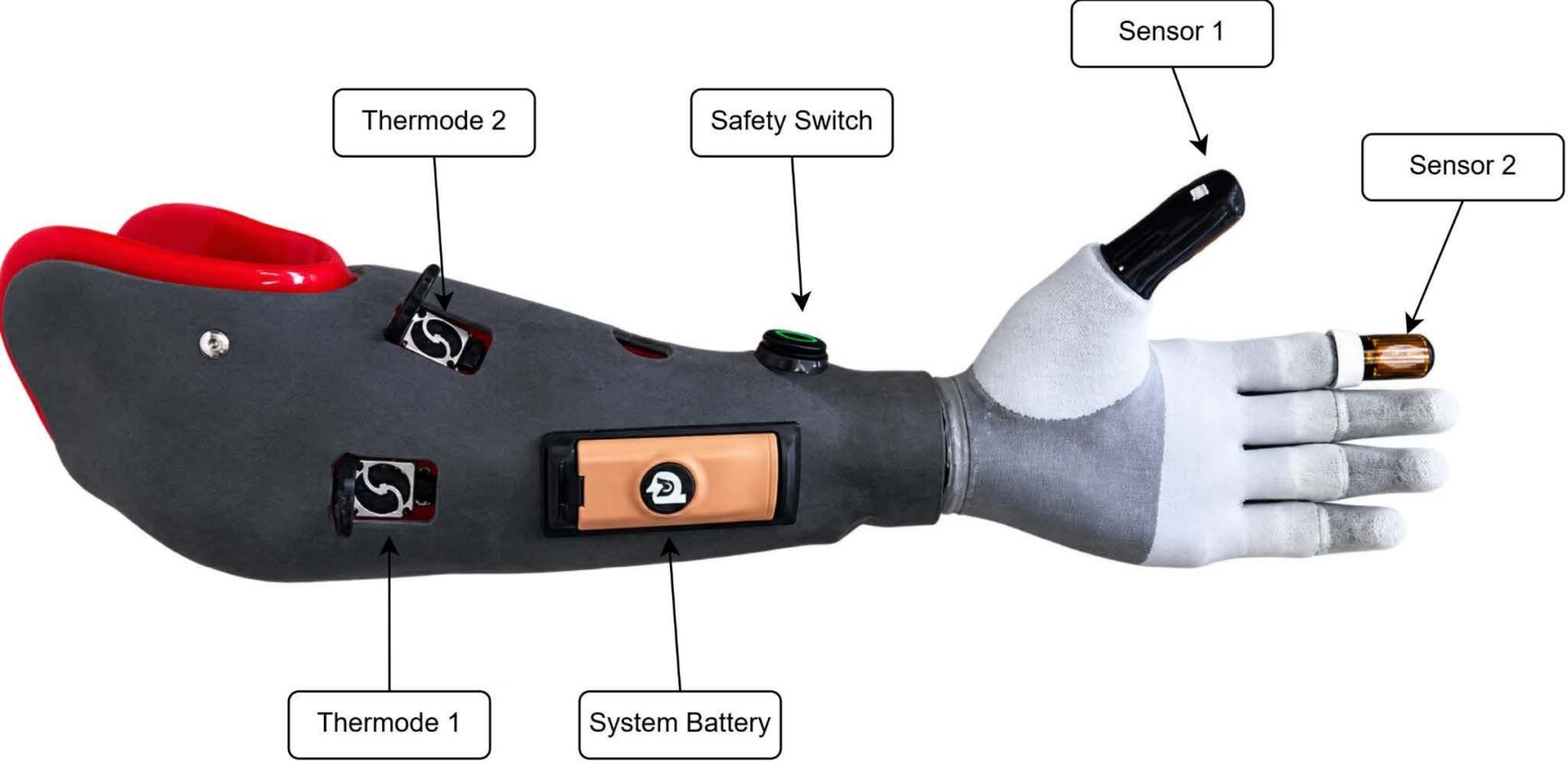
Engineering Laboratory (TNE), Silvestro Micera, PhD, Solaiman Shokur, PhD, and researcher and doctoral candidate Jonathan Muheim applied heating or cooling to specific areas of a person’s residual arm to evoke temperature sensations that feel as though they come from the missing hand. The research team developed a system called MiniTouch, combining a temperature sensor on a prosthetic fingertip with a small thermal stimulator placed on the residual arm. When the prosthesis touches an object, the system detects its temperature and reproduces a corresponding sensation on the skin. Early experiments showed promising results, the TNE team said, with participants able to perceive thermal differences through their prosthetic hands.
The engineering team at BionIT Labs helped refine the device, while the EPFL researchers ensured that its scientific functionality was preserved. The project gave the researchers a closer look at another side of innovation: how to protect and translate scientific discoveries into practical applications.
A refined prototype is ready for the next phase of testing. The next step will be to investigate how the system performs during longer-term experiments in a larger cohort of participants and how they interact with thermal feedback over time.
Editor’s note: This story was adapted from materials provided by EPFL.