

OANDP-L
  • Login
No Result
View All Result
The O&P EDGE
  • PECOS
  • Magazine
    • Subscription
    • Current Issue
    • Issue Archive
    • News Archive
    • Product & Service Directory
    • Advertising Information
    • EDGE Flipbooks
  • O&P Jobs
    • Find a Job
    • Post a Job
  • EDGE Advantage
    • EA Homepage
    • EA Data
  • O&P Facilities
  • Resources
    • Product & Service Directory
    • Calendar
    • Contact
    • About Us
    • O&P Library
    • The Guide
    • Custom Publications
    • Advertising Information
    • EDGE Direct
    • Amplitude Media Group
  • PECOS
  • Magazine
    • Subscription
    • Current Issue
    • Issue Archive
    • News Archive
    • Product & Service Directory
    • Advertising Information
    • EDGE Flipbooks
  • O&P Jobs
    • Find a Job
    • Post a Job
  • EDGE Advantage
    • EA Homepage
    • EA Data
  • O&P Facilities
  • Resources
    • Product & Service Directory
    • Calendar
    • Contact
    • About Us
    • O&P Library
    • The Guide
    • Custom Publications
    • Advertising Information
    • EDGE Direct
    • Amplitude Media Group
No Result
View All Result
The O&P EDGE Magazine
No Result
View All Result
Home News

Rehab Robots Shed Light on Human Gait

by The O&P EDGE
May 26, 2017
in News
0
SHARES
15
VIEWS
Share on FacebookShare on Twitter

A group of scientists has discovered a caveat for rehabilitative exoskeletons and their use in gait training: humans whose lower limbs are fastened to a typical clinical robot only modify their gait if the forces the robot applies threaten their walking stability. The study, led by Paolo Bonato, PhD, associate faculty member at the Wyss Institute for Biologically Inspired Engineering at Harvard University and director of the Motion Analysis Laboratory at Spaulding Rehabilitation Hospital, Boston, was published May 24 in Science Robotics.
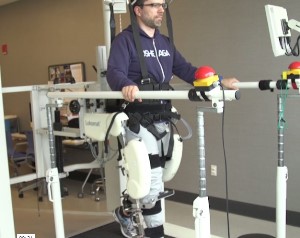
Screenshot of a video showing a user walking with the aid of a rehabilitation exoskeleton, courtesy of Wyss Institute.

The researchers measured how test subjects’ gait changed in response to forces applied by a robotic exoskeleton as they walked on a treadmill and found the walkers adjusted their stride in response to a change in the length, but not the height, of their step, even when step height and length were disturbed at the same time. The scientists believe that this discrepancy can be explained by the central nervous system’s primary reliance on stability when determining how to adjust to a disruption in normal walking. “Lifting your foot higher mid-stride doesn’t really make you that much less stable, whereas placing your foot closer or further away from your center of mass can really throw off your balance, so the body adjusts much more readily to that disturbance,” said Giacomo Severini, PhD, one of the three first authors of the paper, who is now an assistant professor at University College Dublin, Ireland.

In fact, the brain is so willing to adapt to instability that it will expend a significant amount of the body’s energy to do so, most likely because the consequences of wobbly walking can be severe, such as a broken ankle, torn ligaments, or even a fall from a height. However, this prioritization of stability means that other aspects of walking, like the height of the foot off the ground or the angle of the toes, may require treatment beyond walking in a clinical exoskeleton. “To modify step height, for example, you’d need to design forces so that the change in height, which the brain normally interprets as neutral, becomes challenging to the patient’s balance,” said Severini. Most robots used in clinical settings today do not allow for that kind of customization.

The brain appears to create an internal model of the body’s movement based on the environment and its normal gait, and effectively predicts each step. When reality differs from that model (i.e., when a force is applied), the brain adjusts the body’s step length accordingly to compensate until the force is removed and the body recalibrates to the mental model. “The results of our study give us insight into the way people adapt to external forces while walking in general, which is useful for clinicians when evaluating whether their patients will respond to clinical robot interventions,” said Bonato, who is also an associate professor at Harvard Medical School (HMS).

“The results of this research are very important from a clinical point of view,” said Ross Zafonte, DO, chairperson of the Department of Physical Medicine and Rehabilitation at HMS and senior vice president of medical affairs research and education at Spaulding Rehabilitation Hospital. “It is thanks to advances in our understanding of the interactions between robots and patients, such as the ones investigated in this study, that we can design effective robot-assisted gait therapy.”

Editor’s note: This story was adapted from materials provided by Wyss Institute for Biologically Inspired Engineering.

 

Related posts:

  1. I, ROBOT
  2. The Biomechanics of Running: Part 2
  3. Symmetry for Symmetry’s Sake: A Beneficial Goal in Prosthetic Gait?
  4. Key Roles in Dynamic Exoskeletons for O&P Practitioners
Previous Post

BCI Helps Stroke Patients Retrain Brains to Move Paralyzed Hands

Next Post

Zacharias Recognized as Top Women-led Business Leader

Next Post

Zacharias Recognized as Top Women-led Business Leader

 SUBSCRIBE FOR FREE


Get unlimited access!

Join EDGE ADVANTAGE and unlock The O&P EDGE's vast library of archived content.
SUBSCRIBE TODAY

O&P JOBS

Mountain

Orthotic and Prosthetic Technician

Pacific

Certified Prosthetist/Orthotist (CPO), Certified Orthotist (CO)

Central

Certified Prosthetist Orthotist (CPO and/or Board Eligible Clinician)

Linkedin X-twitter Facebook
The O&P EDGE Magazine
 
Required 'Candidate' login to applying this job. Click here to logout And try again
 

Login to your account

  • Forgot Password?

Reset Password

  • Already have an account? Login

Enter the username or e-mail you used in your profile. A password reset link will be sent to you by email.

Close
No Result
View All Result
  • PECOS
  • MAGAZINE
    • SUBSCRIBE
    • CURRENT ISSUE
    • ISSUE ARCHIVE
    • NEWS ARCHIVE
    • PRODUCTS & SERVICES DIRECTORY
    • ADVERTISING INFORMATION
  • O&P JOBS
    • FIND A JOB
    • POST A JOB
  • EDGE ADVANTAGE
    • EA Homepage
    • EA Data
  • FACILITIES
  • RESOURCES
    • PRODUCTS & SERVICES DIRECTORY
    • CALENDAR
    • CONTACT
    • ABOUT US
    • O&P LIBRARY
    • THE GUIDE
    • CUSTOM PUBLICATIONS
    • ADVERTISING INFORMATION
    • EDGE DIRECT
    • AMPLITUDE
  • OANDP-L
  • LOGIN

© 2025 The O&P EDGE

Are you sure want to unlock this post?
Unlock left : 0
Are you sure want to cancel subscription?
 

Account Activation

Before you can login, you must activate your account with the code sent to your email address. If you did not receive this email, please check your junk/spam folder. Click here to resend the activation email. If you entered an incorrect email address, you will need to re-register with the correct email address.


© 2024 The O&P EDGE

  • About
  • Advertise
  • Contact
  • EDGE Advantage
  • OANDP-L
  • Subscribe

CONTACT US

866-613-0257

info@opedge.com

201 E. 4th St.
Loveland, CO 80537

The most important industry news and events delivered directly to your inbox every week.

  • About
  • Advertise
  • Contact
  • EDGE Advantage
  • OANDP-L
  • Subscribe

© 2025 The O&P EDGE

Welcome Back!

Login to your account below

Forgotten Password?

Retrieve your password

Please enter your username or email address to reset your password.

Log In
The O&P EDGE Magazine
 
Required 'Candidate' login to applying this job. Click here to logout And try again
 

Login to your account

  • Forgot Password?

Reset Password

  • Already have an account? Login

Enter the username or e-mail you used in your profile. A password reset link will be sent to you by email.

Close
No Result
View All Result
  • PECOS
  • MAGAZINE
    • SUBSCRIBE
    • CURRENT ISSUE
    • ISSUE ARCHIVE
    • NEWS ARCHIVE
    • PRODUCTS & SERVICES DIRECTORY
    • ADVERTISING INFORMATION
  • O&P JOBS
    • FIND A JOB
    • POST A JOB
  • EDGE ADVANTAGE
    • EA Homepage
    • EA Data
  • FACILITIES
  • RESOURCES
    • PRODUCTS & SERVICES DIRECTORY
    • CALENDAR
    • CONTACT
    • ABOUT US
    • O&P LIBRARY
    • THE GUIDE
    • CUSTOM PUBLICATIONS
    • ADVERTISING INFORMATION
    • EDGE DIRECT
    • AMPLITUDE
  • OANDP-L
  • LOGIN

© 2025 The O&P EDGE

Are you sure want to unlock this post?
Unlock left : 0
Are you sure want to cancel subscription?
 

Account Activation

Before you can login, you must activate your account with the code sent to your email address. If you did not receive this email, please check your junk/spam folder. Click here to resend the activation email. If you entered an incorrect email address, you will need to re-register with the correct email address.