

OANDP-L
  • Login
No Result
View All Result
The O&P EDGE
  • PECOS
  • Magazine
    • Subscription
    • Current Issue
    • Issue Archive
    • News Archive
    • Product & Service Directory
    • Advertising Information
    • EDGE Flipbooks
  • O&P Jobs
    • Find a Job
    • Post a Job
  • EDGE Advantage
    • EA Homepage
    • EA Data
  • O&P Facilities
  • Resources
    • Product & Service Directory
    • Calendar
    • Contact
    • About Us
    • O&P Library
    • The Guide
    • Custom Publications
    • Advertising Information
    • EDGE Direct
    • Amplitude Media Group
  • PECOS
  • Magazine
    • Subscription
    • Current Issue
    • Issue Archive
    • News Archive
    • Product & Service Directory
    • Advertising Information
    • EDGE Flipbooks
  • O&P Jobs
    • Find a Job
    • Post a Job
  • EDGE Advantage
    • EA Homepage
    • EA Data
  • O&P Facilities
  • Resources
    • Product & Service Directory
    • Calendar
    • Contact
    • About Us
    • O&P Library
    • The Guide
    • Custom Publications
    • Advertising Information
    • EDGE Direct
    • Amplitude Media Group
No Result
View All Result
The O&P EDGE Magazine
No Result
View All Result
Home News

Research Shows Steady Improvements in War Amputees

by The O&P EDGE
April 23, 2026
in News
0
SHARES
17
VIEWS
Share on FacebookShare on Twitter

Results of a new study that followed Ukrainians with war-related amputations for one year found that most participants showed steady improvements in pain, mental health, and quality of life. The study was led by Northwestern Medicine and collaborators in Ukraine.

The research is the first to track over time how anxiety, depression, and quality of life interact with pain in people following an amputation, according to the authors. The researchers also sought to answer a long-standing question about chronic pain: Does pain drive emotional distress, or does distress drive pain?
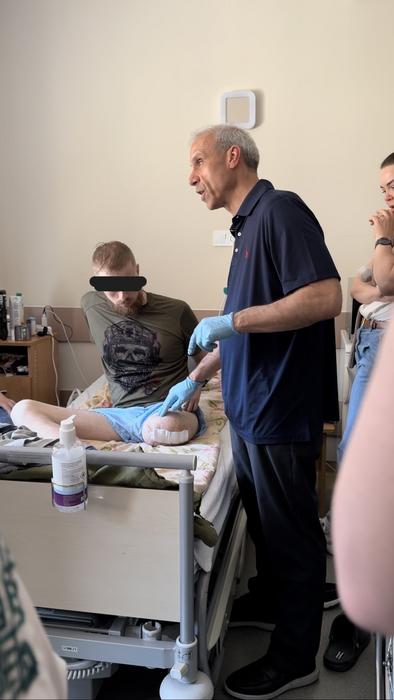
Cohen evaluating a Ukrainian servicemember with a lower-limb amputation. Photograph courtesy of Northwestern University.

The study followed 156 Ukrainians with blast-related injuries and predominantly unilateral lower-limb amputations. Most participants were in their mid-30s and had served in the war. They entered the study a median of 3.7 months after amputation and were followed for one year, with evaluations at baseline, three, six, and 12 months.

At each time point, scientists measured pain on a 0-10 scale, anxiety and depression using validated clinical scales, and overall quality of life on a 0-100 scale. Over 12 months, median outcomes improved substantially across all measures:

  • Phantom limb pain dropped from 4.3 to 1.1
  • Residual limb pain dropped from 3.8 to 0.4
  • Anxiety scores fell by more than half
  • Depression declined steadily
  • Quality of life improved from 57.8 to 77.2

The participants all received standard of care within a large medical system in western Ukraine during the study period. That included physical rehabilitation, psychological therapies, and medications, such as antidepressants and nerve-targeting drugs, but not opioids. Some patients also underwent additional procedures, such as nerve-targeted interventions or surgery.

The research team used statistical models to determine how pain and psychological factors were related and how they influenced one another over time.

For phantom limb pain, psychological distress tended to come first. Specifically, those who had higher levels of depression or poorer quality of life (poor social support, poor function, and poor sleep) shortly after their injury were more likely to report persistent phantom pain months later.

For residual limb pain, the pattern was different. Participants with more severe residual pain at baseline were more likely to develop depression over time. The researchers suggested that could be because residual limb pain often prevents prosthesis use, which limits mobility.

According to the authors, the study supports a new two-staged understanding of post-amputation recovery. Early improvements in pain are driven largely by healing over time and medical care. But later, lingering post-amputation pain appears to be more strongly linked with psychological health and quality of life.

“Thus, people with persistent post-amputation pain need to be continually screened for psychologic distress,” said study senior author Steven P. Cohen, MD, professor of anesthesiology and the vice chair of research and pain medicine, Northwestern University Feinberg School of Medicine.

Cohen also noted that the findings are encouraging and can help with counseling and setting expectations. “People are likely to improve and recover, so they may be less likely to worry and become depressed and anxious,” Cohen said. “Still, worse post-amputation pain, particularly for residual limb pain, can lead people to be depressed, creating a vicious circle.”

Cohen, who traveled to Ukraine in 2024 to help launch the study, is a retired US Army colonel who served four overseas tours in support of military operations. He noted that the findings come from a unique population who were generally previously healthy (a requirement for joining the military) prior to serving in the war and suffered intense physical and psychological trauma.

Cohen said future research will need to examine how pain and emotional distress interact over time in other civilian groups with trauma and chronic pain. He also said that more research is needed to test whether targeted and alternative treatments for psychological distress, such as psychotherapy, biofeedback, or ketamine infusions, can improve pain outcomes.

Editor’s note: This story was adapted from materials provided by Northwestern University.

The open-access study, “The association between quality of life, anxiety and depression, and residual limb and phantom limb pain in war-related amputees: A year-long observational study,” which was partially funded by the U.S. Department of Defense (via the Department of Physical Medicine & Rehabilitation at Uniformed Services University), was published in eClinicalMedicine.



Related posts:

  1. Pedorthic Education, an Update
  2. Using Medical Ethics to Prevent Burnout in O&P
  3. Getting in the Game.. .Staying in the Game
  4. Clinical Notes: Everyone’s Favorite Topic
Previous Post

Morphology, Biomechanics Affected by Sever Disease

Next Post

Empowerment and Veteran Grants Available

Next Post

Empowerment and Veteran Grants Available

 SUBSCRIBE FOR FREE


O&P JOBS

Eastern

CPO / CP

Pacific

CPO, CP or Resident

Eastern

Position Open for a Certified Orthotist

Linkedin X-twitter Facebook

Get unlimited access!

Join EDGE ADVANTAGE and unlock The O&P EDGE's vast library of archived content.
SUBSCRIBE TODAY
The O&P EDGE Magazine
 
Required 'Candidate' login to applying this job. Click here to logout And try again
 

Login to your account

  • Forgot Password?

Reset Password

  • Already have an account? Login

Enter the username or e-mail you used in your profile. A password reset link will be sent to you by email.

Close
No Result
View All Result
  • PECOS
  • MAGAZINE
    • SUBSCRIBE
    • CURRENT ISSUE
    • ISSUE ARCHIVE
    • NEWS ARCHIVE
    • PRODUCTS & SERVICES DIRECTORY
    • ADVERTISING INFORMATION
  • O&P JOBS
    • FIND A JOB
    • POST A JOB
  • EDGE ADVANTAGE
    • EA Homepage
    • EA Data
  • FACILITIES
  • RESOURCES
    • PRODUCTS & SERVICES DIRECTORY
    • CALENDAR
    • CONTACT
    • ABOUT US
    • O&P LIBRARY
    • THE GUIDE
    • CUSTOM PUBLICATIONS
    • ADVERTISING INFORMATION
    • EDGE DIRECT
    • AMPLITUDE
  • OANDP-L
  • LOGIN

© 2026 The O&P EDGE

Are you sure want to unlock this post?
Unlock left : 0
Are you sure want to cancel subscription?
 

Account Activation

Before you can login, you must activate your account with the code sent to your email address. If you did not receive this email, please check your junk/spam folder. Click here to resend the activation email. If you entered an incorrect email address, you will need to re-register with the correct email address.


© 2024 The O&P EDGE

  • About
  • Advertise
  • Contact
  • EDGE Advantage
  • OANDP-L
  • Subscribe

CONTACT US

866-613-0257

info@opedge.com

201 E. 4th St.
Loveland, CO 80537

The most important industry news and events delivered directly to your inbox every week.

  • About
  • Advertise
  • Contact
  • EDGE Advantage
  • OANDP-L
  • Subscribe

© 2026 The O&P EDGE

Welcome Back!

Login to your account below

Forgotten Password?

Retrieve your password

Please enter your username or email address to reset your password.

Log In
The O&P EDGE Magazine
 
Required 'Candidate' login to applying this job. Click here to logout And try again
 

Login to your account

  • Forgot Password?

Reset Password

  • Already have an account? Login

Enter the username or e-mail you used in your profile. A password reset link will be sent to you by email.

Close
No Result
View All Result
  • PECOS
  • MAGAZINE
    • SUBSCRIBE
    • CURRENT ISSUE
    • ISSUE ARCHIVE
    • NEWS ARCHIVE
    • PRODUCTS & SERVICES DIRECTORY
    • ADVERTISING INFORMATION
  • O&P JOBS
    • FIND A JOB
    • POST A JOB
  • EDGE ADVANTAGE
    • EA Homepage
    • EA Data
  • FACILITIES
  • RESOURCES
    • PRODUCTS & SERVICES DIRECTORY
    • CALENDAR
    • CONTACT
    • ABOUT US
    • O&P LIBRARY
    • THE GUIDE
    • CUSTOM PUBLICATIONS
    • ADVERTISING INFORMATION
    • EDGE DIRECT
    • AMPLITUDE
  • OANDP-L
  • LOGIN

© 2026 The O&P EDGE

Are you sure want to unlock this post?
Unlock left : 0
Are you sure want to cancel subscription?
 

Account Activation

Before you can login, you must activate your account with the code sent to your email address. If you did not receive this email, please check your junk/spam folder. Click here to resend the activation email. If you entered an incorrect email address, you will need to re-register with the correct email address.