
About five years ago I played pickleball casually for the first time, a sport that almost five million Americans played at that time.¹
Earlier this summer I joined a coed beginner league and began playing more regularly, becoming one of the more than 24 million Americans (some estimates are as higher 50 million) who have made this sport the fastest growing in the United States over the past three years.1,2 After consistently occupying the top positions on the leaderboard, I decided to join the Men’s Social Scramble League, comprised of players with far more skill. As expected, the higher level of play increased my motivation to improve by highlighting my relative inexperience and providing constant opportunities to develop specific skills using examples of and encouragement from superior players.
What I did not expect was how shaming this experience would be. I was often not just embarrassed by my mistakes but felt a deeper sense of inadequacy, particularly following the ultimate humiliation of being “pickled,” losing a game without scoring a point.
Seeing my name frequently on the lowest levels of the leaderboard was not a complete surprise, and the other players were supportive despite my inadequacies. But the constant reminder of my limited skill and the frequent feeling of having let my partners down sometimes felt like more than my ego could handle. Frequently during games, I would find myself “overthinking and overanalyzing” and developing “a repetitive thought cycle focusing on causes, consequences, and symptoms” of an error.3,4 Rather than trusting the skills I had already developed, being “in my head” this way often resulted in reverting to a lower level of play and making basic mistakes more frequently.3 I questioned whether I belonged in a league of this level and considered quitting on more than one occasion. There was no overt pressure from the circumstances (a recreational league) or other players that demanded I play more skillfully. All this pressure was generated internally by my own recognition that I was not performing at a high level, and more, importantly, a belief that I was flawed as a player.
What Is Shame?
Shame “occurs when an individual attributes a negative outcome to a globally flawed self.”5 It “is an emotion often characterized by a negative representation of the self, such as feeling inferior or deficient, vulnerable to judgement and even worthless.”6 Shame is “often preceded by the ‘sudden awareness of a deficiency of the self, a goal not reached’ that involves the concern about how one is perceived and judged by others, whether real or imagined.”6 As an “exclusively internal phenomenon” that is intimately linked to self-perception and stigmatized in society, shame is difficult—though not impossible—to observe, openly express, and identify.”5
Feelings of shame in social situations or while participating in recreational sports often have minimal negative effects. (I survived the Monday night pickleball experiences and have signed up for an upcoming league.) The effects of shame experienced in the context of clinical education and practice, however, can have more serious ramifications on learning and professional development.
Shame in Clinical Education
Along with several collaborators, William Bynum, MD, an academic family medicine physician and residency program director, published two reports about interviews conducted with 16 medical students.5,7 The first report focused on how shame originates and “what events trigger and factors influence the development of shame in medical students.”7 The second report focused on the nature of shame reactions…including “how they feel, what actions they prompt, and what effects they cause…. After shame has been triggered in medical students, how is it experienced?”5 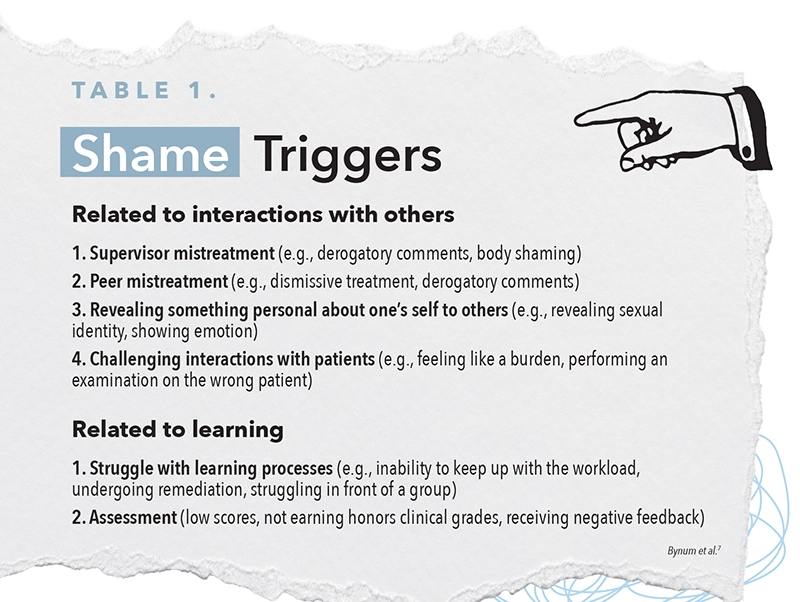
In the first report, Bynum used the metaphor of fire to conceptualize the students’ shame experiences.7 “Shame triggers were the specific events that sparked shame reactions…. Shame promoters [propellants] were the factors and characteristics that fueled shame reactions” and “increased the risk of developing a shame reaction or amplified the intensity or duration of an already triggered shame reaction.”7 (See Tables 1 and 2.)
According to Bynum et al., “numerous participants reported shame reactions triggered by events considered normal and expected in the course of learning medicine, such as being wrong, struggling in public, and receiving negative feedback.”7 While these triggers cannot be completely removed from a learning environment without compromising the educational mandate, being aware of the effect they may have on students can facilitate the development of teaching approaches that mitigate some of this response.
Bynum et al. went on to state that “the tendency for these events to cause shame appeared to be influenced by personal characteristics such as the presence of fixed mindsets and performance-based self-esteem. Fixed (i.e., entity) mindsets, defined as the belief that intellectual ability is fixed and unchangeable, appeared to increase the risk of shame (e.g., ‘I’ll never be smart enough do this; therefore, I’m stupid’), and shame reactions appeared to entrench fixed mindsets (e.g., ‘I’m stupid; therefore, I’ll never be smart enough to do this’).”7 For many participants, the presence of a fixed mindset turned a normal learning struggle into proof of global unworthiness or deficiency (i.e., shame).7 Bynum also studied shame in medical residents, and found that “while objective assessment was an infrequent shame trigger…the transition from objective to subjective assessment—defined by the relative lack of a measuring stick—was the greater contributor to resident shame, especially when they relied on overly harsh self-assessments in the place of objective markers.”7
The Effects of Shame
In the second report, Bynum et al. identified “specific component parts of participants’ lived experiences with shame,” which are including in Table 3.5 According to Bynum, participants reported “persistent, intrusive ruminations about the triggering event,” similar to my experience after making an error when playing pickleball.5 Unlike reflection, a more helpful approach to processing an error or event, rumination contributes to reduced learning and performance by impeding concentration and accurate self-assessment.5 Rumination is also “a well-established risk factor for depression and anxiety.”3,4 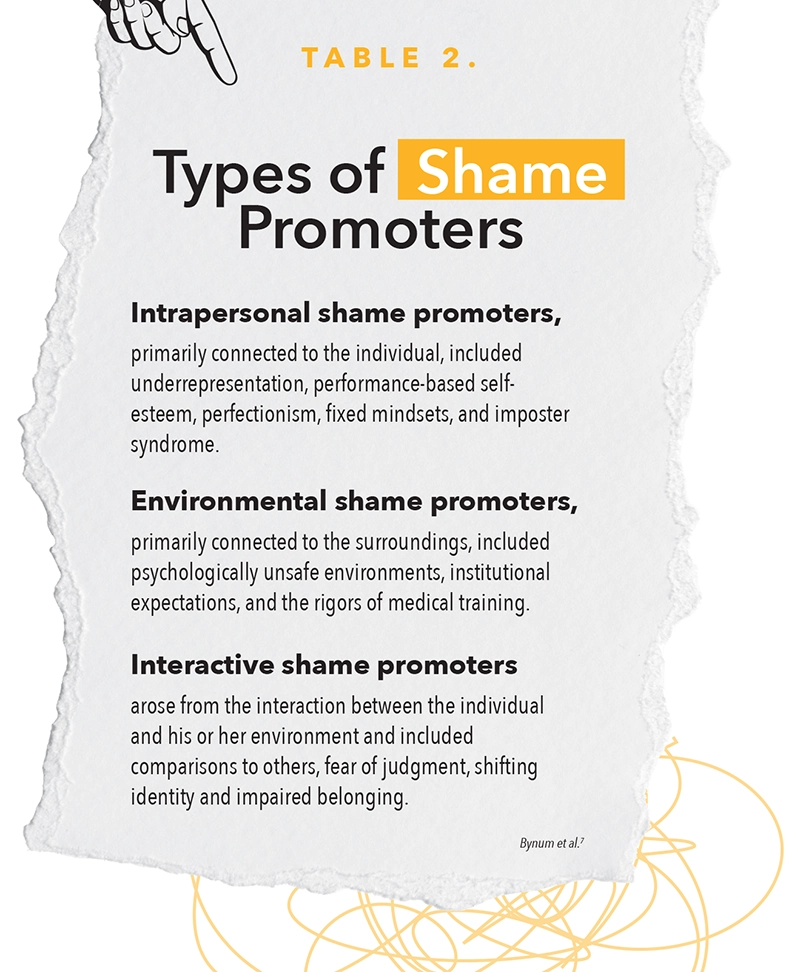
The effect of shame on self-assessment is particularly concerning, since an accurate perception of performance is essential for the self-directed learning that must occur in a clinical setting. Bynum reported that “skewed frames of reference…impaired participants’ ability to rationally and objectively self-evaluate. Self-evaluating through these distorted frames magnified participants’ negative characteristics and failures and minimized—or completely opacified—their positive characteristics and achievements.”5 This is closely connected with the imposter phenomenon, which was the subject of an article in The O&P EDGE earlier this year.8
Dealing With Shame
According to a scoping review on shame in medical encounters by nursing researcher Michael Jaeb, PhD, RN, “there is a lack of specificity about how to bring up topics involving stigma or trauma without making patients feel inferior, how to respond to patients in a nonjudgmental manner, or how to ask patients about their concerns related to these topics without instigating shame.”6 There is also “a gap in the link between which health professional communication strategies are best practices for avoiding and reducing shame.”6 It is likely that this applies to instructors and trainees in an academic or clinical setting. Since shame is experienced inwardly, clinical educators are often unaware when trainees are experiencing this debilitating emotion and should not assume that it is only learners who are performing at a low level who are experiencing it. Understanding shame as a common (if not universal) human experience provides a rationale for developing teaching approaches that address it.
Faculty at the Northwestern University Prosthetics-Orthotics Center (NUPOC) have implemented elements throughout the Master’s of Prosthetics and Orthotics program curriculum to address issues linked to experiences of shame.
Ungrading
This educational practice refers to de-emphasizing grades as a measure of learning. While objective reports of performance using letter grades or points remains a part of assessment, greater emphasis is placed on qualitative feedback. This more closely matches the way performance is assessed in clinical practice and helps instructors and students focus on more qualitative learning objectives. The responsibility to prepare students for clinical practice is more effectively addressed by assessing competency, which is much more complex than a grade or point percentage can communicate. Assessing competency in O&P is particularly difficult, since few objective criteria for determining success exist in clinical practice. It is also important to keep in mind that participants in Bynum’s study of residents identified qualitative assessment as more shame-inducing than objective assessment. Instructors at NUPOC have collaborated on projects to identify assessment criteria for various clinical tasks, and the faculty at Baylor College of Medicine’s O&P program have published research related to assessing hand skills. Identifying specific assessment criteria based on a consensus of qualified trainers may help mitigate some negative reactions in students.
Mindy Thorpe, MS-IDS, CPO, assistant professor, NUPOC, has integrated content during the first quarter of the program that addresses key concepts related to effective learning, including reflection, the growth mindset, and feedback.
Feedback
The ability to receive and interpret feedback is crucial to learning and growth in any context. Students review content based on the book Thanks for the Feedback: The Science and Art of Receiving Feedback Well by Douglas Stone and Sheila Heen. The authors identified three triggers that cause us to reject or react defensively to feedback. The “identity trigger” challenges our view of ourselves in a negative way. Rather than seeing feedback on performance as it was intended, students often perceive it as an attack on who they are as a person. (This is the most common response from students when prompted to identify the trigger they struggle with.) Being aware of this trigger can help both students and clinical trainers structure learning environments to minimize this response.
Reflection
Students are taught about the importance of reflection as a professional skill and have many opportunities to reflect on their performance in clinical activities. Emphasis is placed on identifying positive aspects of performance, since trainees are often more focused on ways their work and results are below the expectations of instructors or their own aspirations. These assignments provide opportunities for instructors to more effectively identify and address the specific learning needs of individual students, and to affirm progress that the student has made. 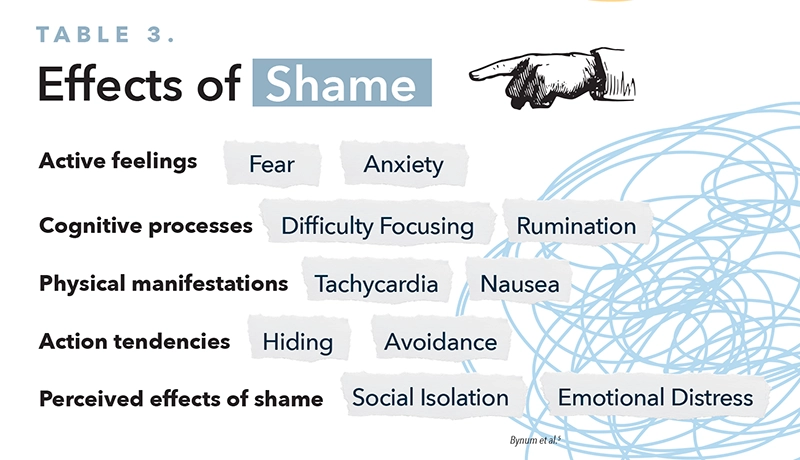
The Gap and the Gain
While identifying the gap between current and ideal future performance can provide some motivation to learn, it can also be a barrier to ongoing success. In content based on the book The Gap and The Gain by psychologist Benjamin Hardy, students are encouraged to focus on past successes (the gain), rather than on how performance did not meet an objective (the gap). This focus on past success can build self-efficacy and increase confidence that performance can continue to improve.
Residency supervisors and their clinical mentors can find book summaries and videos on these content areas that can be viewed and integrated into that phase of clinical training.
Closing Thoughts
Learning is challenging. At times, the recognition that our knowledge or performance is lacking can cause strong negative internal reactions. Being aware of the way that shame operates can help us reduce the effects of this “extremely painful and ugly feeling.”5
John T. Brinkmann, MA, CPO/L, FAAOP(D), is an associate professor at NUPOC. He has over 30 years of experience in patient care and education.
References
- https://sfia.org/research/u-s-pickleball-participation/
- https://www.theapp.global/news/nearly-50-million-adult-americans-have-played-pickleball
- https://www.psychologytoday.com/us/blog/click-here-for-happiness/202209/what-to-do-when-you-are-in-your-head
- https://www.berkeleywellbeing.com/rumination.html
- Bynum IV, W. E., P. W. Teunissen, and L. Varpio. 2021. In the “shadow of shame”: A phenomenological exploration of the nature of shame experiences in medical students. Academic Medicine96(S2):S23-S30.
- Jaeb, M. A., and K.E. Pecanac. 2024. Shame in patient‐health professional encounters: A scoping review. International Journal of Mental Health Nursing33(5):1158-69.
- Bynum IV, W. E., L. Varpio, J. Lagoo, and P. W. Teunissen. 2021.‘I’m unworthy of being in this space’: The origins of shame in medical students. Medical Education55(2):185-97.
- Brinkmann, J. 2026. Of pandas and imposter syndrome. The O&P EDGE 25(2):26-32.
Clinician Image: Krakenimages.com/srock.adobe.com