
Around two years ago I set out to determine if I could create a functional and adjustable transtibial prosthesis from bicycle parts and a wicker basket. I had no idea how the notion could evolve, but I simply had to see if it could be done. I was motivated by the staggering number of people with amputations worldwide who will never get to walk with a traditional prosthesis due to a lack of resources/infrastructure.
While visiting Mary Free Bed Hospital in 2025, Abena Tannor, MD, a sports, exercise, and rehabilitation physician in Ghana, noticed a bike leg I had built and invited me to teach students and staff at a prosthetics school in Ghana to make the device. The country has an annual average income of roughly $3,000. Lower-limb prostheses cost $300-$700. SACH-type feet are used most often and last one to two years at best.
In March, with the gracious sponsorship of Mary Free Bed Hospital, I traveled to Brother Tarcisius Prosthetics and Orthotics Training College in Nsawam, Ghana. The plan for my visit was to craft a transtibial and transfemoral prosthesis out of locally sourced materials with a handful of students assisting me. We encountered some limitations, but I was amazed at how resourceful the students were as we rigged up solutions with what we had. A local basket weaver created the sockets over plaster models of the intended limbs. The transtibial trial patient ambulated without an assistive device on the second day. The students and staff were impressed with the device and with the adjustments we could implement to hone his gait cycle. 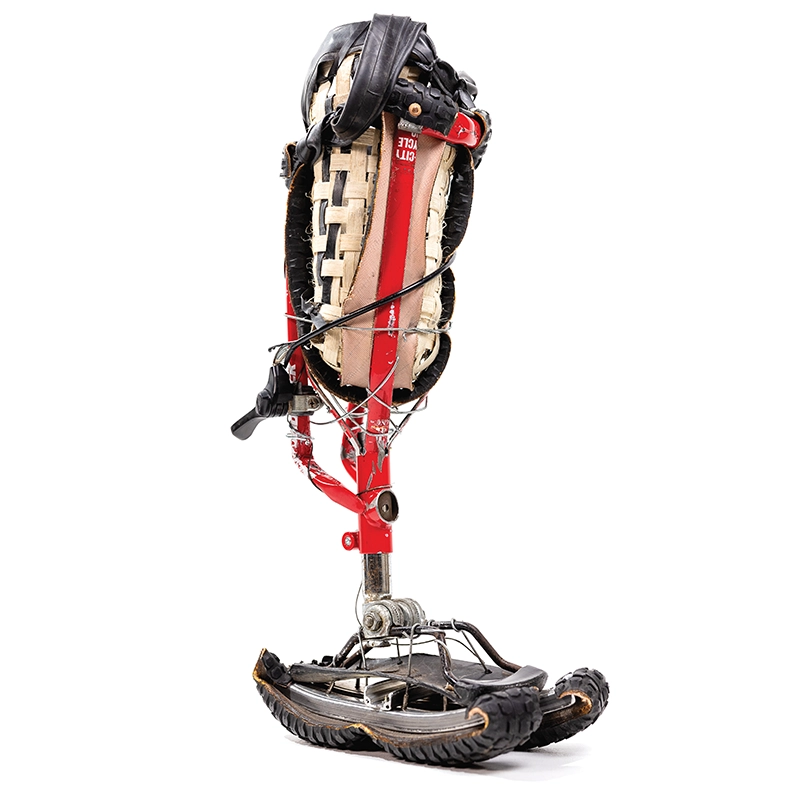
For the transfemoral leg, the students made the foot from start to finish by themselves after learning the process with the transtibial leg. We encountered an issue when a frame cracked when being bent, but a local welder reinforced the section. By day four, the transfemoral trial patient was ambulating without an assistive device and with the knee articulating (without a flexion lock). He remarked at how ergonomically sound the function of the knee was.
The school is attempting to spread the fabrication methods to surrounding clinics with the hope of reaching fringe areas that may utilize the technique when a traditional prosthesis isn’t possible. I remain on call to analyze issues/situations as they arise.
I believe that individuals who lack the means to achieve a traditional prosthesis have the right to access alternative fabrication methods that rely on core prosthetic concepts. That being said, I do find it hard to imagine a DIY methodology ever being sanctioned by any aid agency/international body as it cannot be properly certified as existing products have been. It seems that the question of what is right or wrong hinges on how current outreach strategies are succeeding or failing, and whether or not novel approaches can be accepted as a means to close the access gap.
My hope is to act as a steward to facilitate awareness of the bike leg as an option when there is no other way forward. I believe that we can leverage the power of the internet and combine it with core principles of prosthetic science to usher in a new definition of what a prosthesis can be.
Ben Hogan, CPO, is a clinician with Mary Free Bed Rehabilitation Hospital, Michigan, in the Orthotics & Prosthetics + Bionics department. He can be contacted at mtbhogan@gmail.com.