
Alexander “Avi” Davidson is taking part in a first-of-its-kind clinical trial as the inaugural participant to bring home Utah’s Luke Skywalker-inspired bionic arm. The trial will follow Davidson as he uses the technology at home for one year, with the possibility of a longer extension. It will provide a rare look at whether nerve-connected prosthetic technology enhances daily life for people with limb loss.
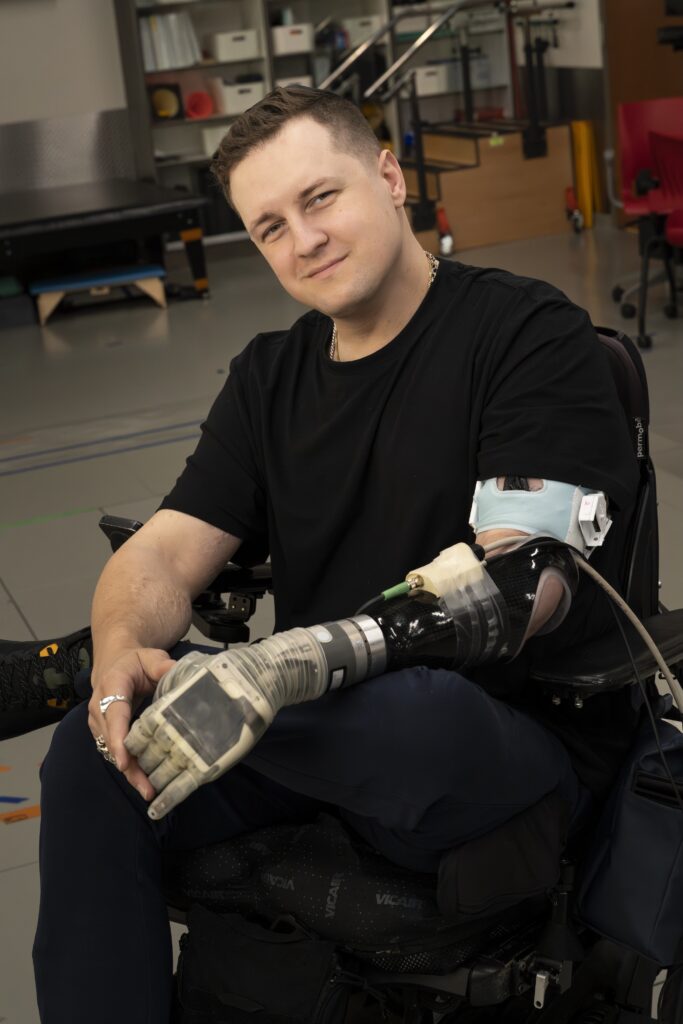
Davidson is the ninth participant to be involved in the research at the University of Utah. Others have helped test the interface’s increasing array of capabilities, including the ability to provide bionic arm users with a sense of touch. Until now, testing has remained largely limited to laboratory settings.
Powered by a direct nerve interface, called the BIOS Controller, the neural interface technology allows Davidson to control the bionic arm with his thoughts while restoring a sense of touch so that it feels similar to using his own arm. Within days of use, he was able to carry out routine tasks, including writing, playing cards, making a sandwich, and holding his wife’s hand.
Each of the previous participants used the device under supervision of engineers and clinicians on the University of Utah’s campus. But the latest iteration of the technology’s software and artificial intelligence allows for more life-like sensation, increased dexterity, and more intuitive control, making unsupervised, everyday use feasible for the first time. The home trial explores how well the neuroprosthetic meets the demands of daily life and whether it is useful and intuitive enough for participants to want to keep using it long term.
Davidson, 33, fell 35 feet from a telephone pole when he was 16 years old, leaving him with paraplegia and leading to a left transradial amputation.
“The ability to have a return of sensation to my previously dominant hand is a life-altering experience, as I never imagined feeling any part of that hand in my lifetime, let alone for it to feel so authentic,” Davidson said. “The ability to recognize how much pressure I’m putting on my wife’s hand and to feel hers back in mine is a wild idea to internalize. This technology has the potential to reconnect so many individuals to a reality they did not believe possible.”
The trial will follow Davidson as he uses the technology at home for one year, with the possibility of a longer extension. It will provide a rare look at whether nerve-connected prosthetic technology enhances daily life for people with limb loss. He is documenting the journey on Instagram.
Davidson has tested other robotic prosthetics but says that none have the range of movement, fine control, sensory feedback, and ease of use that the thought-controlled prosthetic has.
“Clinical trial participants are experiencing the world in a whole new way that really shapes and encourages our research and development and inspires us to keep working on this technology,” said Jacob A. George, PhD, director of the Utah NeuroRobotics Lab. “The goal is to ultimately transform the standard of life and quality of care for individuals with limb loss.”
George has been developing the University of Utah’s Skywalker-style bionic arm since 2015. Based on the LUKE Arm, a commercially available advanced robotic prosthesis made by DEKA, the Utah arm incorporates the BIOS direct nerve interface to make it a true neuroprosthesis.
Despite recent technological advances, many prosthesis users prefer a body-powered hooks owing to robotic arms’ cumbersome controls. Researchers believe that direct nerve interfaces are poised to fundamentally change this dynamic.
“Because of the presence of sensation, it allows that access to do more things in a different context that wouldn’t be possible with other prosthetic devices,” said Leanne Seckinger, OTR, who has been helping Davidson integrate his use of the neuroprosthesis into daily life.
A partnership with spin-out Biologic Input Output Systems (BIOS) is supporting the university’s ongoing Investigational Device Exception Early Feasibility Study, allowing for the recruitment of this participant.
The technology earned the BIOS direct nerve interface a Breakthrough Devices Program designation from the Food and Drug Administration (FDA) in 2024, as well as admission into its Total Product Lifecycle Advisory Program. The FDA uses the programs to fast-track promising experimental medical devices toward everyday use.
The BIOS direct nerve interface can also be integrated with other technology, like other robots, virtual reality systems, or phones/computers, so that individuals can seamlessly control and feel from their devices with just their thoughts.
“The possibilities truly are endless,” George says. “With this technology, we can create an inclusive world for everyone, regardless of their physical capabilities.”
Editor’s note: This story was adapted from materials provided by the University of Utah.