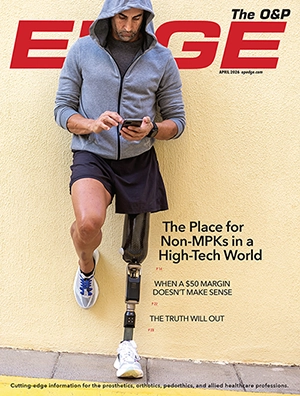

Highly specialized multidisciplinary rehabilitation teams that support limb-loss patients are called upon to develop and amplify their skill sets to collaborate with medical partners who use advanced techniques like upper-limb reconstruction, osseointegration, and more. To achieve best outcomes for their patients, here’s what some surgeons, therapists, and prosthetists recommended.
Omri Ayalon, MD, says, “The team members we have [in the Center for Amputation Reconstruction clinic] are really the gems that make everything work. They’re people who are passionate about taking care of individuals with limb loss, and specifically who are experts in their fields. Our clinic takes care of people with upper- and lower-extremity limb loss, so as such we have team members who have dedicated their careers to this population. We couldn’t have the success that we’re having without our team. Recruiting these individuals was probably the most important thing that Dr. [Jacques] Hacquebord and myself have done.”
Diane Atkins, OTR/L, FISPO, Amputee Clinical Specialist, assistant clinical professor, Department of Physical Medicine and Rehabilitation, Baylor College of Medicine, says, “A critical ingredient that I discovered during the many years of coordinating and helping direct an amputee program in Houston: The value of follow-up to these patients is critical because the only way you really learn the value of what you’re doing and what you’re providing from a therapeutic and a medical perspective is how they are a year, two, or three years later.
“I’ve always said that our patients are our best teachers, and the value of what we can learn when they come back for follow-up on a semiannual or annual basis is filled with a learning opportunity for all of us.”
Laura Katzenberger, CP/L, says, “Although occupational therapists provide mentorship and support, this is not their main role. Occupational therapists are trained to offer holistic care that impacts the wellness, well-being, and quality of life for the patient. This involves considering the individual patient factors including their roles, responsibilities, and relationships, as well as the environments in which they live, work, and recreate to address the person’s physical and mental health. Patients undergoing upper-limb reconstruction have often experienced major trauma, making the presence of a mental health professional a great help to the patient. Although it can be a challenge to find the right person, they represent a critical asset to the team.”
Alta Fried, OTR, MS, OTR/L, CHT, notes, “Most important is to have a team that’s passionate and motivated, willing to donate some of their time if outside clinic hours are needed to address meetings or needs—a team that can work together and thrive through the growing pains. And you need to come together, assured of a common goal, and figure out your logistics in order to set up your team.”
You can read “Bring in the Team: Specialized Multidisciplinary Caregivers Share Their Playbook” in the May issue.
Judith Philipps Otto is a freelance writer who has assisted with marketing and public relations for various clients in the O&P profession. She has been a newspaper writer and editor and has won national and international awards as a broadcast writer-producer.