
Success in clinical practice can be assessed in a variety of ways, with patient outcomes generally regarded as the most important. This aspect of success requires a body of knowledge and skills related to patient evaluation, formulation of a treatment plan, implementation of that plan, and follow-up. The knowledge and skills required to achieve clinical success define what it means to be an O&P professional and form the foundation of the expertise required for effective patient care. Understandably, they are the primary focus of initial education and training in O&P as well as continuing professional education. The combination of these skills and experiences each practitioner possesses generally continues to develop over time and contributes to the quality of their decision-making and care. In this way, they contribute to the success of the organization that employs them. This combination of skill and experience also represents an economic value to organizations, and metrics related to productivity (such as patient volume and billing numbers) are most often used to assess the contributions of individual practitioners to the success of the organization.
Less tangible skills, such as those related to communication and interpersonal relationships, are also an important aspect of professionalism and determine the success of both the individual practitioner and the organization. This combination of technical and intangible skills is sometimes referred to as human capital. Human capital has been defined as “the collective skills, knowledge, and experience possessed by individuals, which contribute to an organization’s performance and success.”1 Many specific clinical and technical responsibilities can be included in job descriptions, but the less tangible aspects of human capital can be more difficult to identify and assess. Previous articles in The O&P EDGE, including “Advocating or Disrupting?” and “How Disruptive Behavior Impacts Patient Care,” have described how problematic behaviors can affect patient care.2,3 This article describes how prosocial concepts and skills—those that are intended to help or benefit others—can increase human capital and clinical effectiveness.
Prosocial Organizational Behavior
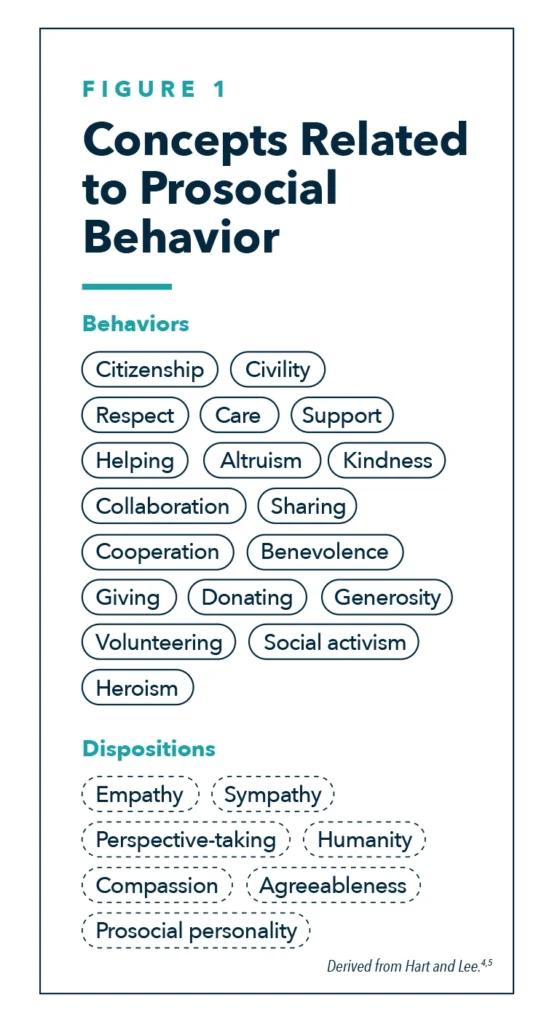
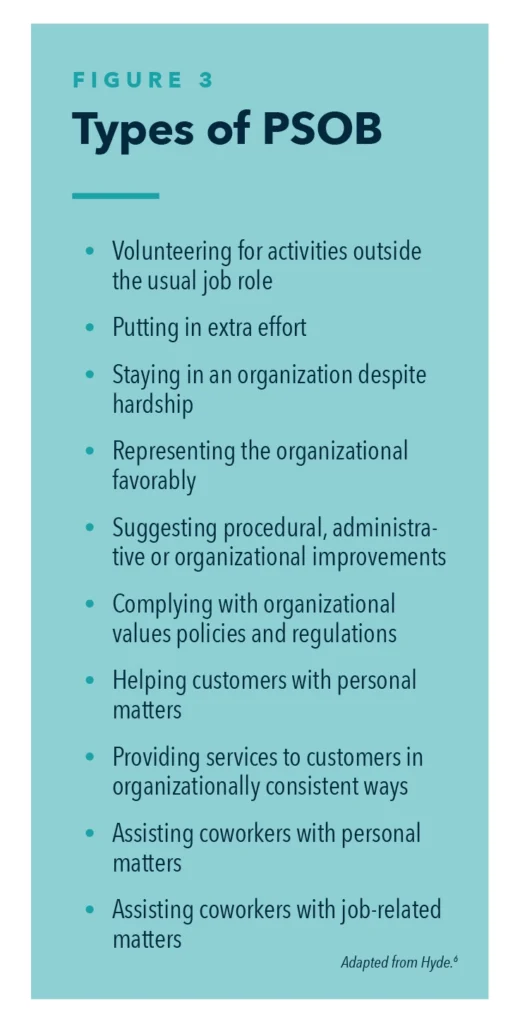
Individual and organizational success depends on specific behaviors, many of which are task-based, included in job descriptions, and not considered optional or voluntary. Prosocial organizational behavior (PSOB), on the other hand, will “encompass a wide range of voluntary actions aimed at benefiting others.”4 They are “aspects of job performance that are not prescribed within a job description and which, therefore, do not necessarily represent ‘duties.’”5 PSOB has also been referred to as “contextual performance” and “extra-role behavior.”6 Figure 1 contains a list of behaviors and dispositions related to PSOB.
Several types of PSOB have been identified. “Altruistic or helping behavior…is a generalized form of helping behavior directed at others” (both individuals and the organization) and can include helping to relieve a coworker’s or supervisor’s workload, conserving organizational resources, executing “role-relevant behaviors at a level that far exceeds minimum requirements,” or speaking highly of the organization.5 PSOB focused on service quality “is a consciously proactive form of behavior directed at customers or patients and designed to contribute to service quality,” such as engaging “in creative activities to better serve patients’ needs and make suggestions to improve the quality of care provided to patients.”5
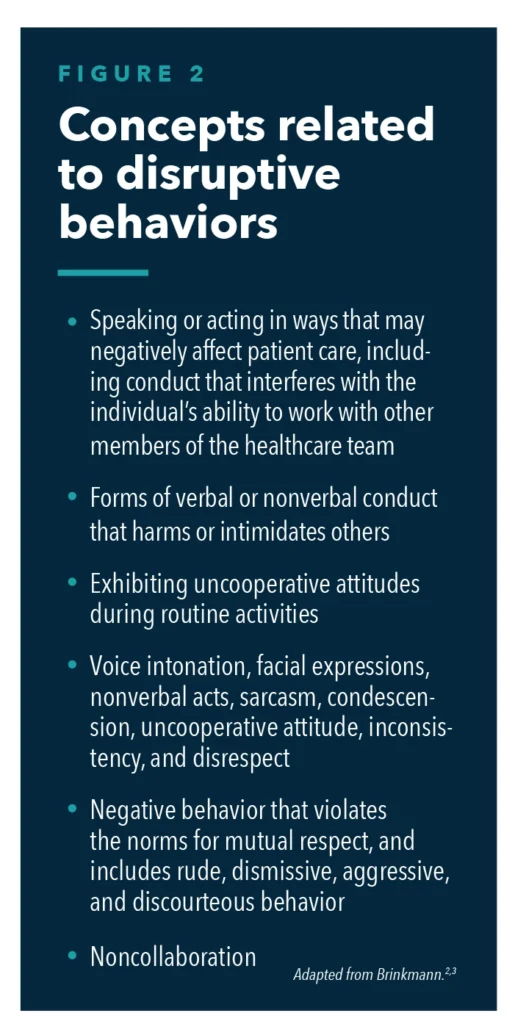
This collection of behaviors and attitudes sharply contrasts with the disruptive behaviors mentioned in previous articles and that are summarized in Figure 2.
Fostering PSOB Benefits All
 Identifying and encouraging prosocial behavior is important because “it is not thought possible for organizations formally to prescribe all of the desirable behaviors that are necessary for organizational effectiveness…. PSOB as a concept directs attention to important forms of behavior that the notion of standard role performance cannot capture.”5 Behaviors that are considered vital to an organization’s success, “such as cooperating with coworkers, taking actions to protect the organization from unexpected danger, and speaking favorably about the organization” are “difficult to prescribe as part of an individual’s formal job and role requirements.”5 Fostering these types of attitudes and behaviors is desirable “since they are likely to contribute to the smooth functioning, pleasant atmosphere, helpfulness, and thus efficiency of the organization.”5 In addition to improving clinical effectiveness, efficiency impacts productivity and profitability, making PSOB a benefit to an organization’s bottom line.
PSOB is also important because of its impact on the well-being of individual practitioners. Providing healthcare involves a significant amount of stress, and “heightened and continuous stress levels can impair cognitive abilities, diminishing diagnostic skills, decision-making capabilities, and problem-solving efficiency, and also reduce the likelihood of engaging in helpful behaviors.”4 Applying prosocial behaviors, such as kindness, “builds positive interpersonal relationships, which can mitigate stress and enhance resilience.”4 PSOB can also influence job satisfaction. Since specific tasks and responsibilities are similar in most O&P workplaces, it is often the way that members of the organization interact with each other that differentiates them. Describing the workplace as a family can have unintended negative connotations, but employees are likely to be more satisfied and productive in an environment where mutual respect and collegiality is the norm.
The Special Demands of Clinical Practice
While effectiveness in any workplace context is enhanced by PSOB, work in “certain types of organizations is more dependent upon individual members’ spontaneous cooperative actions than on standardized rules and procedures. Work in these types of organizations is usually carried out by a variety of experts who possess high levels of skills, and who need to cooperate with each other and draw on various areas of expertise in the performance of their tasks.”5 This description closely matches the demands of clinical practice and patient care, where work “is often performed in teams where individual employees use their own knowledge as well as the knowledge of their coworkers to solve problems.”7 O&P practitioners rely on referrals from physicians and frequently collaborate with them and other allied health practitioners, and the quality of patient care is impacted directly by the ability to work effectively with coworkers and other members of a healthcare team. These working relationships are improved by behaviors that go beyond job descriptions.
Because of the complexity and uncertainty inherent in clinical practice, “active coordination and cooperation” is essential to individual and organizational effectiveness.5 Many skills and tasks can be standardized, but “the precise combination and sequence of skills to be used in specific circumstances cannot always be specified in advance, since the performance of particular types of tasks depends by and large on situational requirements, i.e., changing requirements arising from the conditions of patients.”5
While patient care involves a higher commitment than customer service, service provision is inherent in healthcare. The production and consumption of a service takes place concurrently, in real time, as a cooperative effort between the provider and the consumer.6 This accurately describes the clinical decision-making process, which should include actively soliciting the patients’ perspectives, values, and opinions. “Prosocial organizational behavior (PSOB), i.e., the willingness of workers to both fulfil and go beyond formal job requirements” can influence the outcomes of care, since care quality “depends on the spontaneous actions of employees as they co-produce services with the patient.”6
Provision of O&P care involves more than the device and includes a broader range of services. “Because of the intangibility, heterogeneity, and simultaneous nature of services, it is not possible for organizations to fully prescribe formally all of the desirable behaviors that are necessary” to achieve clinical goals.6 The quality of interactions with patients can be impacted by interactions among coworkers and other members of the team, and the therapeutic value of encounters may be improved within a culture of PSOB. The behaviors of individual practitioners in these interactions with patients are also “vital to service quality yet difficult to prescribe as part of formal job requirements.”6
Conflicting Objectives

Hyde et al. interviewed 31 clinical and 52 nonclinical staff at six healthcare organizations within England’s National Health System about PSOB. They wrote that “over 80 percent of participants reported effects of PSOB on patient care, even where behavior was not targeted at patients or motivated by a desire to act for patients. Therefore, the extent to which employees exhibit PSOB aimed at supporting coworkers and the organization is likely to affect patient care positively.”6 Despite this positive impact on patient care, engaging in PSOB may conflict with other aspects of performance: “Whilst these behaviors may improve service quality, they may at times be contrary to organizational performance in terms of patient throughput.”6 Most practitioners have felt the tension between doing what is best for a patient and organizational expectations related to time management and cost of materials. The difficulty in defining and measuring PSOB makes it easy to focus on the more tangible factors related to time and materials. According to Hyde et al., “In healthcare, staff tend to distinguish between what is good service for the patient and what an organization actually measures as performance.”6
As with many aspects of team performance, individuals in management and leadership roles can influence the likelihood that employees will engage in PSOB. “Strategies to encourage kindness are vital, including leadership demonstrating positive behaviors and discouraging negative ones. The level of support provided by a leader affects perceived team cohesion.”4 How employees are treated by those to whom they are accountable either facilitates or hinders PSOB. Leadership can provide training to increase employees’ abilities related to PSOB and provide opportunities for employees to “make full use of skills and abilities.”6 Lee’s study of “the determinants of prosocial organizational behavior among nurses” in the United Kingdom concluded that “the main practical implication of the study is that human resource management systems can significantly affect employees’ prosocial behaviors.”5 Increasing the organizational commitment of employees through “workplace justice and fairness, job redesign, and supportive supervision and climate” as well as “increased job autonomy…
and involvement in decision-making” can “enhance prosocial organizational behaviors.”6
A Personal Commitment
While a supportive work environment can enhance PSOB, the internal motivations of practitioners may be the most important factor. Hyde et al. reported that in addition to leadership behaviors, individual attitudes were a strong predictor of PSOB. “Healthcare workers chose to engage in PSOB because such actions met deep-seated values, needs, and goals….”6 Lee reported that “PSOB in fact, is seen as less likely than task performance to be constrained by limitations of ability or by the nature of the work process. To a greater extent, instead, it is seen to be under the control of the individual and to depend on motivational factors limited to
people’s ‘willingness’ to engage in particular forms of discretionary behavior.”5
Our personal and professional values impact our behavior, and our willingness and ability to engage in PSOB reflects most on our individual characters. A commitment to supporting our colleagues and the organizations that employ us in ways that go beyond strict job descriptions will positively impact our patients and improve our job satisfaction.
John T. Brinkmann, MA, CPO/L, FAAOP(D), is an associate professor at Northwestern University Prosthetics-Orthotics Center. He has over 30 years of experience in patient care and education.
References
- https://www.investopedia.com/terms/h/humancapital.asp
- Brinkmann, J. 2021. Advocating or disrupting. The O&P EDGE 20(12):20-5.
- Brinkmann, J. 2026. How disruptive behavior impacts patient care. The O&P EDGE 25(1):20-4.
- Hart, R. 2024. Prosocial behaviors at work: Key concepts, measures, interventions, antecedents, and outcomes. Behavioral Sciences14(1):78.
- Lee, H-J. 2001. Willingness and capacity: The determinants of prosocial organizational behaviour among nurses in the UK. International Journal of Human Resource Management12(6):1029-48.
- Hyde, P., C. Harris, and R. Boaden. 2013. Pro-social organisational behaviour of health care workers. The International Journal of Human Resource Management24(16):3115-30.
- Bartel, A. P., C. S. Phibbs, N. Beaulieu, and P. Stone. 2011. Human capital and Organizational Performance: Evidence from the Healthcare Sector w17474. National Bureau of Economic Research.