

OANDP-L
  • Login
No Result
View All Result
The O&P EDGE
  • PECOS
  • Magazine
    • Subscription
    • Current Issue
    • Issue Archive
    • News Archive
    • Product & Service Directory
    • Advertising Information
    • EDGE Flipbooks
  • O&P Jobs
    • Find a Job
    • Post a Job
  • EDGE Advantage
    • EA Homepage
    • EA Data
  • O&P Facilities
  • Resources
    • Product & Service Directory
    • Calendar
    • Contact
    • About Us
    • O&P Library
    • The Guide
    • Custom Publications
    • Advertising Information
    • EDGE Direct
    • Amplitude Media Group
  • PECOS
  • Magazine
    • Subscription
    • Current Issue
    • Issue Archive
    • News Archive
    • Product & Service Directory
    • Advertising Information
    • EDGE Flipbooks
  • O&P Jobs
    • Find a Job
    • Post a Job
  • EDGE Advantage
    • EA Homepage
    • EA Data
  • O&P Facilities
  • Resources
    • Product & Service Directory
    • Calendar
    • Contact
    • About Us
    • O&P Library
    • The Guide
    • Custom Publications
    • Advertising Information
    • EDGE Direct
    • Amplitude Media Group
No Result
View All Result
The O&P EDGE Magazine
No Result
View All Result
Home News

Monkeys “Move and Feel” Virtual Objects Using Only Their Brains

by The O&P EDGE
October 7, 2011
in News
0
SHARES
11
VIEWS
Share on FacebookShare on Twitter

In a first-ever demonstration of a two-way interaction between a primate brain and a virtual body, two monkeys trained at the Duke University, Durham, North Carolina, Center for Neuroengineering learned to use electrical brain activity alone to move an avatar hand and identify the texture of virtual objects. This method of feeling without touching may allow people with paraplegia or limb loss to interact with the world using neural-prosthetic devices that send sensations directly to the brain. The work was funded by the U.S. National Institutes of Health.
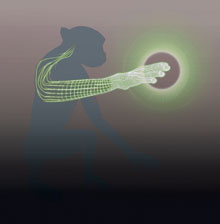

Researchers describe the demonstration as “liberating the brain from the physical limits of the monkey’s body.” Photograph courtesy of Katie Z. Zhuang, Nicolelis Lab, Duke University.

“Someday in the near future, quadriplegic patients will take advantage of this technology not only to move their arms and hands and to walk again, but also to sense the texture of objects placed in their hands, or experience the nuances of the terrain on which they stroll with the help of a wearable robotic exoskeleton,” said study leader Miguel Nicolelis, MD, PhD, professor of neurobiology at Duke University Medical Center and co-director of the Duke Center for Neuroengineering.

Although the virtual objects employed in this study were visually identical, they were designed to have different artificial textures-expressed as a pattern of minute electrical signals transmitted to the monkeys’ brains-that could only be detected if the animals explored them with virtual hands controlled directly by their brains’ electrical activity. Three different electrical patterns corresponded to each of three different object textures.

Because no part of the animals’ real body was involved in the operation of this brain-machine-brain interface (BMBI), these experiments suggest that in the future patients with paraplegia due to a spinal cord lesion may take advantage of this technology, not only to regain mobility, but also to have their sense of touch restored, said Nicolelis, who was the senior author of the study published in the journal Nature on October 5.

“Such an interaction between the brain and a virtual avatar was totally independent of the animal’s real body, because the animals did not move their real arms and hands, nor did they use their real skin to touch the objects and identify their texture,” Nicolelis said. “It’s almost like creating a new sensory channel through which the brain can resume processing information that cannot reach it anymore through the real body and peripheral nerves.”

The combined electrical activity of populations of 50 to 200 neurons in the monkeys’ motor cortex controlled the steering of the avatar arms, while thousands of neurons in the primary tactile cortex were simultaneously receiving continuous electrical feedback from their virtual hands’ palms that let the monkeys discriminate between objects, based on their texture alone. It took one monkey four attempts and another nine attempts before they learned how to select the correct object during each trial. Several tests demonstrated that the monkeys were actually sensing the object and not selecting them randomly.

“The remarkable success with non-human primates is what makes us believe that humans could accomplish the same task much more easily in the near future,” Nicolelis said, adding that the findings provide further evidence that it may be possible to create a robotic exoskeleton that patients with paraplegia could wear in order to explore and receive feedback from the outside world.

Such an exoskeleton would be directly controlled by the patient’s voluntary brain activity in order to allow the patient to move autonomously. Simultaneously, sensors distributed across the exoskeleton would generate the type of tactile feedback needed for the patient’s brain to identify the texture, shape, and temperature of objects, as well as many features of the surface upon which they walk.

Other study authors include Joseph E. O’Doherty, PhD, Mikhail A. Lebedev, PhD, and graduate research assistants Peter J. Ifft, and Katie Z. Zhuang, all from the Duke University Center for Neuroengineering, and doctoral assistant Solaiman Shokur, and Hannes Bleuler, PhD, from the École Polytechnique Fédérale de Lausanne (EPFL), Switzerland.


This story has been adapted from materials provided by Duke University.

Related posts:

  1. Examining the Uses of Virtual Reality in Prosthetic Rehabilitation
  2. I, ROBOT
  3. BMI Enables Monkeys to Move Two Virtual Arms
  4. Monkeys Drive Wheelchairs Using Only Their Thoughts
Previous Post

Hanger Kicks Prosthetic Knee Antitrust Suit

Next Post

Orthocare Hires, Promotes Management Team

Next Post

Orthocare Hires, Promotes Management Team

 SUBSCRIBE FOR FREE


Get unlimited access!

Join EDGE ADVANTAGE and unlock The O&P EDGE's vast library of archived content.
SUBSCRIBE TODAY

O&P JOBS

Mountain

Certified Orthotist (CO)

Eastern

Prosthetic Orthotic Technician

Eastern

Multiple CPO and CPed Openings @ UNC Health

Linkedin X-twitter Facebook
The O&P EDGE Magazine
 
Required 'Candidate' login to applying this job. Click here to logout And try again
 

Login to your account

  • Forgot Password?

Reset Password

  • Already have an account? Login

Enter the username or e-mail you used in your profile. A password reset link will be sent to you by email.

Close
No Result
View All Result
  • PECOS
  • MAGAZINE
    • SUBSCRIBE
    • CURRENT ISSUE
    • ISSUE ARCHIVE
    • NEWS ARCHIVE
    • PRODUCTS & SERVICES DIRECTORY
    • ADVERTISING INFORMATION
  • O&P JOBS
    • FIND A JOB
    • POST A JOB
  • EDGE ADVANTAGE
    • EA Homepage
    • EA Data
  • FACILITIES
  • RESOURCES
    • PRODUCTS & SERVICES DIRECTORY
    • CALENDAR
    • CONTACT
    • ABOUT US
    • O&P LIBRARY
    • THE GUIDE
    • CUSTOM PUBLICATIONS
    • ADVERTISING INFORMATION
    • EDGE DIRECT
    • AMPLITUDE
  • OANDP-L
  • LOGIN

© 2025 The O&P EDGE

Are you sure want to unlock this post?
Unlock left : 0
Are you sure want to cancel subscription?
 

Account Activation

Before you can login, you must activate your account with the code sent to your email address. If you did not receive this email, please check your junk/spam folder. Click here to resend the activation email. If you entered an incorrect email address, you will need to re-register with the correct email address.


© 2024 The O&P EDGE

  • About
  • Advertise
  • Contact
  • EDGE Advantage
  • OANDP-L
  • Subscribe

CONTACT US

866-613-0257

info@opedge.com

201 E. 4th St.
Loveland, CO 80537

The most important industry news and events delivered directly to your inbox every week.

  • About
  • Advertise
  • Contact
  • EDGE Advantage
  • OANDP-L
  • Subscribe

© 2025 The O&P EDGE

Welcome Back!

Login to your account below

Forgotten Password?

Retrieve your password

Please enter your username or email address to reset your password.

Log In
The O&P EDGE Magazine
 
Required 'Candidate' login to applying this job. Click here to logout And try again
 

Login to your account

  • Forgot Password?

Reset Password

  • Already have an account? Login

Enter the username or e-mail you used in your profile. A password reset link will be sent to you by email.

Close
No Result
View All Result
  • PECOS
  • MAGAZINE
    • SUBSCRIBE
    • CURRENT ISSUE
    • ISSUE ARCHIVE
    • NEWS ARCHIVE
    • PRODUCTS & SERVICES DIRECTORY
    • ADVERTISING INFORMATION
  • O&P JOBS
    • FIND A JOB
    • POST A JOB
  • EDGE ADVANTAGE
    • EA Homepage
    • EA Data
  • FACILITIES
  • RESOURCES
    • PRODUCTS & SERVICES DIRECTORY
    • CALENDAR
    • CONTACT
    • ABOUT US
    • O&P LIBRARY
    • THE GUIDE
    • CUSTOM PUBLICATIONS
    • ADVERTISING INFORMATION
    • EDGE DIRECT
    • AMPLITUDE
  • OANDP-L
  • LOGIN

© 2025 The O&P EDGE

Are you sure want to unlock this post?
Unlock left : 0
Are you sure want to cancel subscription?
 

Account Activation

Before you can login, you must activate your account with the code sent to your email address. If you did not receive this email, please check your junk/spam folder. Click here to resend the activation email. If you entered an incorrect email address, you will need to re-register with the correct email address.