
OANDP-L
  • Login
No Result
View All Result
The O&P EDGE Magazine
  • PECOS
  • Magazine
    • Subscription
    • Current Issue
    • Issue Archive
    • News Archive
    • Product & Service Directory
    • Advertising Information
  • O&P Jobs
    • Find a Job
    • Post a Job
  • EDGE Advantage
    • EA Homepage
    • EA Data
  • O&P Facilities
  • Resources
    • Product & Service Directory
    • Calendar
    • Contact
    • About Us
    • O&P Library
    • Lower Limb Directory
    • The Guide
    • Custom Publications
    • Advertising Information
    • EDGE Direct
    • Amplitude Media Group
No Result
View All Result
The O&P EDGE Magazine
No Result
View All Result
Home News

ANU Researchers Working to Advance Neuroprosthetic Scaffolds

by The O&P EDGE
January 2, 2022
in News
0
SHARES
18
VIEWS
Share on Facebook
Share on Twitter

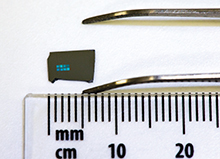
Researchers grew the brain cells on a semiconductor wafer patterned with nanowires which act as a scaffold to guide the growth of brain cells. Image courtesy of Stuart Hay, ANU.


Researchers at Australian National University (ANU) have developed a material that allows brain cells to grow and form predictable circuits—a brain on a chip. The researchers grew the brain cells on a semiconductor wafer patterned with nanowires that act as a scaffold to guide the growth of brain cells. The study is the first to show the neuronal circuits grown on the nanowire scaffolds are functional and highly interconnected, opening the potential to apply their scaffold design for neuroprosthetics.

Lead researcher Vini Gautam, PhD, said the scaffold provides a platform to study the growth of the brain cells and how they connect with each other. “The project will provide new insights into the development of neuroprosthetics which can help the brain recover after damage due to an accident, stroke, or degenerative neurological diseases,” said Gautam, who is a postdoctoral fellow with the university’s College of Engineering and Computer Science and College of Medicine, Biology and Environment

Project group leader Vincent Daria, PhD, from The John Curtin School of Medical Research at ANU and fellow, group leader (Neurophotonics Group) with the ANU College of Medicine, Biology and Environment, said he hopes to use the brain on a chip to understand how neurons in the brain form computing circuits and eventually process information.

“Unlike other prosthetics like an artificial limb, neurons need to connect synaptically, which form the basis of information processing in the brain during sensory input, cognition, learning, and memory,” Daria said. “Using a particular nanowire geometry, we have shown that the neurons are highly interconnected and predictably form functional circuits.”

Daria said it was important to build up the appropriate environment where neurons can be predictably connected into functional circuits. “We were able to make predictive connections between the neurons and demonstrated them to be functional with neurons firing synchronously,” he said. “This work could open up new research model that builds up a stronger connection between materials nanotechnology with neuroscience.”

The research was published online April 24 in Nano Letters.

Editor’s note: This story was adapted from materials provided by ANU.

Support authors and subscribe to content.

Subscribe to read the entire article.

Login if you have purchased

Subscribe

Gain access to all Premium articles.
Your support helps keep The O&P EDGE online.
Subscribe Now

Related posts:

  1. PLX-PAD: Stem Cell Treatment May Save Limbs
  2. Researchers Regrow Cut CNS Nerves
  3. Researchers Discover Way to Boost Cancer-Killing Cells
  4. BCI Devices Open Doors for People with Disabilities
Previous Post

Deadline Extended: Researcher Seeks Upper-limb Prosthesis Users for Study

Next Post

COPA Seeking Speakers for Fall Conference

Next Post

COPA Seeking Speakers for Fall Conference

The O&P EDGE October 2026 issue

Read the Current Issue

SUBSCRIBE FOR FREE


O&P JOBS

Central

HH Manager, Orthotics & Prosthetics

Pacific

Orthotics and Prosthetics Assistant

Central

Certified Orthotist — Full-Time or Part-Time, Pediatric Practice

Linkedin X-twitter Facebook

Get unlimited access!

Join EDGE ADVANTAGE and unlock The O&P EDGE's vast library of archived content.
SUBSCRIBE TODAY


© 2026 The O&P EDGE

  • About
  • Advertise
  • Contact
  • EDGE Advantage
  • OANDP-L
  • Subscribe

CONTACT US

866-613-0257

info@opedge.com

201 E. 4th St.
Loveland, CO 80537

EDGE DIRECT

The most important industry news and events delivered directly to your inbox every week.

  • About
  • Advertise
  • Contact
  • EDGE Advantage
  • OANDP-L
  • Subscribe

© 2026 The O&P EDGE

Welcome Back!

Login to your account below

Forgotten Password?

Retrieve your password

Please enter your username or email address to reset your password.

Log In
Close
No Result
View All Result
  • PECOS
  • MAGAZINE
    • SUBSCRIBE
    • CURRENT ISSUE
    • ISSUE ARCHIVE
    • NEWS ARCHIVE
    • PRODUCTS & SERVICES DIRECTORY
    • ADVERTISING INFORMATION
  • O&P JOBS
    • FIND A JOB
    • POST A JOB
  • EDGE ADVANTAGE
    • EA Homepage
    • EA Data
  • FACILITIES
  • RESOURCES
    • PRODUCTS & SERVICES DIRECTORY
    • CALENDAR
    • CONTACT
    • ABOUT US
    • O&P LIBRARY
    • LOWER LIMB DIRECTORY
    • THE GUIDE
    • CUSTOM PUBLICATIONS
    • ADVERTISING INFORMATION
    • EDGE DIRECT
    • AMPLITUDE
  • OANDP-L
  • LOGIN

© 2026 The O&P EDGE

Not enough quota to unlock this post
Unlock left : 0