

3D printing has come a long way in the past decade. What began as a means to fabricate quick prototypes has turned into a powerful tool with the potential for creating functional, custom O&P devices. As the materials available for 3D printing have evolved, so have the possibilities for how we design and deliver patient care.
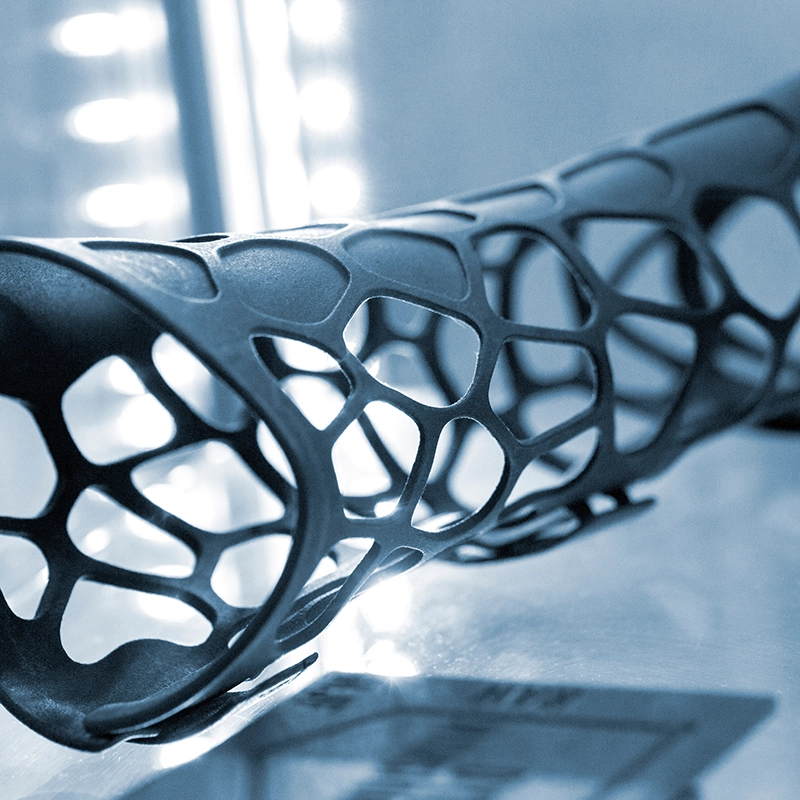
While advantages of a digital workflow and 3D printing have been explored (reduced production time, less material waste, reduced risk of human error, and improved patient fit and comfort), more research is needed to demonstrate that 3D-printed devices can be produced with comparable structural qualities than that of traditionally fabricated devices.1
According to a systematic review on 3D-printed transtibial sockets, there is still a lack of standards or studies about their clinical use or long-term use comparisons with their traditionally fabricated counterparts.2 However, studies have demonstrated that some 3D-printed transtibial sockets have successfully met the ISO 10328 standards set for prosthetic lower-limb components, suggesting that their load strengths may be comparable to traditionally fabricated sockets.2-3
Today’s 3D-printing materials, print methods, and modulation of print parameters and techniques may bring 3D-printed devices closer to achieving the strength, flexibility, and durability of traditional devices. These materials can significantly impact how devices perform and how patients experience them. From lightweight nylons and flexible TPUs to carbon fiber–based designs, O&P professionals now have access to options that can match specific patient needs. This article addresses the history of 3D-printing materials and techniques, material properties, materials used in other industries, and how 3D printing has impacted O&P workflow, cost, and patient outcomes.
History of 3D-Printing Materials
The origins of 3D printing trace back to a 1983 invention of stereolithography (SLA), a process that used ultraviolet light to cure layers of photopolymer resin into solid objects.4 Fused deposition modeling (FDM), a more accessible method that extruded thermoplastic filament layer by layer to create 3D parts, followed in 1989.4 These early developments primarily served industrial purposes, with the automotive and aerospace industries taking advantage of rapidly prototyping components.4
By 1997, the field advanced further with the introduction of laser additive manufacturing (LAM), which utilized lasers to fuse powdered metals, such as titanium alloys, into complex structures.4 This milestone expanded 3D printing beyond plastics, opening the door for high-strength applications. In the early 2000s, the release of affordable materials like polylactic acid (PLA) and acrylonitrile butadiene styrene (ABS) helped bring 3D printing to the public, sparking a wave of innovation among hobbyists, engineers, and small manufacturers.5
Today, 3D printing has evolved into a detailed, accessible technology with wide-ranging applications across healthcare, aerospace, and construction. In O&P, it has added another tool with which clinicians can design and fabricate devices, offering new levels of customization, comfort, and efficiency. With ongoing research focusing on biocompatible materials, sustainability, and scalability, 3D printing continues to push the boundaries of what is possible in both industry and medicine.
Materials Application

It is important to understand the range of 3D-printing technologies and how materials have evolved to meet different clinical and industrial needs. Some of the most common printing methods include FDM, SLA, and selective laser sintering (SLS).6 Other printers include digital light processing (DLP), Multi Jet Fusion (MJF), selective laser melting (SLM), laser metal deposition (LMD), and laminated object manufacturing (LOM).5 More information on printer types can be found in Table 1 and Table 2.
In O&P, commonly used materials to design and fabricate 3D-printed devices are PLA, ABS, nylon (PA11 and PA12), thermoplastic polyurethane (TPU), polyvinyl alcohol (PVA), and polyethylene terephthalate glycol (PETG).6,7 These materials are often used for inner and outer sockets, customized AFOs, cranial remolding orthoses, foot orthoses, and spinal orthoses.7,8 In addition, other accessories for wheelchairs, cosmetic covers, or adaptive equipment can also be created using these materials.

Within other industries, different materials are utilized to achieve specific outcomes. In dentistry, a variety of synthetic polymers, including PLA, metals like titanium and cobalt-chromium, and ceramics, including glass, alumina, and zirconia ceramics have been used.9 Commonly used materials in the aircraft industry include alloys of aluminum, titanium, ceramic, polymers, and steel, and mixing those with composites, functionally graded materials (FGMs), or hybrids to ensure fully functional parts.10 And in construction, researchers have developed a bendable, 3D-printed concrete made of many materials and fibers, like polyvinyl alcohol, fly ash, silica fume, and ultrahigh molecular weight polyethylene fibers.11 Drawing inspiration from advancements in other fields could significantly enhance innovation within O&P. Cross-industry applications could not only improve patient comfort and function but also make clinical production more efficient and sustainable.
Material Properties and Advantages
As clinicians integrate 3D printing and CAD modeling into their daily practice, they often face a steep learning curve and numerous questions. A crucial step in navigating these challenges is developing a strong understanding of the properties and advantages of different materials. Each printing method and material offers unique benefits depending on the application, and no single 3D-printing technology can address every healthcare or manufacturing need.
In addition, O&P facilities typically benefit from access to multiple printer types, each used to address specific stages of fabrication. For example, a low-cost FDM printer may be ideal for producing diagnostic sockets or test devices, while a MJF printer may be better suited for definitive orthoses or prostheses that require high strength, durability, and a smooth finish.6 To access multiple printers or outside expertise, Dan Blocka, BSc, CO(c), FCBC, Boundless Biomechanical Bracing, Mississauga, Ontario, suggests that forming a partnership could help smaller clinics share costs and resources, making additive manufacturing more accessible.12
Following this advice, collaborating with external companies at the start of the 3D-printing journey can reduce expenses, streamline production, and provide valuable technical support before potentially transitioning to in-house fabrication. This allows O&P companies to take small steps, removing some of the fear of having to completely jump in and commit to the entire 3D-printing process.
In terms of materials, PLA is commonly used for check sockets and prototypes due to its affordability and ease of printing, while ABS offers greater durability for short-term orthoses. PETG is useful for high strength and lightweight applications, and nylon (PA11/PA12) is preferred for definitive orthoses and prosthetic sockets for its long-term durability. In addition, TPU adds elasticity for flexible orthoses, SMOs, liners, and cushioning. PVA acts as a support material for complex prints, while photopolymer resins are ideal for complex prosthetic sockets and cranial orthoses. Lastly, carbon fiber–reinforced filaments are used where lightweight, high-strength components are needed.
Continuing research has shown that adding materials such as carbon filaments to PLA in transtibial sockets has led to increasing the failure point by 31.5 percent compared to the use of PLA alone.2 In addition, “adding carbon to PLA has also improved the bending modulus and maximizes the bending strength of material samples by about 208 percent and 36 percent relative to PLA alone.”2 Overall, developing a solid understanding of material properties allows clinicians to strategically combine materials for stronger and more functional devices. A summary of common material types and properties is included in Table 3.

Printing techniques and design parameters are as important as the material selected in the production of a 3D-printed device. Tony Gutierrez, CP, director of clinical advancement and innovation, Bionic Prosthetics and Orthotics, Indiana, says “print method, layer height, orientation, and infill density all change how the final part distributes load, resists crack propagation, and behaves under cyclic stress.” Throughout nearly a decade of 3D-printed socket designs and testing,
Gutierrez has manipulated not only the material type, but also the flow rate, nozzle diameter, filament thickness, infill percentage, and geometric print pattern to develop functional 3D-printed diagnostic sockets that account for nearly 95 percent of the company’s test socket needs.13
A study done on the optimization of printing parameters for transtibial prosthetic sockets with an FDM printer focused on how varying combinations of nozzle diameter, layer height, and infill percentage have an impact on the socket’s ultimate loading force, fabrication time, and weight.14 Results showed that altering the variables could achieve an optimal socket, with infill percentage having the greatest impact on socket outcomes. By dialing in printing parameters, clinicians can greatly enhance the strength and performance of O&P devices. Blocka recommends first verifying geometry and print settings with low-cost materials to ensure accuracy before committing to more expensive designs.
Overall, understanding both material properties and printing parameters is essential for maximizing the performance, durability, and patient-specific functionality of 3D-printed orthoses and prostheses. By combining the right materials with optimized printing techniques, clinicians can create devices that are not only stronger and more reliable but also better tailored to individual patient needs. This knowledge empowers practitioners to innovate safely and efficiently, bridging the gap between traditional fabrication methods and the expanding possibilities of digital manufacturing in O&P.
The Future of 3D Printing in O&P
As the state of O&P changes, more techniques and materials are created to improve the field. Additive manufacturing is one aspect of innovation that can be used to reduce cost, improve turnaround time, and enhance patient outcomes. However, there are challenges to overcome before there is widespread adoption of 3D printing. In Lessons in Additive Manufacturing for O&P, Brent Wright, CP, Advanced 3D, North Carolina, points out that “clinicians often struggle with or have concerns about material limitations, postprocessing requirements, print quality, and adjustability.” To solve these issues, Wright says that companies are continuingly investing in higher quality postprocessing techniques and clinician focused automated design tools.12
Looking ahead, collaboration and education with other professionals will be key to advancing 3D printing in O&P.12 As clinicians early in our careers, we’ve witnessed both the excitement and hesitation that come with adopting new technology. Our curiosity about how 3D printing could bridge the gap between innovation and practicality motivated us to explore its potential in patient care. Blocka suggests that “the future lies in mass customization with clinics designing locally and printing through centralized hubs, and that advances in materials, AI-driven modeling, and automation will make the process faster, more predictable, and more sustainable.”
Our own experience supports this potential, as our company has recently been exploring the use of 3D printing for orthoses and has achieved positive patient outcomes through collaborations with external printing partners, as shown in Figures 1 and 2. Seeing the positive results reaffirmed that the value of 3D printing lies not only in its technology, but in how it can enhance patient comfort and function. While traditional manufacturing will always be vital to the field, incorporating 3D printing is another tool clinicians can rely on to meet patient needs. O&P EDGE
Rio Strosnider, MPO, resident, Orthotic and Prosthetic Lab, Missouri, received her bachelor’s degree in engineering at Robert Morris University and master’s in O&P at Northwestern University.
Megan Merryman, MSOP, resident, Orthotic and Prosthetic Lab, studied exercise science at Liberty University and attended the International Institute of Orthotics and Prosthetics for graduate school.
Keith M Smith, CO/L, FAAOP, is a practitioner with Orthotic and Prosthetic Lab.
References
- Atallah, H., T. Qufabz, H. R. Bakhsh, and G. Ferriero. 2025. The current state of 3D-printed orthoses clinical outcomes: A systematic review. BMC Musculoskeletal Disorders 26(1):822.
- Kim, S., S. Yalla, S. Shetty, and N. J. Rosenblatt. 2022. 3D printed transtibial prosthetic sockets: A systematic review. PLoS ONE 17(10):e0275161.
- Nickel, E., K. Barrons, and M. K. Owen, et al. 2020. Strength testing of definitive transtibial prosthetic sockets made using 3D-printing technology. Journal of Prosthetics and Orthotics 32(4):295-300.
- González, C. M. Infographic: The History of 3D Printing. The American Society of Mechanical Engineers. Published January 30, 2020. Accessed October 18, 2025. https://www.asme.org/topics-resources/content/infographic-the-history-of-3d-printing.
- NUI Galway. A Brief History of 3D Printing. Published 2021. Accessed October 18, 2025. https://openpress.universityofgalway.ie/designingthedigitalworld/chapter/brief-history-3d-printing/
- Andrysek, J., and S. Ramdial. 2023. Transforming P&O care with 3D printing–More than meets the eye. Canadian Prosthetics & Orthotics Journal 6(2):42138.
- Hassan, B. B., and M. S. Wong. 2023. Contemporary and future development of 3d printing technology in the field of assistive technology, orthotics and prosthetics. Canadian Prosthetics and Orthotics Journal 6(2):42225.
- Barrios-Muriel, J., F. Romero-Sánchez, F. J. Alonso-Sánchez, and D. Rodríguez Salgado. 2020. Advances in orthotic and prosthetic manufacturing: A technology review. Materials 13(2):295.
- Jeong, M., K. Radomski, D. Lopez, J. T. Liu, J. S. Lee, and S. J. Lee. 2023. Materials and applications of 3d printing technology in dentistry: An overview. 12(1):1.
- Karkun, M. S., and S. Dharmalingam. 2022. 3D printing technology in aerospace industry–A review. International Journal of Aviation, Aeronautics, and Aerospace 9(2).
- Bowling, C. UNM Engineers Build the Future of 3D Printing with Bendable Concrete. Published January 16, 2025. Accessed October 19, 2025. https://news.unm.edu/news/unm-engineers-build-the-future-of-3d-printing-with-bendable-concrete
- The American Academy of Orthotists and Prosthetists. Lessons in Additive Manufacturing for O&P from the Academy. Accessed October 19, 2025. https://www.associationbriefings.com/aaop25-additive-manufacturing
- Gutierrez, A. R. 2023. Exploring the future of prosthetics and orthotics: Harnessing the potential of 3D printing. Canadian Prosthetics & Orthotics Journal 6(2):42140.
- Lim, G. D., M. J. Abd Latif, and M. R. Alkahari, et al. 2022. Parameter optimization of fused deposition modeling process for 3d printed prosthetic socket using PCR-TOPSIS Method. International Journal of Nanoelectronics & Materials 15:247-58.