

Purdue University engineers and collaborators at the University of Notre Dame developed a prosthetic interface with embroidered, light-emitting textiles that integrate illumination and sensing to detect normal and shear forces where the residual limb and prosthetic socket meet. The innovation addressed the drawbacks of existing strategies for sensing in-socket pressure and shear, the researchers said.
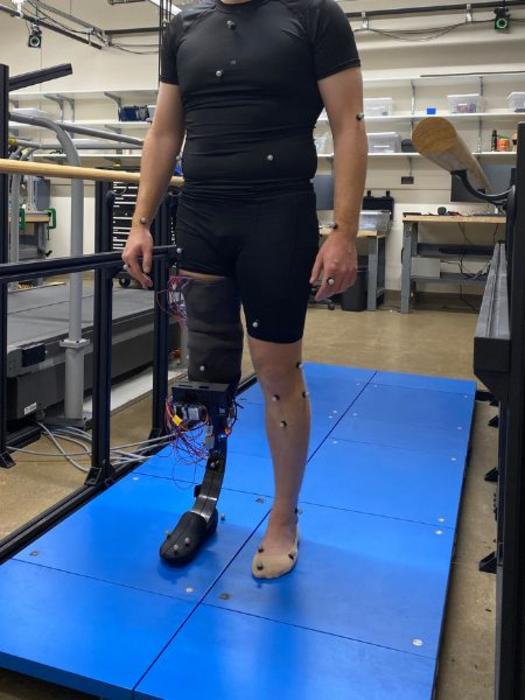
“This work represents a step forward in developing practical, wearable solutions for continuous biomechanical monitoring in lower-limb prosthetic users,” said Chi Hwan Lee, PhD, a professor in the university’s Weldon School of Biomedical Engineering and School of Mechanical Engineering, and corresponding author of the related study.
The wearable, textile-based platform satisfies the key requirements of flexibility, washability, multiaxial detection, and compatibility with wireless systems. The system sensors are integrated with a Bluetooth-enabled data acquisition module and a textile-based electroluminescent display to enable real-time, close-loop feedback of pressure levels that are streamed and visually communicated via illuminated embroidered pixels.
The system consists of a textile sheath embedded with a sensor array that is positioned inside the prosthetic socket and connected to the data acquisition module; the modular design enables plug-and-play functionality via snap button connections to the electronics. Pressure data is wirelessly transmitted to a portable device for digital mapping and feedback is displayed in real time via an embroidered textile display on the subject’s sleeve.
“The embroidered sensor forms a multilayered capacitive structure with a large common top electrode and four smaller bottom electrodes arranged in a quadrant configuration,” Lee said. “The sensor detects differential capacitance changes. Under normal compression, all four quadrants exhibit similar capacitance increases. Combined normal and shear loading induces asymmetric changes, revealing both the magnitude and direction of shear.”
The sensing element is fabricated via machine embroidery by using a polyester top thread and a silver-plated conductive bobbin thread stitched into the substrate fabric. The sensor is integrated into the all-embroidered system so the microcontroller unit can process the capacitance signals and actuate the textile-based electroluminescent display.
The system’s ability to measure both normal and shear pressures is critical for practical wearable applications, especially when limb-socket interface forces vary dynamically during daily activities. The fabric architecture can be tailored in size, layout, and electrode configuration for different socket shapes and sheath design. Sensitivity and working range can be tuned for customization across different users and loading conditions.
To test the wash-and-wear capability, the embroidered sensors were placed in a water-permeable protective sack and run through more than 30 full cycles of laundry (wash, rinse, spin, spin-dry), using a standard household washing machine and commercial liquid detergent.
“The pressures of the prosthetic limb interface are very intricate and complex,” said Tianhao Yu, a doctoral candidate in mechanical engineering and the paper’s first author. “We want to deliver the most granular, most customizable data for patients to give them the best possible experience with their artificial limbs across their daily lives.”
Editor’s note: This story was adapted from materials provided by Purdue University.
The study, “Embroidered textile sensors for real-time multiaxial force mapping in prosthetics,” was published in Science Advances.